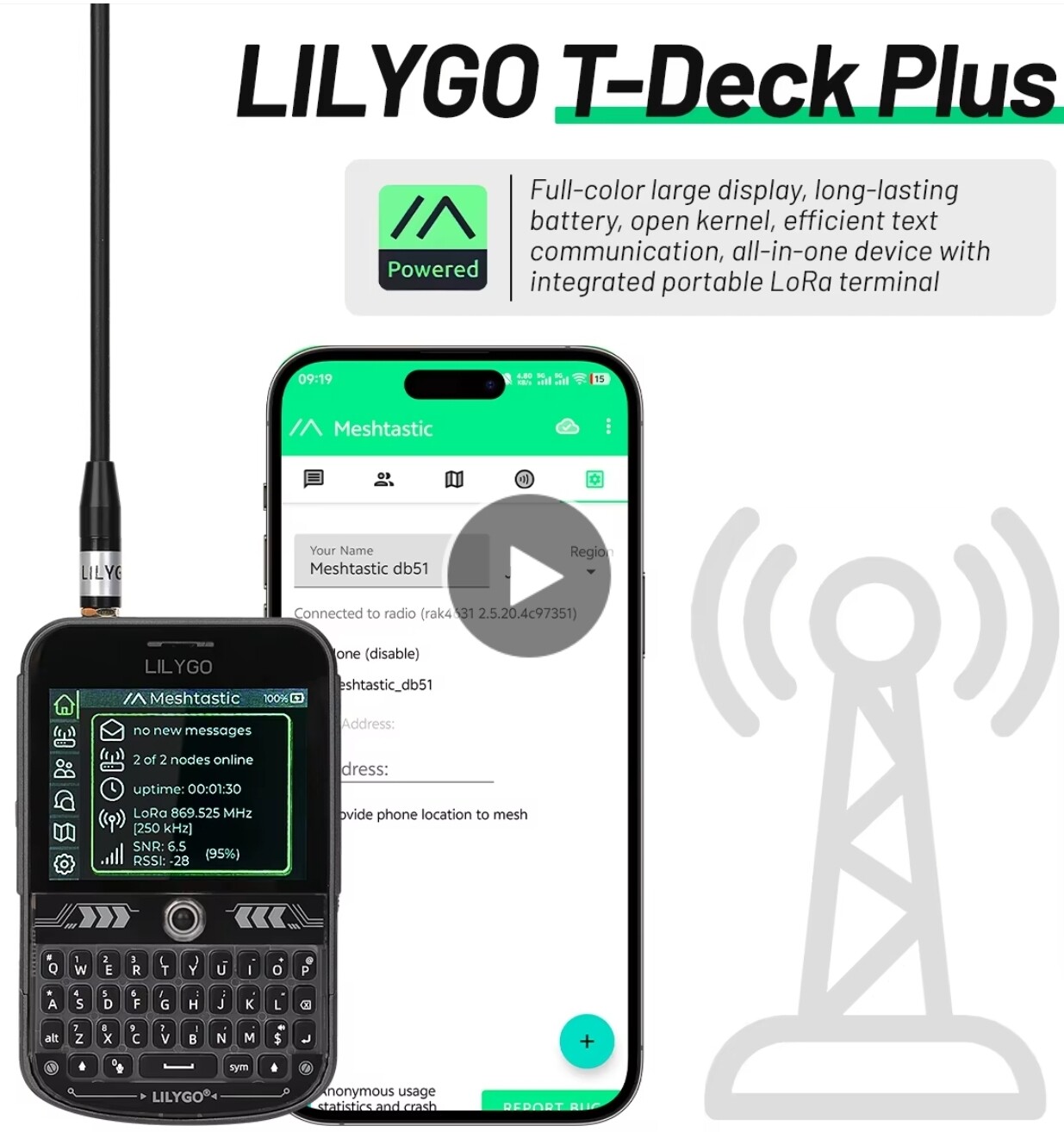
I couldn’t resist that nifty Lilygo Meshtastic handheld and am on the verge of ordering one. Is there any way to use Meshtastic for SOTA as well?
S2S on 868 MHz outside the amateur radio bands?
Viewing or posting spots?
I’m open to negative feedback, too. That way, I’d save 120 euros and focus on our current SSB TRX project with Paul VK3HN instead.
Chris, SOTA rules say you can only use “Amateur Bands” for QSOs. That rule is being changed because as written it excludes experimenting on frequencies amateurs can use but are not specifically licenced as Amateur Bands. For example in Germany and the UK, special permits are available to allow amateur operation about 300GHz with special ranges of frequencies off-limits (radio astronomy etc.) Above 3000GHz there is no regulation but the current SOTA rules make experimenting there not possible.
A possible change is below:
3.7.1
Participants shall be licensed to communicate on the amateur frequencies in use…
All operations must comply with the amateur radio licensing regulations and must use frequencies permitted for amateur radio use in the country of operation.
This would allow SOTA operation above 3000GHz as the frequency is available to amateurs without licence etc. There have been several articles on 30THz operation in DUBUS in recent issues and the latest issue has reports of French hams operating on 30THz. So changing the rules to remove “band” with “frequencies” enables that.
A long winded introduction to the fact that whether the rules say “band” or “frequency”, 868MHz is not an amateur band or frequency. So QSOs on 868MHz would not count for SOTA. But there’s no reason why Meshtastic devices/networks etc. cannot be used for spotting / alerts or other actions related to SOTA, just not for the QSOs themselves. Analagous to hams like myself arranging 13cm SOTA QSOs using 800/900MHz/1.8/2.1/2.6GHz comms (mobile phone). And we already have plenty of LoRa APRS services in use.
Pushed by the hype, I always wanted to buy some Meshtastic gear. So I won’t blame you haha.
But, all things considered, I think it’s a total mess. It’s mostly limited to short text messages, and the few existing nodes are often spread across different protocols and settings (Meshtastic, Gaulix, different frequencies, etc.), making them unable to communicate with each other.
So unless you live in or near a city where the node network is dense enough, it seems pretty much useless to me.
My local club has a whole bunch of folk using Meshcore (or whatever it’s now called) rather than Meshtastic, but it’s very much a parallel interest. The trick seems to be to use whichever system has the most adherents you want to chat with. I gather there’s still a small core of folk using packet…
Now, if you take the different protocols (Meshtastic, MeshCore, Reticulum, etc.), divide the nodes between the different frequencies (868, 433 MHz, etc.), and then divide them again between the different modem presets (LongFast, MediumFast, etc.), the probability of actually being able to communicate with a reachable node becomes… very small.
To me, that’s completely defeating the purpose of a mesh network. A mesh is only really useful if there are enough compatible nodes around you to form a network. If everyone is using a different protocol, frequency or configuration, you can have dozens of nodes physically within range and still have essentially no network.
This is where getting a group organized makes a difference. Folks at my local club can chat with one another because they’ve made a collective decision to use this specific mix…
So, has anyone shown interest in being the first to do a 300GHz S2S?
A pair of easy 2-pointers, say ~2km apart and LoS - like Great Mell Fell (G/LD-035) and Little Mell Fell (G/LD-037) would be suitable.
Apparently, 300 GHz attempts rely heavily on bone-dry, freezing air found during winter to minimise water-vapour signal smothering. So, they could get winter bonus points into the bargain.
I don’t think your change of wording makes any difference. Since amateur radio is clearly defined in the Radio Regulations I think this would still limit SOTA to amateur radio bands.
The central belt of Scotland is pretty well covered by Meshtastic, largely on the grounds of having a pretty useful online community of people actively trying to increase coverage.
There are far cheaper routes into Meshtastic too, and I’d probably recommend these over some of the more expensive options. I recently picked up another Seeed nRF board and antenna for under £20, powered off a salvaged vape battery and housed in a small Ikea plastic tub!
Am I missing something - I thought Meshtastic was a network, where one unit relays traffic for other units as well as its own traffic - wouldn’t that make it a repeater and SOTA contacts are not allowed via repeaters.
Using these units “offline” - but talking between just two units, I suppose would be OK but is that even possible?
Sorry, LoRa/Meshtastic is something I haven’t dabbled in but I think they can operate within the 70cm amateur band, so that should address the communication within an amateur band question.
Yes it’s a network (using mesh routing rather than specific routing paths). But each hop is 1 to 1. There’s nothing stopping my device talking to your device directly and SOTA band/frequency rules aside that’s not a mesh/repeated QSO. It’s quite probable someone on a summit would get quite decent ranges.
You can set the private/public keys the same in all the devices and publish those keys. At that point it is encrypted but can be decrypted by anyone loading the published keys into their device. I am sure there were some changes to encryption in the UK licence at the same time the other recent changes happened which would allow this. But I could be wrong.
I agree with @DD5LP Ed and @OE5JFE Joe. Most of the features that Meshtastic (or Meshcore) add to the regular LoRa stack – mesh networking and group encryption – are not what you would want for SOTA contacts. You would be better off with simplex unencrypted communication directly over LoRa (such as the FT8/LoRa I mentioned here). The hardware is the same, the difference is the software/protocol stack (there’s an interesting discussion in that same thread about which frequency to use, which influences the hardware model you may want to buy).
So, a direct SOTA application is ruled out by the frequency issue. OK! That’s one reason against it.
And one more reason to consider SOTA via ATV on 5 GHz. 7 years ago we managed connections covering up to 100 km, as shown in the clip below.
@ Remy At my QTH in Hanover, there are a few repeaters showing activity on the Meshtastic map. I still need to find out if a consistent mode is being used in my area.
@ Leonardo I’ll take a look at that post about FT8 via LoRa on 70 cm right away.
73 Chris