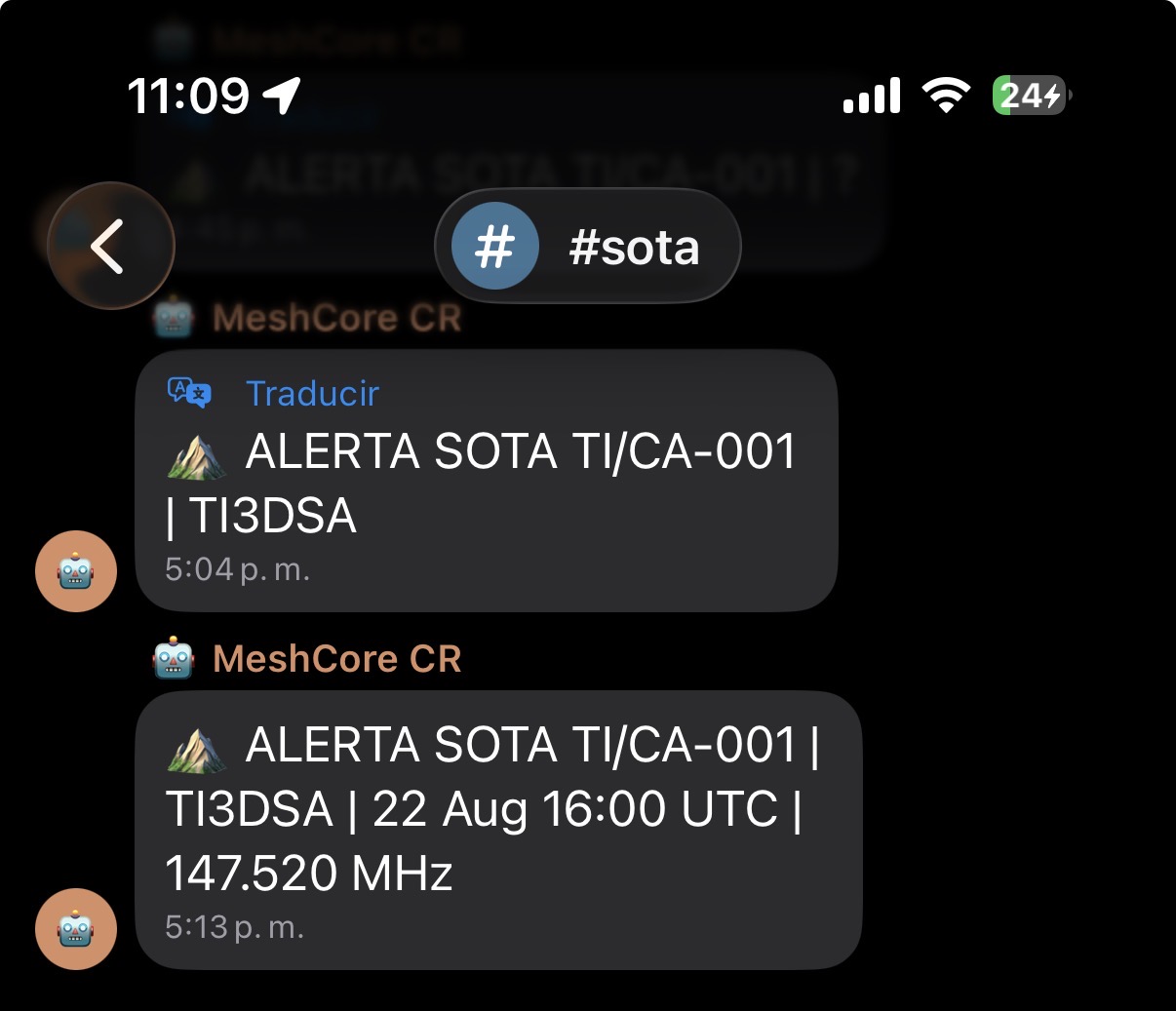
I don’t think the frequency is the issue here. Even though most people use Meshtastic and Meshcore on 868 MHz (e.g. the snapshot in your original post), you can also use it on 433MHz, which is an amateur band in most countries. The issues for amateur radio, and for SOTA, are elsewhere.
The issues from the amateur radio point of view could be the transmission bandwidth (the LoRa spread-spectrum modulation used by Meshtastic and Meshcore can use a bandwidth of up to 500 kHz) and the use of encryption, both of which go against amateur radio regulations in some countries.
And the issue from the SOTA point of view would be the difficulty to ascertain if a given message exchange was point-to-point or routed over the ad-hoc mesh network (which is what Meshtastic and Meshcore are designed to do).
I have just checked the LILYGO website, and they have the T-DECK Plus with the 433MHz LoRa radio. You could change its firmware to transmit simplex LoRa frames (e.g. with APRS or FT8 syntax), which is much simpler than maintaining a mesh network. With that, you would then be able to make QSOs that meet the SOTA General Rules (assuming your country is not one of those that forbids spread spectrum, as mentioned above).
And just to make my point 100% clear: I am trying to say that Meshtastic/Meshcore are not a good idea to make SOTA QSOs. If the goal is to coordinate with other ops, send and receive spots, etc., then it’s a completely different story, and they could be excellent tools (as discussed here).
That is becoming clear now. I was looking for applications in the SOTA realm and see that there aren’t any practical ones.
The 433 MHz version wouldn’t be usable at my QTH; as I’ve just learned, the only available option here is a large MeshCore network operating on 868 MHz.
In Costa Rica, our setting is out of an amateur band, ham radio operators are using it as a tool, and I wrote about how we are trying to use MeshCore as a SOTA Tool .
As far as I know, Meshtastic does not have a centralized Internet gateway comparable to APRS-IS, so services such as a SOTA spotter for sending or viewing spots cannot really be deployed to be globally accessible across the whole Meshtastic network. It may be possible within a particular mesh, of course, but not across the entire network, at least as far as I understand it.
And I think this is precisely where APRS is especially powerful, and rather unique. The APRS-IS backbone gives us a centralized network layer connected to the entire RF infrastructure, so applications and services can be developed and made accessible from essentially anywhere in the APRS network.
So, if the main goal is SOTA use (sending spots, receiving information, messaging, and potentially other emergency services) my suggestion would be to look at LoRa APRS rather than Meshtastic. You still get the advantages of LoRa for low-power portable operation, but with the APRS ecosystem and its Internet-connected infrastructure.
Hi Danny, I’m starting to understand how mesh networks work. So, a user in TI will be able to get the spots, but if you are outside of the TI mesh, you will need to build a new “spot service” connected to internet and to the meshcore network.
In the ham world we have APRS, which is unique because it is a globally centralized network via the APRS-IS service. And it is also accessible via LoRa.
I really think we should use LoRa APRS (and regular APRS) instead of meshcore/meshtastic to build apps for ham radio.
You’ve all got me motivated now. I have a couple of 915MHz LoRa modems set up to sit on the SPI pins on the Raspberry Pi GPIO. And a couple of spare RPi’s lying around. And some LoRa / LoRaWAN python software I hacked together to make it all talk, as a PoC for a project I worked on. It could all be further hacked to make a simple LoRa broadcast terminal I could SSH into from a mobile phone. Clear-type free-form broadcast messages. No protocol in the stack above LoRa really needed. A LoRa chat session.
If I didn’t have 915 other things on the urgent ToDo list, a 33cm-band LORA S2S would be heading rapidly for the top of the list!
Sorry. Not meshtastic. But a much more relevant point-to-multipont, unenctrypted technology for SOTA contacts!