you will have been vertical and the sender will have been horizontal. if the antennas are the same polarity it will work. Most people do 2m/70cm ssb on horizontal and fm vertical but theres no rule to stop you doing ssb vertical but other people will need to know your doing it vertical. For HF it doesnt matter as the signal twists when it gets bounced round the world. Thats how i understand it i think anyway.
3 Likes
Aha! That is how I envisaged it at the time, which is why when @EI4JY was on SSB I tried to use the telescopic antenna built in to the legendary radio that is the FT-290R to see would it work. Audio improved but not enough to hear clearly enough to chase him.
I think that is how I was mixing myself up over polarity with regards the RHM-12. Thanks everyone for clearing that up, it makes more sense to me now. Always something new to learn!
Regardless, about the RHM-12, yes, she costs a small fortune, but it is Diamond quality and performance for me both QRP and QRO has been fantastic for all of 2025 since I received it and used it in the field.
Highly recommended, just if you do consider buying one, do your sums first as it may work out better for you to purchase direct from Japan. It worked out about €100 cheaper for me after including shipping, taxes, duties etc to EI.
1 Like
Hi Ian,
The most common mistake made by FM users when first trying SSB is to assume that the frequency readout on your radio is accurate. If your contact says he is on 144.305 and when you tune to that frequency on your dial, his signal sounds garbled, it means there is a frequency difference between your radio and his. Which one is correct? Probably neither is. Precise frequency accuracy was never a strong point with early radios and the practice was to tune to the other signal, whatever your dial says. Tuning SSB accurately is an art but the voice should sound very close to the same as it is on fm or am. A mistake often made is to tune in the incoming signal so it is slightly high pitched. Then when you transmit, your voice will sound low pitched in his receiver. If he corrects his tuning so you sound high pitched, when he transmits on that frequency he will sound low pitched to you. Before long you leapfrog each other all the way up the band and you are nowhere near where you intended to be. And with the ft290 it does not have the small frequency steps of more recent radios, so the only way to tune in an incoming signal so it sounds exactly right is to use the clarifier or RIT control. This allows for 10-20 hz adjustments to make the voice sound right, without taking you into the contact going on a few kHz away. Does that help to understand the SSB tuning problem?
73
Andrew VK1DA/VK2DA
3 Likes
That is of great help, thanks Andrew! Oddly enough I did try using the clarifier on the 290 but to no avail. I thought it was more for CW use. I had the radio fully serviced and aligned recently so it should be spot on, hence I took the assumption during the attempt to make contact that it was more (my) user error than anything else. I get now why 2m and 70cm SSB is a tricky beast!
I’m going to read up on VHF and UHF more to try and get more knowledge about them in general. Thanks for the steer, it is really good information.
1 Like
There are several versions available, now even from AliExpess. As @DD5LP stated above, the one from Kommunica is the original.
About two years ago I bought a copy from Wimo (the one from Kommunica was not available anymore).
On the higher bands, this 2.5m tall antenna performs pretty well. Save some weight and leave the 80m coil at home.
About two years ago, I created a YouTube video with my mounting solution for space restricted summits:
73 Stephan
3 Likes
Hello Stefano,
Congratulations, great video! I subscribed to your channel. I purchased the antenna on Aliexpress and was able to trace the Taiwanese manufacturer, following the link to their website. The price is very attractive. You use a tuner?
73 Luca
1 Like
Hi Luca,
I’m happy that you liked the video. This is my solution for space restriced summits and sometimes I use the full length telescopic antenna from Aliexpress instead.
No, there is no need.
Have fun and 73, Stephan
2 Likes
I caved and bought the @MM0EFI red whip thing that is a little bit like the JPC-12.
Don’t need another whip antenna but still here I am. 
1 Like
Hi everyone, the RHM-7350T antenna arrived, good build quality.
I started testing it in two configurations. I should point out that the instruction sheet included with the product states that the antenna must be used with a tuner. However, I preferred to start testing it without a tuner.
The first installation was on a balcony with the ground connection (railing). Adjusted with reference to the graduated scale, I didn’t immediately find resonance on the 40 and 20 m bands. I had to rely on my trusty NanoVna, which found the resonance points and a decent SWR of 1.5:1. The second test was performed on a simple magnetic base, in the center of the car roof but without a counterpoise. The result was negative; I was unable to obtain useful resonances. This makes me think that the ground is essential, perhaps more important than using a tuner.
What is your experience on car roof?
73 IW2EPE
1 Like
Hi Luca,
How much metal is in the car roof? I prefer to run my Komunica HF-PRO2-PlusT (of which that 7350T is a copy) using a three magnet base on the car roof and it runs fantastically. While on holiday though, I only took a single magnet base. The settings on the antenna slider were different but the antenna worked well with that as well. In both the home and holiday car situations the cars had a full metal roof though (no glass sliding roof, plastic sections or anything like that).
73 Ed DD5LP.
Hi Ed, the car’s roof is completely metal, the magnetic base has a diameter of 110 mm. Environmental conditions: wet roof from previous rain. 73 Luca IW2EPE
Hi Luca,
I’m surprised you are having issues. I never use radial wires with a mag mount (the roof is the counterpoise). The wet should not matter, I suppose it could affect the capacitive coupling between the base and the roof but I have used my set up on a wet roof as well, without any issues (SWR OK, signals out and in OK).
I’m not sure what to suggest.
73 Ed.
1 Like
Ed, The difference with the tests at home is that I didn’t have the choke in the car. 73 Luca
How much power are you running to need a choke? Could the choke be affecting the antenna on the mag mount on the car roof? Possibly. I don’t use an inline choke on the coax and I don’t see the issue you see with the antenna’s VSWR when car roof mounted. It’s worth trying without the choke and back to power down to under 30 watts and see what happens.
73 Ed.
1 Like
Hello Ed,
I usually always use the choke even with qrp powers.
I think the whole antenna system benefits from it, don’t you think?
73 Luca
I personally would only fit a choke in the feeder if I was getting RF back into the radio, (and then only as a last resort as common mode currents “normally” reflect antenna problems that should be resolved). I like to operate with the least number of components that can go wrong or affect other components.
73 Ed.
2 Likes
I always use a common mode choke with every antenna. This often helps to significantly reduce QRM during reception. Common mode currents indicate that the antenna type is not correct and that conductors are seeking to “close the circuit.”
Common mode currents are NOT generated if the antenna is not resonant or if the SWR is not OK.
73, Peter - HB9PJT
2 Likes
Hello everyone,
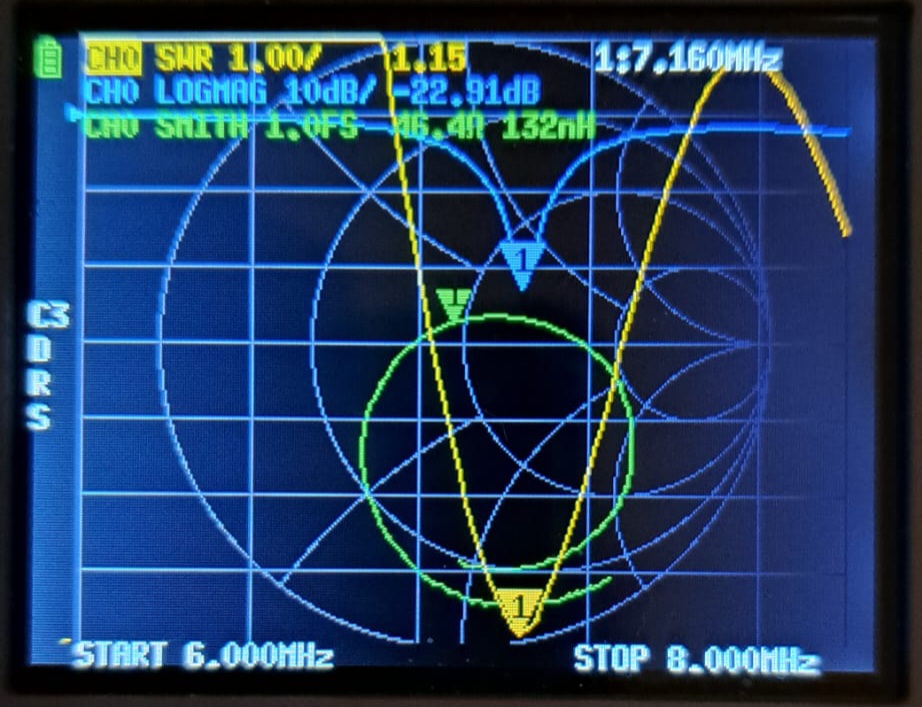
This morning, I took advantage of a holiday break to do a quick test on 40m. I used the tuner, and the antenna was temporarily placed on the railing. For now, the magnetic base is in standby. The tuner is essential for good tuning, and the manufacturer also states this in the manual. I found the coil setting to be 11 cm, not 17 cm as per the manual, but this graph is indicative.
I’ve always used the RF choke. So far, I’m satisfied with the product because it does what it promises. 73 Luca
1 Like
Hi Luca,
It is normal that you cannot rely on the setting numbers given in the manual/instruction sheet, as the required inductance depends heavily on what is being used as the counterpoise. Your metal railing is different to a car roof, which is different to using radial wires.
Using an ATU in addition to the tuning on the antenna gives the ability to set the antenna resonant to the frequency you intend to use, but then re-match the antenna to the radio if you move a distance up or down the band away from where you have the antenna tuned.
73 Ed.
PS - try getting on 40m around 0800 UTC (0900 CET) at the moment and you could get some gray line contacts down into ZL/VK.
3 Likes
Hello Ed,
I’m continuing to experiment with this new antenna, particularly on 40 meters, and for now, I’m still installing it on a balcony.
As I wrote, I can confirm that the 114 mm setting is the most resonant on 40 meters, achieving a 2:1 SWR. So, I’ve found my own tuning method that allows me to then find resonance using a tuner on all 40 meters.
Basically, I adjust the coil for the best resonance in the high end of the band and then connect the tuner to bring the SWR to 1.1:1. Obviously, I use the choke under the antenna, and the ground

is the railing. I’ll replicate this setup in a car by adding a 10m counterpoise. I’ve also seen that the Mat 50 can help with magnetic bases, but for now, I’m going without it. I’d like to build one myself.
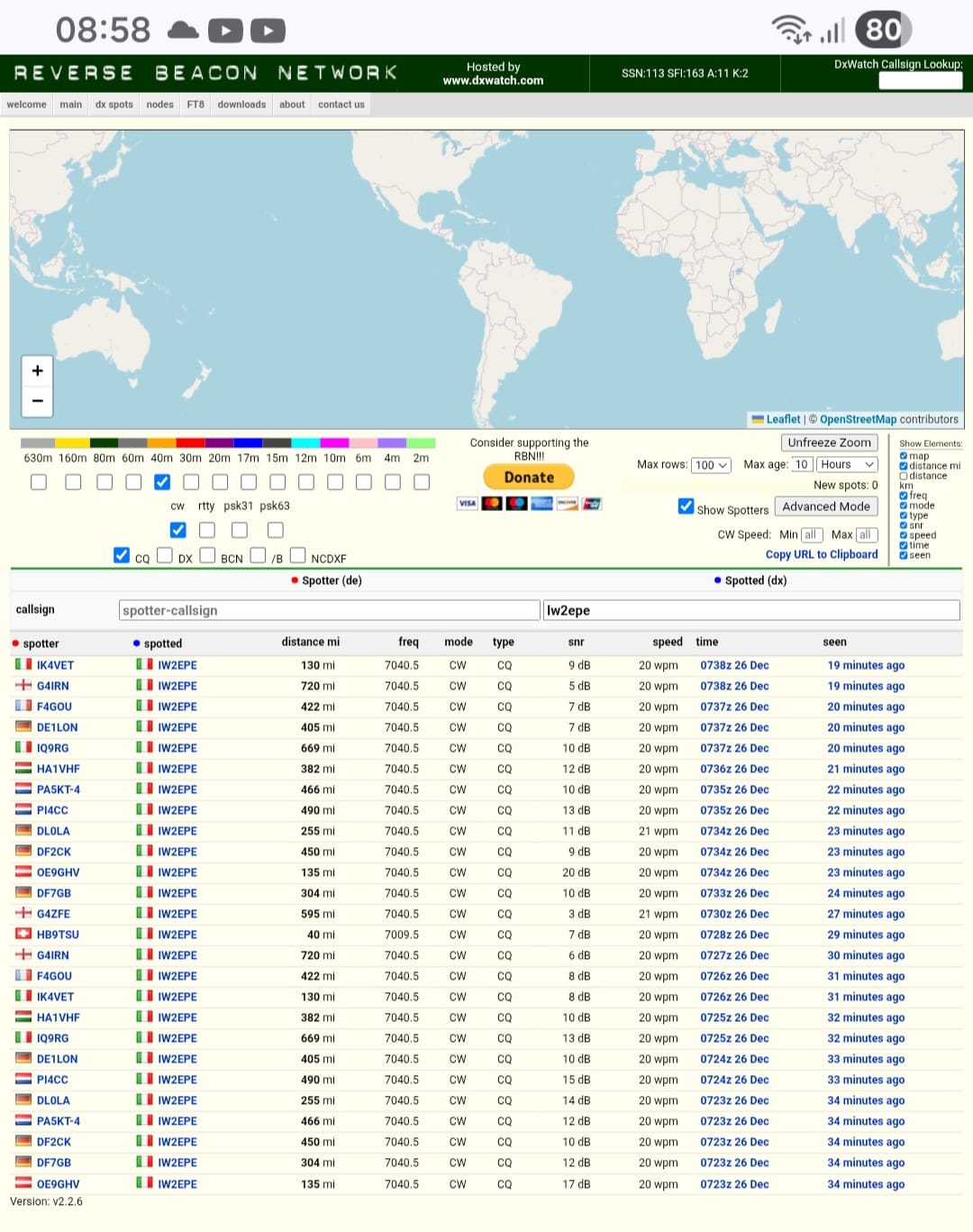
I’m attaching a reception report of my signal this morning on 40 meters with FT8.
73 Luca