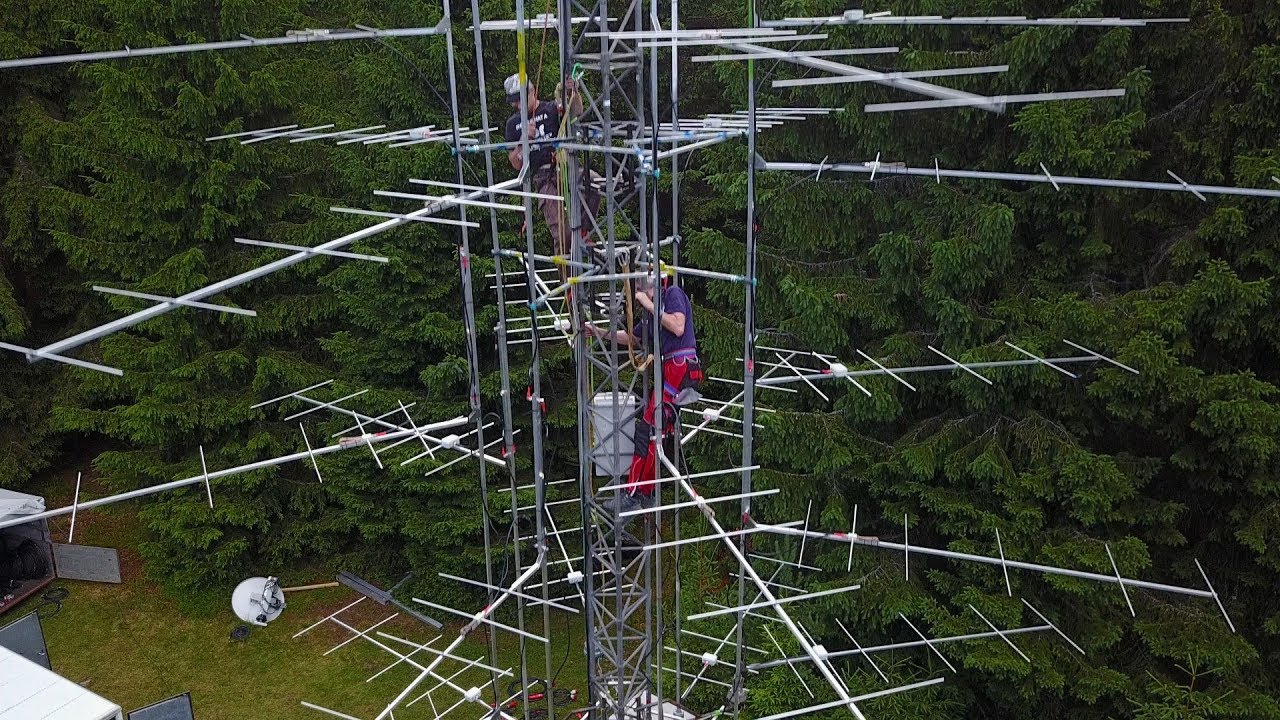
In our local club we have an ongoing discussion about the approach in 2m contest. One group is convinced that the key to success is in hunting the stations furthest away with stacked yagis and as much gain as possible. Another group thinks that this neglects the stations in our proximity and an array of shorter Yagis pointing in four directions (N, S, E, W) should also be considered. A recent talk to a fellow OEM also active in 2m-contests made me think again about the different approaches. He reported that his local club uses two stacked Big Wheels and two additional 9-el. Yagis. The Big Wheels are predominantly used for calling and when a station’s answer can be heard, it can also be worked in most cases with the omnidirectional antennas. Only when the signals are too weak “on channel one” the stacked Yagis are employed. [Remark: They are also preferably used for dedicated hunting when the traffic is low, e. g. during the night.]
What’s in for us not taking part in contests but the 2026 SOTA challenge?
First of all, we have some limitations compared to the contesters, just to mention portability and power supply. However, picking low-hanging fruit with most efficient harvesting is an attractive thought. Recently, Roman @DL3TU and me have tested the basic principle of combining different antenna types on a summit quite successfully.
The single and double hourglass antennas are bi-directional and require a 90° turn of the pole to cover the whole circle. Omnidirectional Big Wheels and Turnstile Antennas have a certain complexity limiting their portable use, but the opportunity to reach as many potential QSO partners as possible already with the very first call remains attractive.
Based on your use cases and criteria [weight, package size, footprint, ease of use (hassle with turning for covering 360°)…] your assessment and equipment choice may be very different. Whatever floats your boat is fine with me, just let us know what works best for you.
What works best for you?
Highly directional (F/B ratio > 0, yagis, loops with reflector…)
Interesting stuff for having a proper strategy to maximize your log in a summit.
Looking at your double hourglass antennas (Horizontal pol.), what if you mount one of them looking N-S, and then stack the other rotated 90 degrees beaming E-W, so that you don’t need to rotate them anymore??
Of course you loss the extra gain into a single orientation, but you win a fixed antenna position with a quasi omnidireccional pattern, right?
Yes, Ignacio, this is a solution which would cover all directions.
This principle was realized by another contest group by means of two VGR antennas. The VGR antenna was published by Prof. Dr.-Ing. Gerd Janzen (DF6SJ) and has a very similar performance profile compared to the SHA (single hourglass antenna). I have simulated the VGR antenna with 4NEC2 to match the 50 Ohm without the remaining reactance (disadvantage of the original design, needs compensation).
I agree that better results are obtained not by stacked massive Yagis but by using antennas with very narrow vertical beamwidth and wide horizontal beam width. This idea is taken to extremes by DR9A contest group. I have taken a picture of a UHF contesting setup from their webpage to show this.
This picture shows 6x 9 ele Yagis for 70cm x 3. This gives a narrow vertical and wider horizontal beamwidth compared to the typical box of 4 x 21ele. But by having 3 arrays, you can transmit an omni signal or concentrate on just one 120deg sector. Each array of 6 is on a rotator for peaking up in any area. Not yet mounted are multiple quads (diamonds) for 23cm. Exactly the same principle, lots of stacked narrow vertical, wide horizontal antennas. Not shown are the antennas for 13/9/6/3cm & 24/47GHz. When you get to this scale of station, you can always put up another tower with 8x 21 and 8x 55 Yagis for 70/23 for super directivity. Most the broader antennas will do the job. DR9A do keep coming 1st in contests so this would appear to be a very valid antenna setup
When we (GM3HAM) have used 55ele Yagis on contests, we found the backlash in the rotator was often greater than the beamwidth of the antenna giving rise to wind born QSB as the antenna rocked back and forth.
So Peter, having a good omni, near omni setup with a peaking antenna is the way to go. In most of the contests my group take part in, we are limited to a single antenna per band due to the contest class we enter. (Not enough operators/riggers/transport for the multi antenna sections and we are all getting older )
Interesting thought that when I started on 2m (1968 when the B licence was changed to include 2m) nobody would have considered asking this question. Mainstream thought was to use the biggest beam that you could mount and rotate, not just because it would give you the furthest reach (with points per km) but because it would reduce QRM from stations outside the beam heading. This was important because band occupancy was vastly greater than it is today. Imagine a mid-week evening and no empty channels for SSB operation! Unthinkable now but normal then. During a contest or major opening it was QRM City!
Using a beam to reduce QRM can still be necessary if you have nearby QRO stations, for this reason I would never consider omni-directional antennas. A nearby QRO station could really ruin your day if you cannot turn a beam to null him out. Even a simple HB9CV would be useful, small, low gain and a very wide beam, BUT a very sharp null on the back of the beam which can be used to null out a station otherwise strong enough to cause splatter or blocking…or null out a noise source!
It may be that today activity might be low enough to get away with an omni-directional antenna, but why risk it?
Thanks Brian. The original question is related to the SOTA challenge and the contest story served only as introduction. In other words: “When you sit on the summit and call CQ, what is the best antenna and therefore fastest method to get your four 2m QSO into your log?”
When the MT were discussing this challenge, the idea we settled on was to make distances the object of an activation. What was visualised was rather than using FM and working a handful of semi-local chasers, activators would concentrate on looking for and working DX, accumulating a score of kilometres and using the more efficient modes that are neglected today. In other words, we expected activators to start thinking like contestors or DXers, looking for ways to get their signal out as far as possible and seeking out the weakest and most distant stations to work for the high scores that they would provide. Similarly, it was expected that chasers would start listening for activations that they would normally have dismissed as too far away if on FM.
Obviously, if your objective is to work long distances then you need to get your signal out to those distances, and antenna gain carries less weight penalty than a higher powered rig. Obviously you can stick with a low (or negative!) gain omnidirectional antenna, log as many semi-local stations as possible, and hope for a lift in conditions or a helpful aircraft reflection to boost your score, but if you want to work a few hundred kilometres then you need to make sure that your signal will get that far.
It’s been interesting to see how different SSB and FM signals have been in the few cases I’ve worked activators who’ve used both modes. Sometimes I’m left guessing as to whether the differences are down to the antenna, the rig, or both. I’m slightly hampered by only having a vertically-oriented yagi at this end at present, but I’m working on that…
I have had ~82 SSB QSOs on 2m since the start of the year and more FM QSOs often working the same chaser with both modes and in most cases the same power level and antennas at each end. And my experience is that weak signal SSB VHF signals are in general more readable than the equivalent FM ones.
That makes sense because SSB has ~10dB SNR advantage compared to FM using the same bandwidth (eg 3kHz). With typically S0-S1 noise on 2m SSB I can still perfectly read weak signals that don’t even move my (FT817) S-meter whereas the weak FM ones are lost in rx white noise.
From what MT members have written, the primary purpose of a SOTA challenge is to promote activity on a particular band or mode(s) on that band, which the 2026 one has certainly done. It would seem that getting dx contacts (although rewarded by points) is a secondary benefit. For many of us it’s the fun of doing VHF/UHF SSB and any dx contacts are a bonus.
Quite a few activators (including me) have posted elsewhere that for their week-in-week-out SOTA activations so far this year they’ve been using the same 2m vertical antenna as they use for FM, i.e. for convenience and zero-extra deployment time in winter weather.
While it’s true that some chasers will be semi-local from one activation to another, I find it varies as I activate in neighbouring regions (G/LD, G/NP and G/SP in my case) and it’s routine to get a few contacts over 100km e.g. I had Pen-y-Ghent to Snowdon (171km) using just a J-pole on a 5m pole with no lift on. No dx records broken but fun anyway.
Weather permitting, with the first RSGB 144MHz Backpackers Contest on Sunday (17th May) it’s an opportunity worth carrying and deploying a directional antenna, in my case a modest portable 4-element Yagi (on a short pole) to get some SSB (and CW) a bit farther afield.
I have on occasion seen the opposite effect. There have certainly been cases where the SSB was workable but the FM was not, but also others where the FM was 59 and the SSB was (being generous) no better than 55. I don’t know whether that’s been down to the operator using a different (lower power?) rig for SSB, or using an antenna that isn’t getting the signal out to me in as good a way, or something else entirely. Too few examples so far to draw any meaningful conclusions, though.
Since there is a chance of missing potential QSO partners with a highly directional antenna, Peter @DM7KN and I tried the following setup during the last DARC VHF contest. Here is a photo of my location in JN48mj:
The Double Hourglass Antenna (left, ~ 9dBi) has a large horizontal beamwidth. It has been used as the main antenna while running. The idea is to illuminate a large part of the horizon simultaneously while still benefiting from some gain toward low elevation angles.
The Yagi (right, ~ 12.4 dBi) came into play when a QSO was close to failing and a few extra dB were needed.
In other words: make yourself easy to find - and optimize for DX at the same time
This is what I have been doing. I don’t think I’ve worked any great DX and often FM has produced some even more distant stations.
On my last activation I used my new hourglass antenna. Calling CQ on the SSB calling channel brought me a station 240km away. I wouldn’t have managed that with the vertical as we would have been cross polarised.
The exception that proofs the rule? When the chaser was stronger on FM than he was on SSB, I ask about his power and antenna. Sometimes it’s because he switched rigs (more power on FM) or antenna (e.g. SSB h-pol to FM v-pol same as my vertical ant.)
One can’t assume there’s been no change at the chaser’s end between the two QSOs other than mode.
As above.
Especially if there’s a lift on that day. My distance record with 5W to a RH770 vertical whip - by shear chance and initial disbelief by me - was when using FM between the Lake District and Isle of Wight (via tropospheric ducting); better than any of my SSB / RH770 contacts I’ve had during normal conditions.
This what I tend to do, no distance records, but just enjoying the simplicity of switching between SSB and FM with a button press, well two actually if you count the menu exit button
My best distances so far are around 120 miles. That said, for some of those contacts, I have logged the same caller on both SSB and FM
This was my setup on Rhobell Fawr, GW/NW-021 today.


 )
)