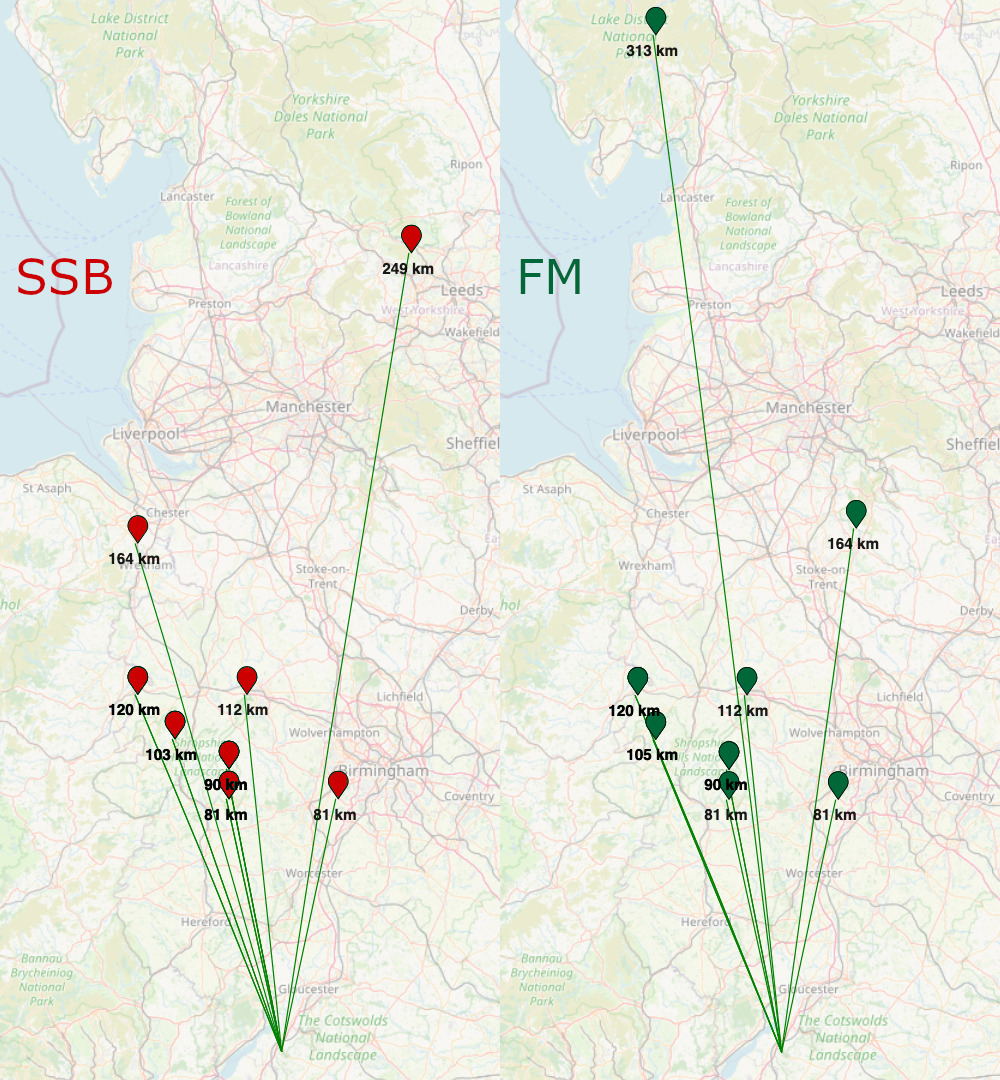
(Map background from OpenStreetMap)
That Lake District FM contact was on a morning when conditions were exceptional. The fan pretty much defines the gap my antenna gets between chunks of Cotswold to left and right…
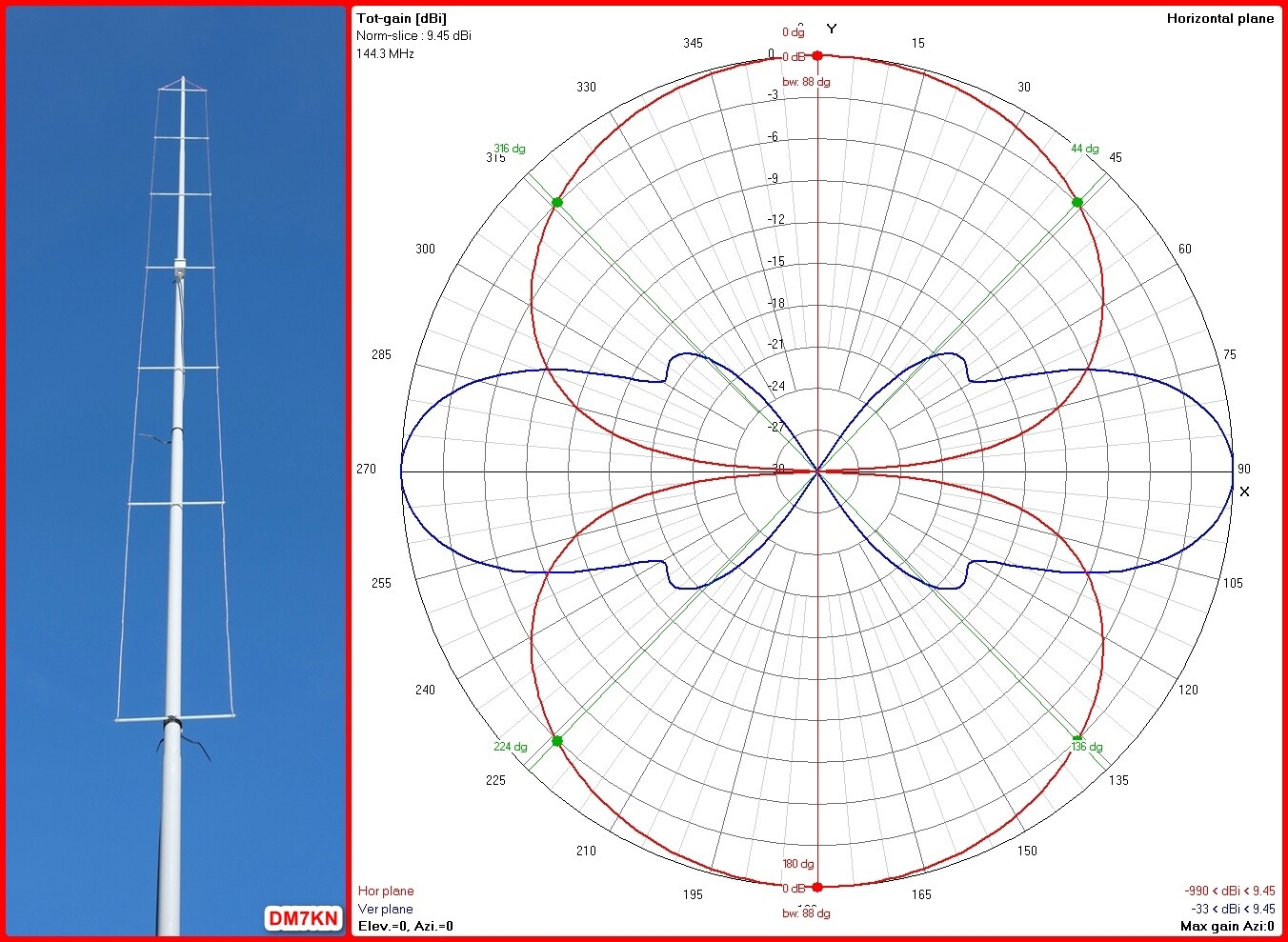
Antennas such as the dipole or hourglass have nulls off the sides that could be used to reduce the signal from a strong station if needed, and still give a wide coverage area.
While activating you just get a relatively brief window of time to work whoever is about and interested. Working from home with more relaxed time constraints it is possible to do better, but in the end we are ruled by chance. On a summit or in the shack, it comes down to being on the air at the right time. That said I would like to illustrate the capabilities of 2m QRP with assist from a beam.
While rummaging for a manual today I came across a map I had marked up with my squares worked in 2004. After several years off the air I had decided to get active again and having parted with my old gear I bought an FT817 as a starter, I also got a 2m 5el yagi which was horizontally mounted just above the level of the gutters and rotated with a cheap TV rotator. With this QRP set-up on SSB in that year I was able to work much of the UK plus EI, GJ, GU, F, ON, PA, LX and OZ by tropo, plus by Es I was able to work three stations in the south of EA and the prize was a contact in LZ at 2245 km. The irony is that for much of that year I was running 2.5 watts due to mis-reading the manual!
Actually most of my attention that year was 6m, not having worked that band before, and using a long wire antenna I was able to work, IIRC, 34 DXCC entities. Pretty well all my 6m contacts were by Es. From the point of view of squares worked, in 2004 I worked 56 on 2m and 141 on 6m. It would be nice if one day we could have a 6m challenge, but at present not all SOTA Associations have access to that band!
In the 1980s I had a very brief involvement with a contest group that operated VHF Field Day from the Quantocks in Somerset. Their logic was to use wide beam width antennas beaming east where most of the potential contacts would be.
I’ve used small beam antennas on 2m sota and in the 145 Alive events. They work well but it is a pain trying to turn them to get the optimal signal and it’s not great calling CQ when you don’t know where your potential contacts might be.
I have had this experience as well. My explanation is that the FM signal is always transmitted at full power as a continuous carrier, whereas with SSB, power is applied only during speech peaks. With weak signals, SSB offers an advantage due to the receiver’s narrower bandwidth and lower noise power.
73, Chris
If you hadn’t reported that I’d have suggested it was a prime candidate for AS (aircraft scatter). Especially as there are lots of aircraft from Heathrow etc. make for the Wirral where they tun over NDB WAL for the routes out to America / Canada etc. They’ll be at 30000ft or so and so easily visible from your QTH.
Yes, so like AM FM wastes RF power going into the carrier which conveys no information, typically 50% going to the FM carrier. AM and FM are ideal modes for analogue broadcasting. But SSB is more power efficient: almost all of my FT817’s 5W RF (at least for a good SWR) goes into the sideband with SSB.
Result: SSB readable at -138dBm, FM often unusable at -129dBm
By the same reasoning I normally left my beam pointing to the southeast as in a lift that was usually where the first signs of an opening would come from, but I always checked the Met Office synoptic chart and if the pressure was high over the North Sea I would leave the beam pointing to Scandinavia.
Going back to counterintuitive cases where the FM was stronger than the SSB, I would suggest that most habitual SSB ops use horizontal polarisation so if the activator was using vertical then there is a loss of about 20 dB, and many SSB ops probably switch to a white stick when they use FM, and then the 20 DB loss no longer applies.
This is exactly the case for a chaser I’ve worked quite a few times so far in the 2026 Challenge both on SSB and FM on the same activation [because he confirmed the polarisation in each case]. Fortunately 1) he was only about 35km away [though that varied depending on my G/LD summit] and 2) with S0 noise on 2m SSB I could still read his voice. Being cross-polarised does indeed make a huge difference.
So far this year the vast majority of my 2m SSB chasers have been using ‘white stick’ collinears at home or vertical whips on summits.
My horizontally polarized 6-fold Oblong has an extremely sharp null. I have used it on summits and in contests. You can blank out one very strong station, but when multiple big guns come in with their signals from different directions, it can be very disturbing.
For a Wednesday noontime SOTA activation with almost zero traffic, when I am desperately looking for any chaser available, the bidirectional antennas (single & double hourglass, oblongs…) are ideal for “both-sided fishing”.
I made a contact from a summit over a distance of 40 km using a Quansheng handheld radio with a short antenna—and the chaser was using the exact same setup.
The signal strength increased significantly when we both held our antennas horizontally in the same direction, rather than vertically as is customary.
I started off chasing using a white stick, and caught nobody. Turned out the white stick was knackered. Replaced it with a horizontal yagi, and caught nobody. Turned out folk were generally using something vertical on summits. Turned the yagi vertical, and finally started making contacts. At present it’s still vertical because it seems to work more often than not and changing it would involve ladders, spanners and a fair bit of Anglo-Saxon. A method for changing the polarization and pointing is being worked on, slowly…
No doubt easy to do when both parties are using 2m HTs with short HT-mounted whip antennas, less practical for most chaser’s antennas or when the activator’s vertical in on a pole.
It’s why horizontal polarisation is the choice of serious VHF DX’ers and contesters – there’s less attenuation by the ground and other objects (trees, vegetation, buildings, etc) if the E field component of the signal is parallel to the ground (H-pol) rather than perpendicular (V-pol).
Yes, changing the polarization of my 4-el Yagi on summit involves dropping the 5m support pole to the ground (carefully so as not to bend the elements), unclamping the boom and rotating 90 degrees, re-clamping and righting the pole, A bit of a faff if all you’re doing is to switch modes (e.g. SSB to FM).
In practise I don’t have that problem. Either I use the Yagi (always H-pol) for SOTAs coinciding with a contest (like the forthcoming RSGB 144MHz Backpackers Contest) or some special SSB/CW day OR I use my usual 2m vertical (RH770 or J-pole) for my common-or-garden SOTAs for all modes.
Yeah, I’ve been following the VK folks’ comments about AS on VHF. Once I sort out a rotator for my yagi…
That particular contact was, however, on a particularly good morning for VHF, and @EI3LH also had a good day thanks to the same conditions, so they were moderately well spread out.
Since 2m FM does not contribute to the 2026 Challenge, I hope that you do not mind when I try to direct the discussion again to the original topic, 2m SSB, and the corresponding poll.
Although by far not representative, the result up to now [41 % for highly directional and 42 % for bi-directional] is somehow surprising as I would have expected a clearer vote for the yagis. Those who are in the 42 % may perceive a confirmation in their thinking that working both ways (“both-sided fishing”) is the most efficient way of getting hold of their chasers. But mind you, this is not an invention made by amateur radio operators!
Hi Ian,
Thanks for joining the discussion. I fully agree that good quality equipment gives you a return in the long run. However, the few meters of HQ coax have never been a serious issue. Compared to shortwave, where I can reach many chasers much more than 1000 km away with a KX3 and 10 W, the 2m Challenge is more demanding. My KX3 has a built-in transverter, but the output is just 3 W. This means that I need a PA on top. The alternative is a TRX with VHF/UHF, like the FT-817, IC-705 (both + PA) or a FT-857 with more punch (and weight!). More output may also require longer battery life, depending on the number of potential QSO partners (much less than on SW).
Yes, it is something that needs consideration, but I guess, there are other more painful items.