Single or double - you now have the choice!
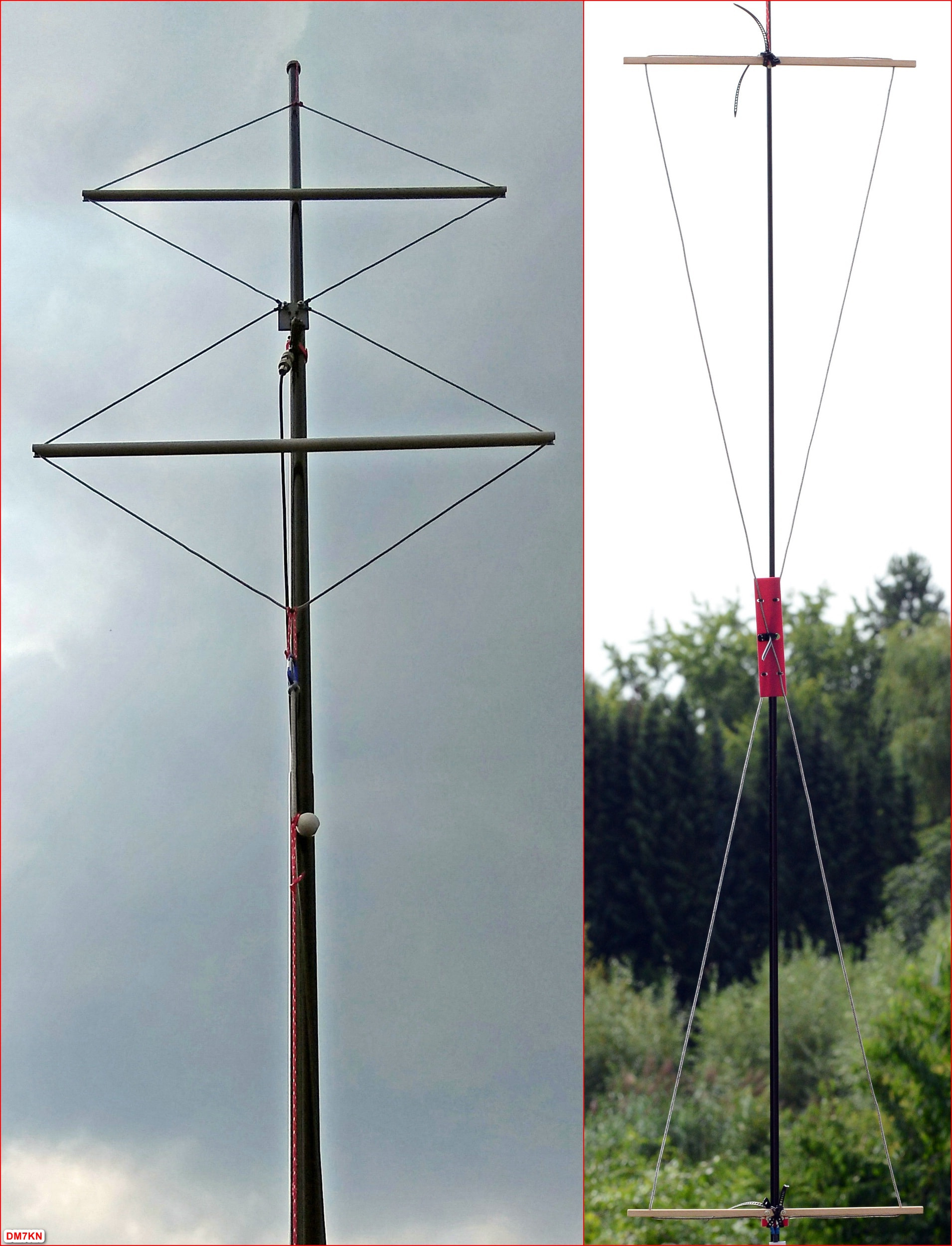
During my first 100 SOTA activations a 144 MHz double-quad antenna served as my reliable portable companion. The gain of about 6 dBi is rather low but its advantages (almost 90° horizontal beam width, small footprint and usable in FM & SSB mode) allow almost effortless “both-sided fishing” on summits. As mentioned before, with only one 90° turn of the pole almost the full circle could be covered since front and back of the antenna work simultaneously during tx and rx.
Early in 2023 I looked for a successor with more gain and found several candidates. When I compared the stacked delta loops published by Martin, DK7ZB, to the hourglass antenna developed by John, K4ERO, I realized that both designs delivered almost identical performance, while John’s very smart stacking method resulted in a more compact and portable setup.
However, when I looked at my SOTA double quad and the SHA (Single Hourglass Antenna) I had just built, I asked myself: “Is there perhaps also a DHA (Double Hourglass Antenna)”? Of course I looked into ROTHAMMELS ANTENNENBUCH and searched in the web but without a positive result. Finally, I contacted John and he confirmed that he had experimented with stacking and adding reflectors but never published anything about those experiments. He was also not aware of any publications or patents about the DHA. I would like to seize this opportunity to thank John for his impulses and open communication.
Well, since there were apparently no blueprints available, I fired up 4NEC2 and built a DHA from scratch.
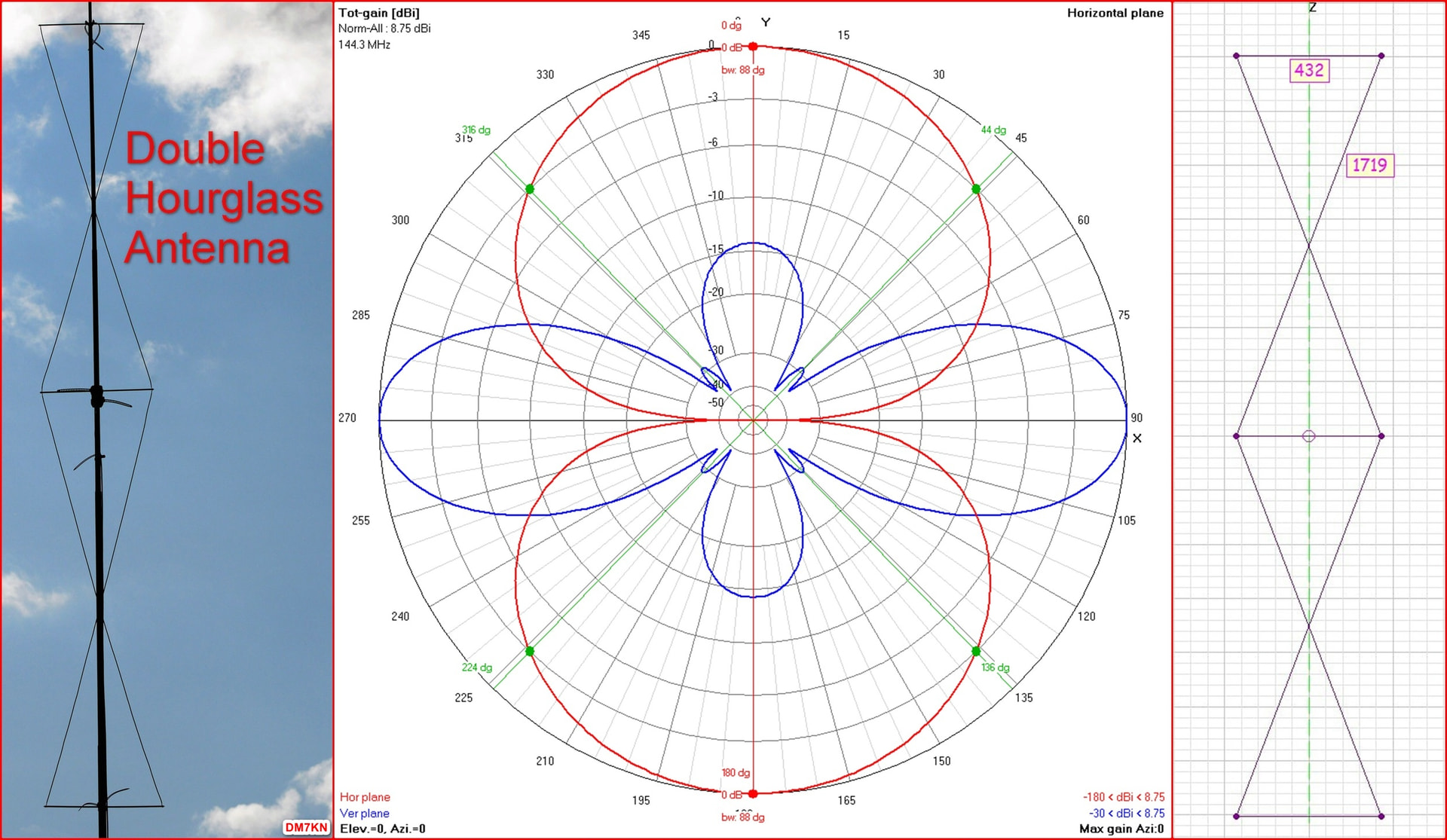
In contrast to my first attempt with the SHA, which was exclusively built from wire with some stabilizing wood sticks, I used 6 mm Al pipes for the horizontal elements of the DHA and wires only for the diagonal ones [dimensions in the right sketch are in Millimeters]. The pipes and wires are connected by vertical panel-mount pin connectors with a 4 mm thread. 6x1 mm Al pipes should – theoretically – have a 4 mm orifice but I had to widen my pipes with a 4 mm drill. You will find more details in the following pictures.
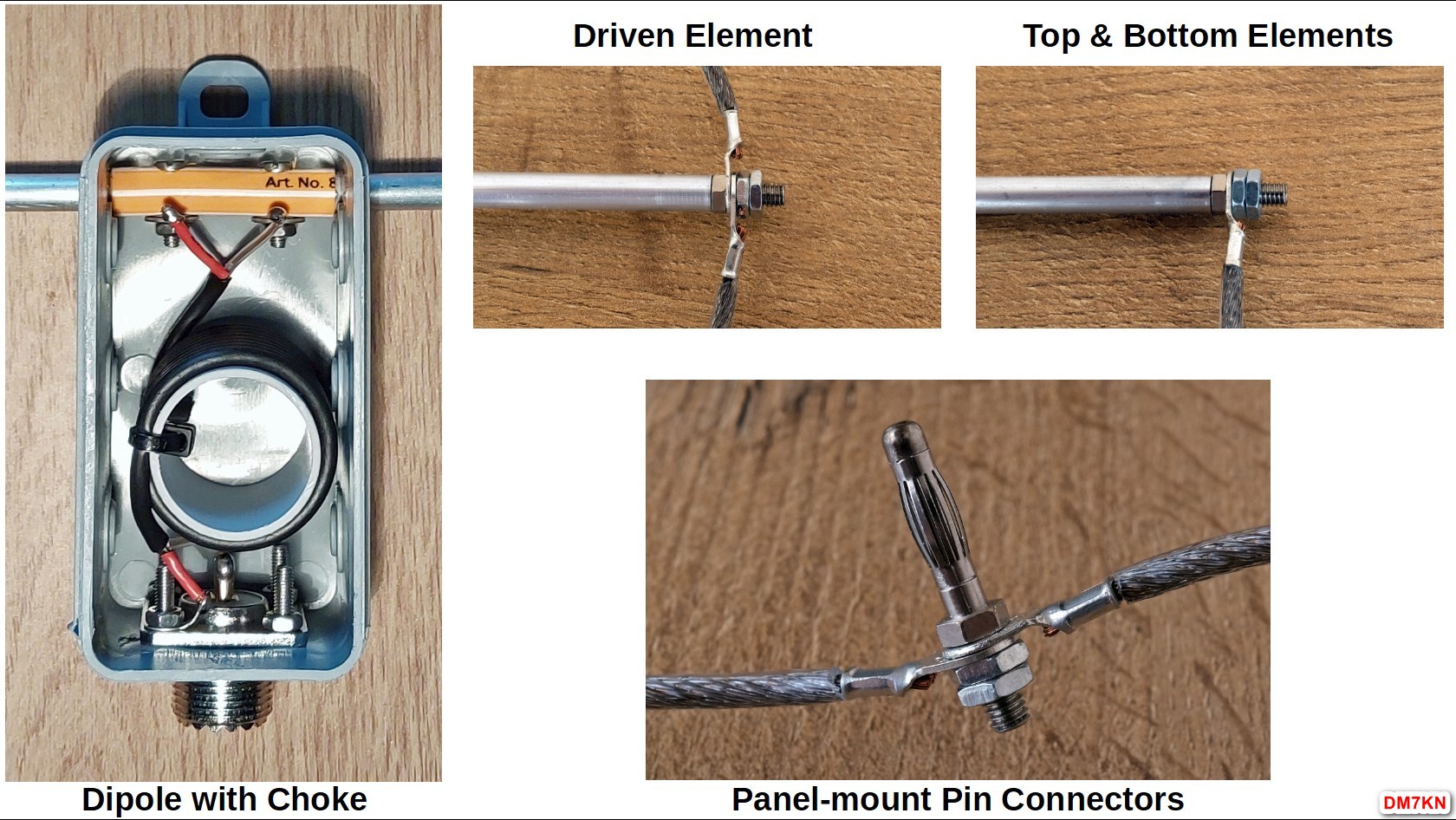
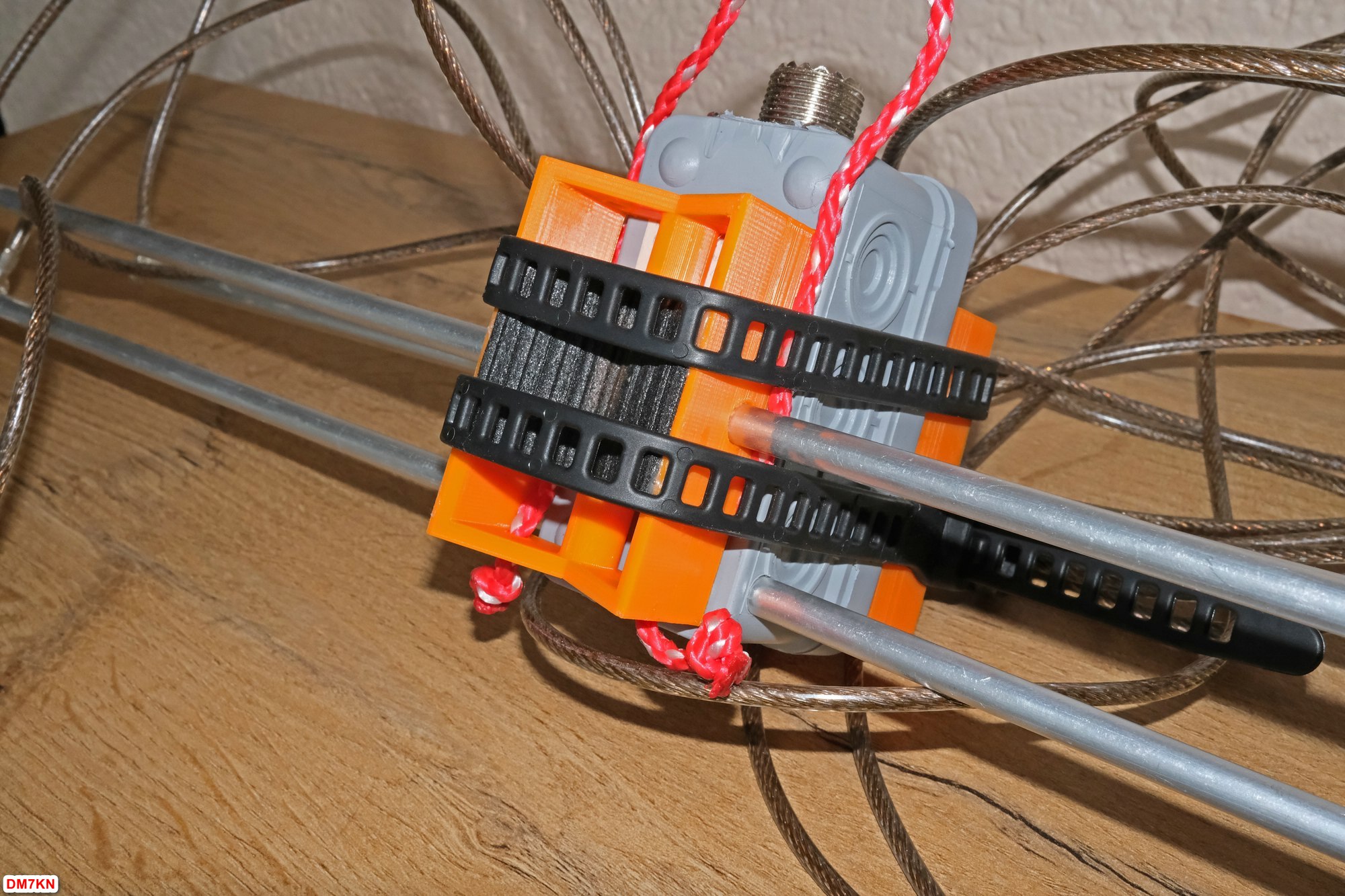
By means of the orange 3D printed clamps the top and bottom elements can be mounted to different poles at variable heights and diameters.
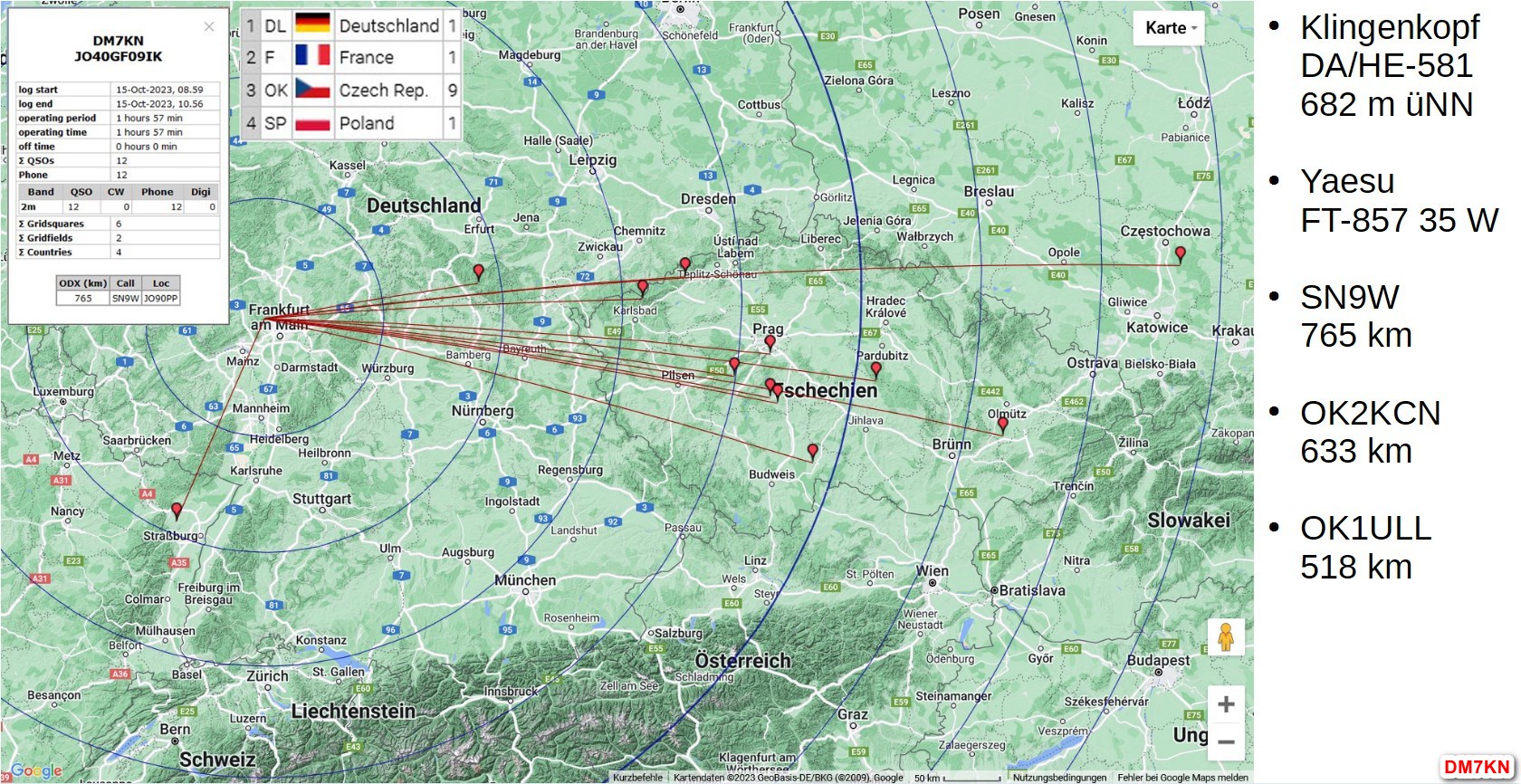
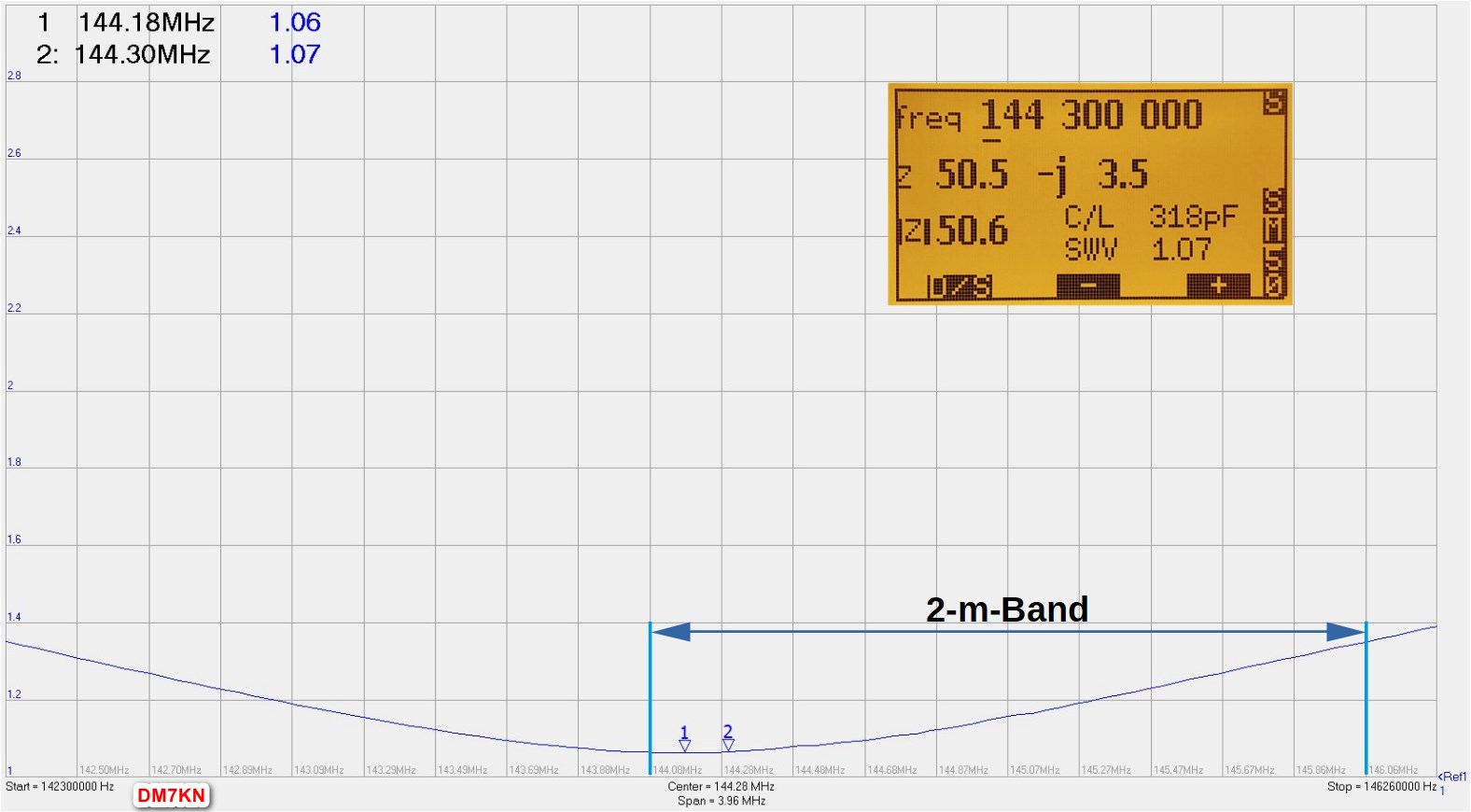
I am quite pleased with the performance of the 2 m DHA and like with a dram of good old Scotch Whisky, I meanwhile prefer the double over the single. 
It goes without saying that I tried to exploit the concept further by designing e. g. a fourfold 2 m hourglass antenna (gain 11 dBi) but the height of 7,2 m limited the portable use. However, for those who are interested in this band, a 70 cm version would be a realistic option.