Continuing the discussion from 2026 SOTA Challenge (Part 4) - #100 by VK1DA.
Previous discussions:
Continuing the discussion from 2026 SOTA Challenge (Part 4) - #100 by VK1DA.
Previous discussions:
A few Activators have told of their experience with VHF ssb from summits, as its total fire ban season here in vk5 I can not access summits yet during summer.
I made up a simple 1/4 wave ground plane for 2m using a bnc to banana binding post fitting and placed it on my hiking pole fed with a metre or so of RG 174 coax to my FT817.
Drove to the closest High point east of my home QTH and had 4 successful QSO with a local group on 2m ssb no problems. This antenna packs up nicely on my SOTA bag and I think it will become the Challenge antenna of choice once I get back to SOTA.
Furthermost distance was 110 km with 2 others at 80km the closest station was 10 km. Once I get out in the summit areas these distances will be somewhere in that foot print also. maybe not possible on some summits but I have a good idea I will make contacts on most.
Can recommend the 1/4 wave GP made of a binding post and 3 pieces of hard drawn copper wire.
Hope this helps.
Regards Ian vk5cz ..
I’ve just had 3 QSOs with Paul MW0PDV/P who was on GW/NW-043 Cyrn y Brain. I was using my FT818 at 5w into a X50 vertical. A distance of 40km.
On FM 145.375 we were 59 both ways. On ssb 144.286 both V-pol, my sigs to him were 58 & his to me 59.
With him H-pol & me still V pol, my sigs to him dropped to 51 & his to me 58.
So not much difference for me receiving his H pol sig, but a big difference vice versa. Curious.
Are horizontal antennas less sensitive to V pol sigs than the other way round?
Not the most scientific of experiments, but interesting to us both.
73 John G0MHF
I’ll be doing the 2m FT8AC event from The Cloud G/SP-015 tonight 1900-2100z. If I am set up in time, I’ll self-spot and call on 2m SSB before 7pm, and after 9pm.
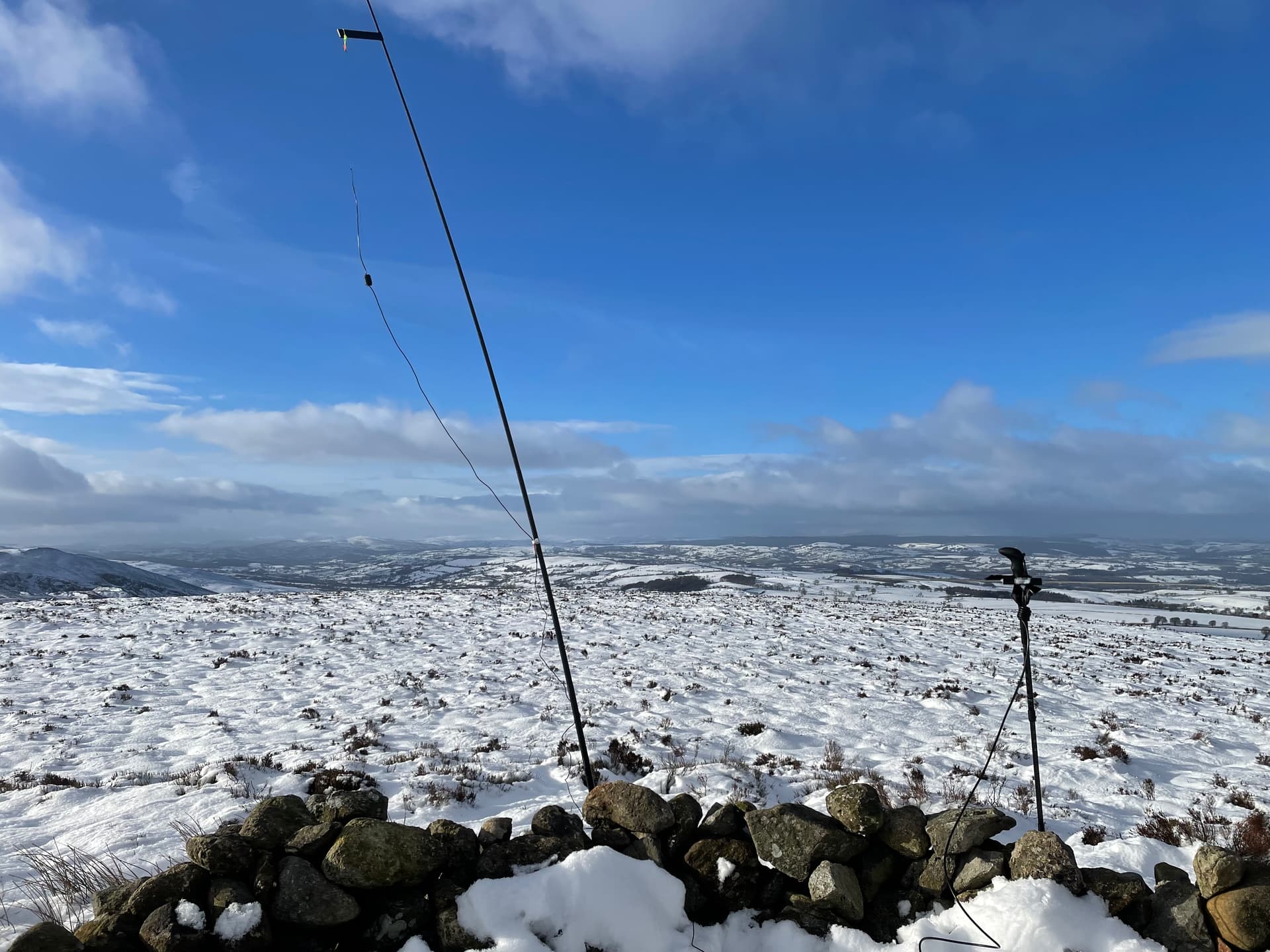
Thanks for the QSO’s John, it was interesting to compare vertical vs horizontal. It wasn’t a straight comparison though. I was running 10w using the IC705. For vertical, I was using a flowerpot on my carbon 6 pole. The feed line was 5m of RG174, and so about 30% loss at 144MHz. For Horizontal I was using half wave dipole, fed with 3m of M&P Hyperflex 5, so about 10% loss. Although the dipole was a bit closer to the ground. I assume the gain of the flowerpot is offsetting some of the feeder losses. After putting both up in a biting wind chill today, I think I will be using the flowerpot for winter, given the pleasing results today..
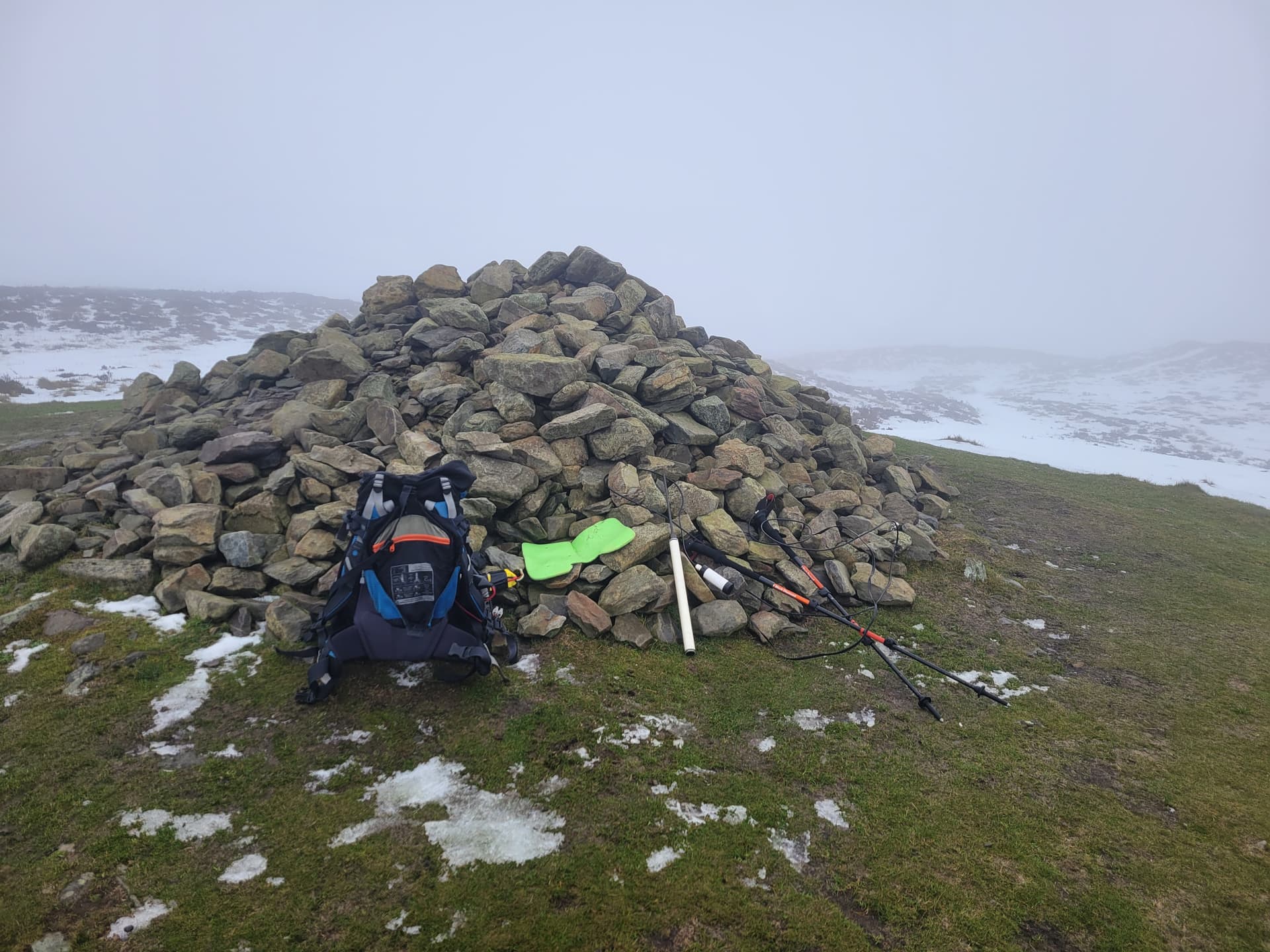
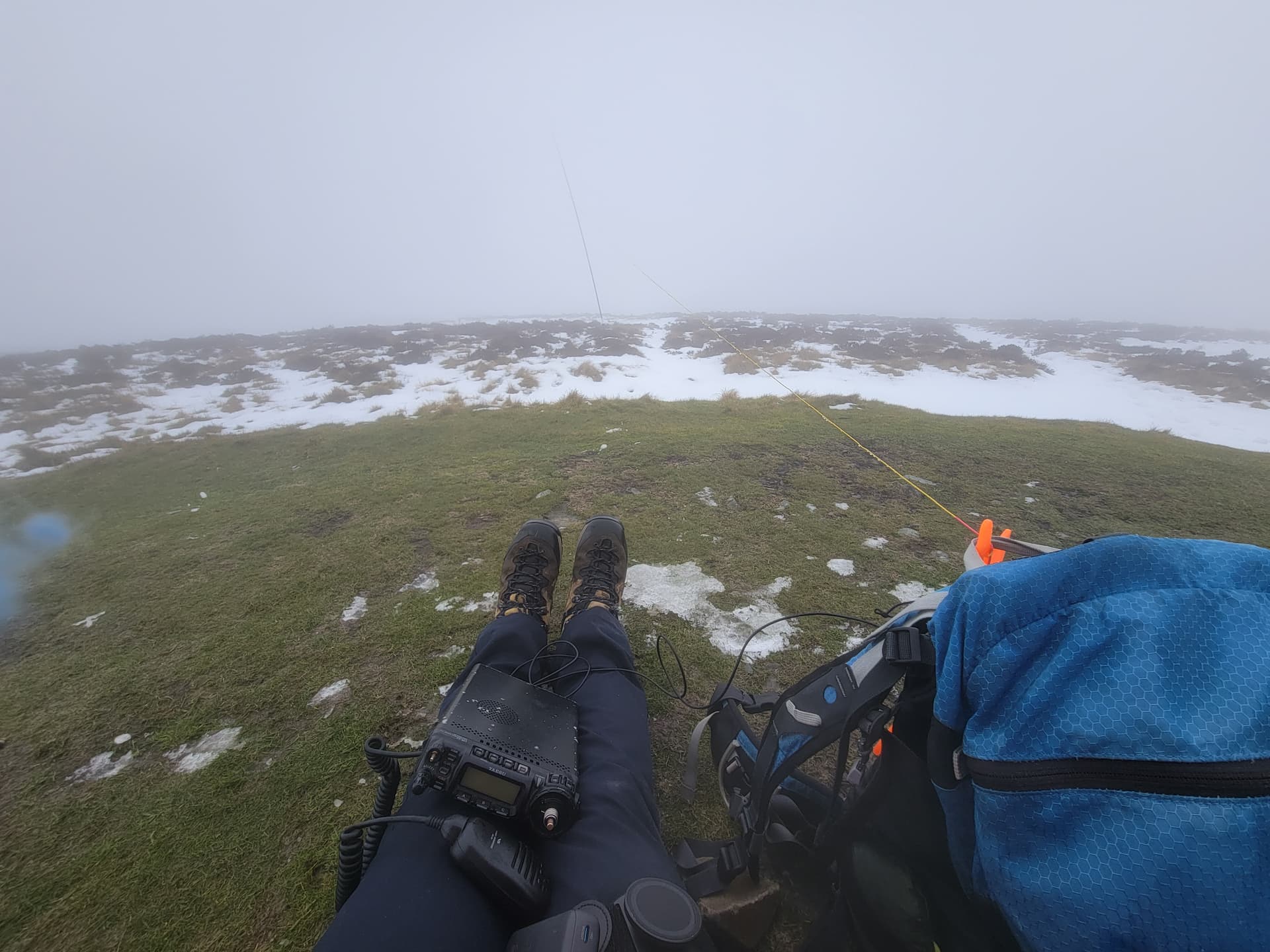
See picture below of both antennas. The horizontal dipole is on the walking pole on the right, it’s hard to see with the snow behind.
I think its also worth noting that on FM there is the carrier which means that you are transmitting full power at 100% of the time, whereas with SSB , depending on your voice and radio settings and any compressor , you will not acheive that so the signal meter will move up and down accordingly.
I’m not saying the test/experiment isnt worthwhile , it definately is, especially with the cross polarisation figures. Did you try the cross polarisation on FM as well or just too cold to be messing around 
Also would be interesting to see a similar test with two stations 40km apart and then 140km apart. I’m guessing that the FM would be hard to copy at the 140km mark but the SSB would still be R5 (assuming average conditions). CW would fare even better (due to same power being spred over a much smaller bandwidth). If all stations were on summits then the ranges would increase for all modes.
Over the coming months it wil lbe interesting to see more stuff like this, especially when it gets a little warmer and people are more likely to want to hang around and try stuff out.
No.
Consider the antenna is the only thing in the universe…
An antenna does not know if it is transmitting or receiving. A voltage applied to its terminals produces electric and magnetic fields. Likewise placing the antenna in electric / magnetic fields results in a voltage at the terminals.
The antenna does not know its orientation. All that matters is the orientation of the fields to the antenna components. When suitably aligned, the field induces a maximum voltage.
The real world will influence those fields. In the picture the horizontal is close to the ground, that will affect the pattern. Note there’s not much of anything on the CyB summit. Not much in the near fields to reflect the fields apart from the ground. At your house John, you are probably surrounded but many, many houses with pitched rooves* that will cause the horizontal or vertically polarised signal to be scattered such that you receive a lot of equally strong mixed polarised signals. Summit to summit from pointy summits is more likely to make the polarisation loss much more significant.
*rooves: When I was at school starting in 1966 I was taught the plural of roof is rooves. Apparently roofs is now preferred and even sixty years ago, my teacher was behind the times!
[As I understand it] it’s true that the constant carrier of an FM transmission will typically show on the receiver with a higher S-meter reading than does an SSB tx with the same input power.
However, less RF power goes into the modulation (sidebands relative to total power) with FM than with SSB. SSB is significantly more power-efficient than FM for voice communication over long distances, despite FM’s constant carrier.
So, in principle. with all other factors being equal, an SSB signal should be still be readable when an FM one has become too weak.
FM has better noise immunity than SSB but I find in rural areas - like SOTA summits - that’s rarely a problem.
Agreed
What was the issue that you needed to refine?
My experience over the statistically insignificant 2 activations is that strong signals are much better on FM than SSB so it will be interesting to compare when signals are weak. This challenge is going to be interesting.
This is what amateur radio is about.
Yes, most of us activators are rarely in a situation to have a very weak-signal 2m chaser conduct an A vs B experiment (i.e. FM vs SSB comparison) with us to test the theory. With medium to strong signals, you obviously won’t notice a difference in readability.
I enjoy both HF and VHF/UHF but they have their interesting differences. I’m often surprised by some of the quirky aspects of 2m and 70cm operation, like having an ‘impossible’ non-line-of-sight QSO with mountains between you or an operator 450km away sounding like he’s a local due to tropo(spheric) ducting.
I hope it has improved, when it was first available it wasn’t very reliable! I prefer to watch the Met Office surface pressure charts (www.metoffice.gov.uk) and my barometer, if the pressure on my baro is at or above 1020 mb then a propagation enhancement is likely. A major event in spring or autumn can bring in most of western EU. They can happen at lower pressures but less reliably, and you sometimes get propagation along a warm front.
At the risk of telling grandmothers how to suck eggs …
Just to be clear, “tropo” in this context is tropospheric ducting, which is an intermittent, weather-dependent phenomenon and means of propagation – hence the need to check on-line for its occurrence over your intended RF path.
The other main ‘tropo’ mode is tropospheric scattering (troposcatter), which is a reliable, continuous, 24/7 mode of propagation, much underused by amateurs (and used by the military during the Cold War before satellite links became common).
So, you can exploit tropospheric scattering any time provided that you can point directional antennas a bit above each other’s horizons. Best on 13cm and 23cm, it’s still effective on 70cm and 2m.
First attempt at the Challenge today.
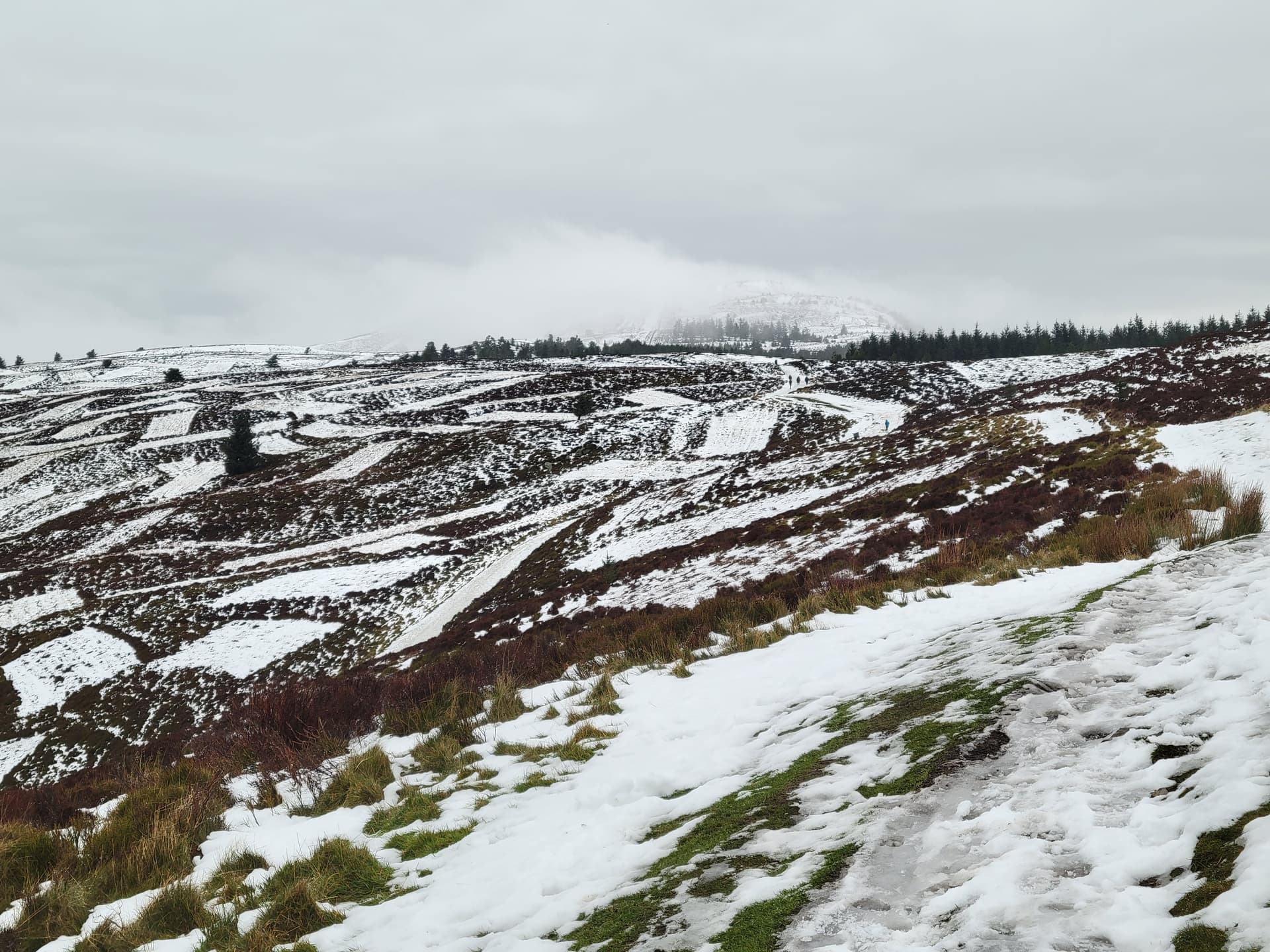
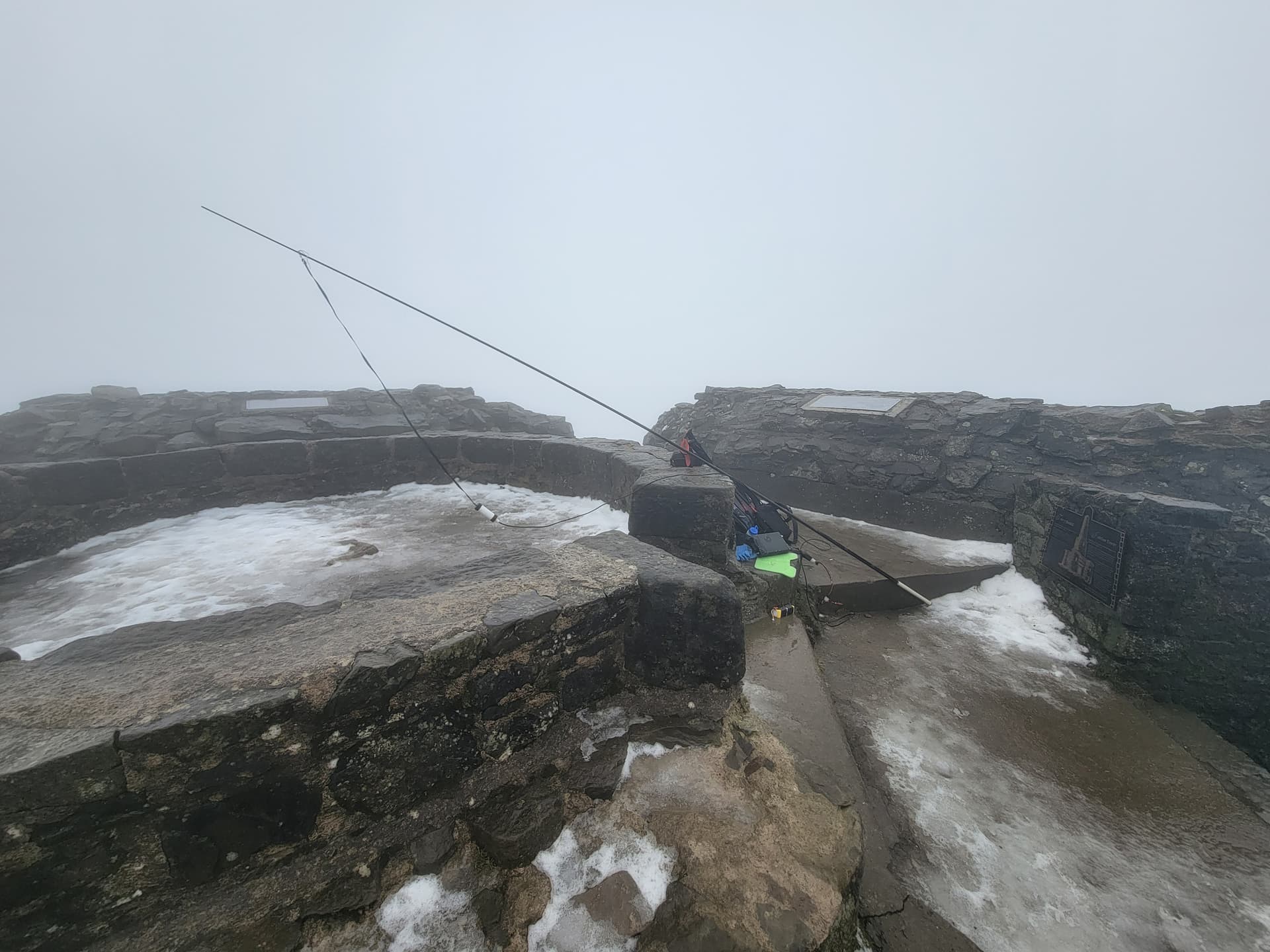
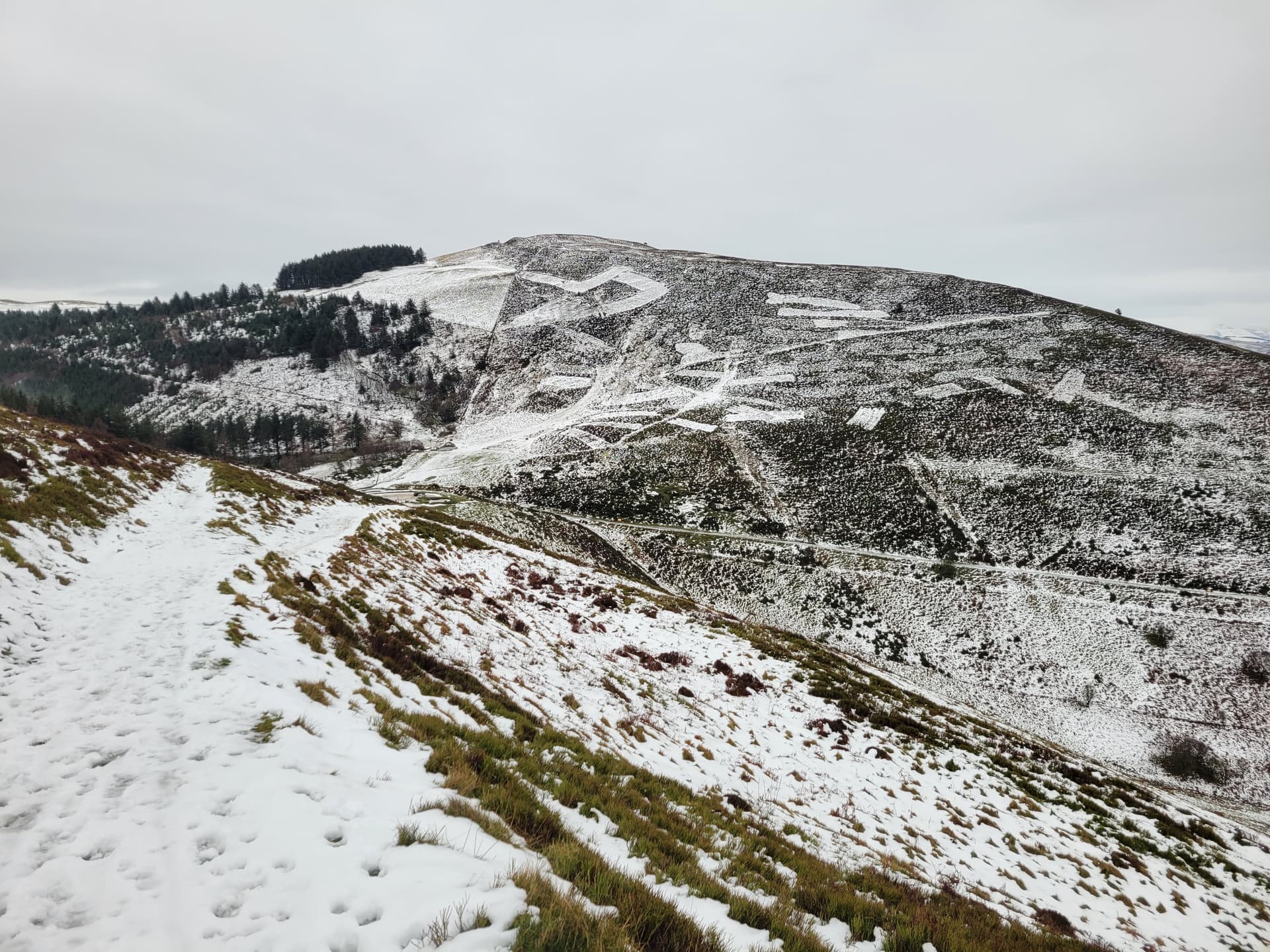
Moel Famau GW/NW-044 and Foel Fenlli GW/NW-051
Super fun… I got 9 (!) 2m SSB contacts on each of two summits. Mostly the same people on both.. but a few differences. So 13 separate stations.
This bodes well for the challenge.
13 operators on a miserable mid week day, when I couldn’t hang about to collect more people that might become available.
I first used 2m FM and told everyone I spoke to what I planned to do next… which seemed to work well.
I was vertical polarisation for FM and SSB. FT-857 10w.
Thanks everyone.
Gerald
I never used to think the loss due to cross polarisation was significant, so did not worry that I was always H-Pol.
This changed back in 2023 when I was trying to work Andy GM4LLD (then operating as MR0FMF/P) He was on G/NP-018 and I was on G/SP-004 with a distance of ≈ 83 miles. There was no problem on 2m, but when we tried 23cm he was inaudible. After a few tries and some VHF talkback, it seems his aerial was vertical and mine was horizontal. A quick turn of my aerial to vertical and the contact was made with little fuss. I was really surprised at the difference.
From that day on, I have always tried to take aerials that I can easily change from H to V polarisation.
Due to the curvature of the Earth, you two were definitely not line of sight on Pennine hills. There are few mountains in the world where a 83-mile path is LOS.
A 1.3-GHz signal is generally more sensitive to antenna polarisation mismatches than a 145-MHz signal in non-LOS paths. That’s because its shorter wavelength interacts more significantly with reflections and obstructions, causing greater polarisation rotation and loss, while the lower-frequency 145-MHz signal is more robust to multipath fading, making polarisation effects less dominant than frequency-dependent scatter.
Having your two antennas cross polarised only exaggerated that situation.
The thing to remember is nothing is black or white but various shades of grey. If the signal has ionospheric propagation then the polarisation gets mixed and so there’s not normally any polarisation benefit to being the same RX polarisation and TX.
I don’t recall seeing too many “amazing” 2m polarisation events in my 35.5 years on hamming. But I do see more as you go up in frequency. There’s the 23cm event Stuart mentions and I offer this 70cm event from my past: Loss due to polarisation error - #7 by GM4LLD and this 23cm event from Andrew G4VFL’s past: Loss due to polarisation error - #9 by G4VFL
And in all 3 people were on summits so relatively clear of nearby reflecting surfaces, e.g. house roofs, only the ground to affect things. Normally, in the UK at least, when there were many hams with VHF and up beams, most were mounted on a pole on the chimney rather than masts due to our twee gardens and houses. If you were lucky your beams were 10m AGL or about 5 wavelengths for 2m. 70cm antennas would be 15 wavelengths clear and 23cm 45 wavelengths clear. Professional RF dudes will tell you getting beam antennas 45 wavelengths clear of the ground gives them a warm gooey pleasant feeling. 
Tropo scatter doesn’t seem to affect the polarisation much… there are reasons why horizontal is preferred for VHF and up DXers but if there was significant polarisation change we would need mixed polarity receive antennas and they’re not found commonly. So enough horizontal tropo scattered signal must arrive for horizontal transmission for it to be viable.
Likewise, diffraction doesn’t seem to affect polarisation. I’ve worked plenty of people VHF handy to VHF handy when there have been serious sharp ridges for the signal to diffract over.
The major source of polarisation change seems to be reflection of ground based objects.
Do you need H and V polarity? No, things will work. But if you can switch or run both then things will be better.
This takes no account of refraction. Line of sight for refracted VHF signals can be up to about 160km assuming no ducting. A LOS path of 134km is quite feasible.
Reading through the 5 parts of this challenge
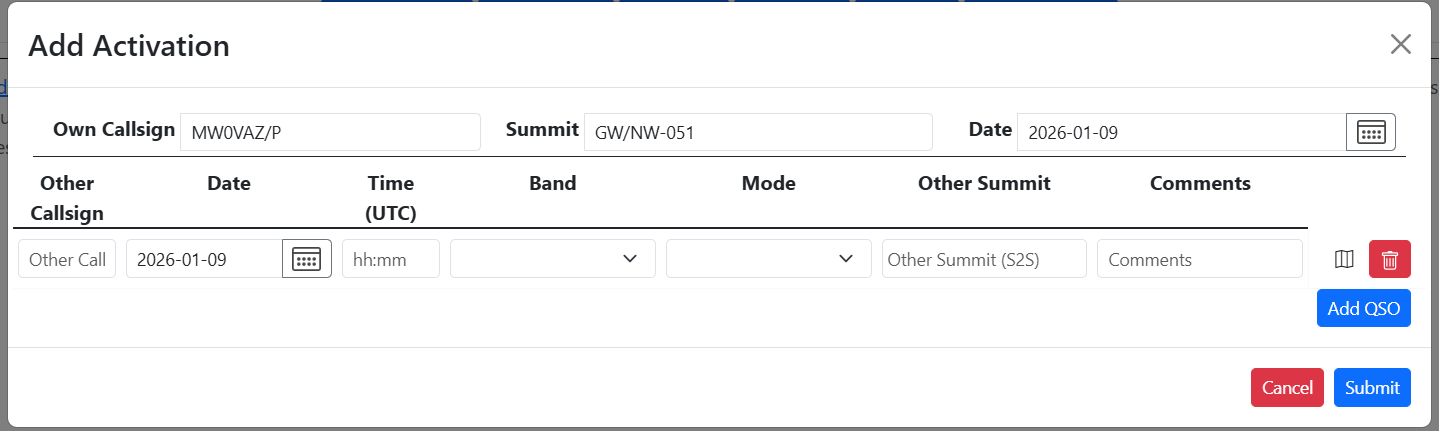
If I activate GW/NW-051 on SSB; I log to paper and then manually enter details when home.
S2S is position is automatically recorded.
As I do a manual entries
Add activation QSO
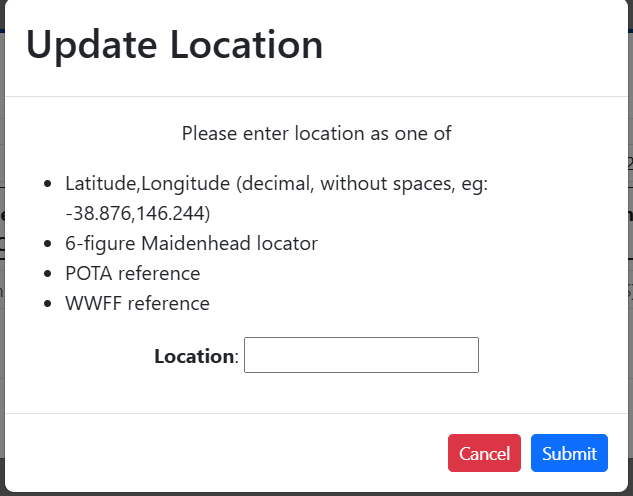
Then click the map icon on the right
For the location (of me?)
But is this not already known as I am activating GW/NW-051 ?
Cheers