When someone mentioned the HAB ‘bursting’ one imagines a party balloon bursting catastrophically. I know nothing about high-altitude balloons but I assume it’s the usual fate – at least for the thinner short-lived ones - that at very high altitudes the latex becomes over-stretched due to the low atmospheric pressure up there, and the fabric ruptures.
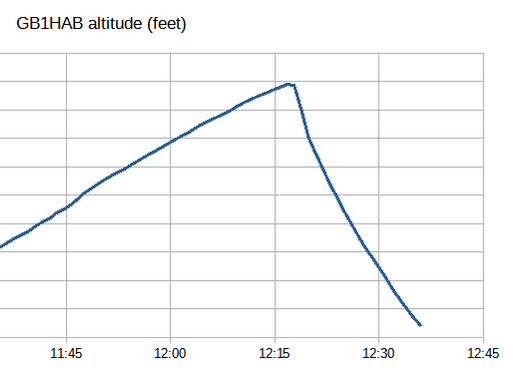
Looking at the altitude data it looks like the balloon took about 15 minutes to descend to the ground so maybe that’s due to its terminal velocity [which should increase as it encounters denser air lower down] with added drag due to some of the latex fabric still attached.
I couldn’t find anything about its recovery. Was the balloon and electronics found? And did the latter survive the landing?
Well done to all involved in organising, launching and tracking GB1HAB.
Actually it carries a parachute to slow its descent. Have a look at the picture of our flight ascending earlier in the month: Bolton Wireless Club - Gallery
Yes. When I did some path loss calcs 100mW over 350km LOS was about 4dB above the noise floor for the receiver. Don’t forget it’s a spread spectrum mode so the despreading in the receiver of the desired signal spreads out the noise making the signal effectively louder.
Yes, there is ~10dB process(ing) gain due to Lora’s Chirp spread-spectrum modulation compared to traditional narrowband modes. It’s why the signal can often be recovered when it’s actually below the noise level. That and its robustness against interference has made SS modes beloved by the military for decades.
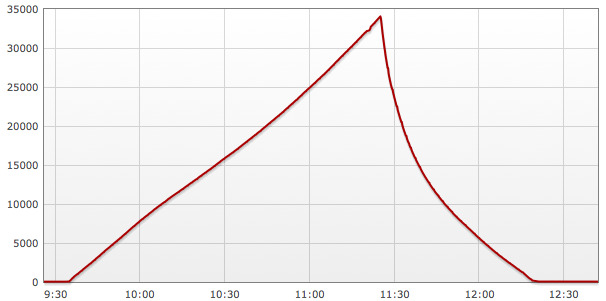
Pretty much, except that there’s a lot more latex, and sometimes the balloon fragments into countless small pieces. If the burst’s a clean one you typically end up with a flight profile something like this:
(Time of day along the bottom against height in metres.)
After burst the payload will at first descend very rapidly until it gets down into denser air, at which point its parachute will begin to have some effect.
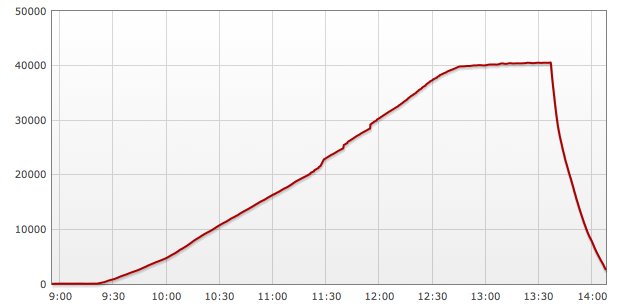
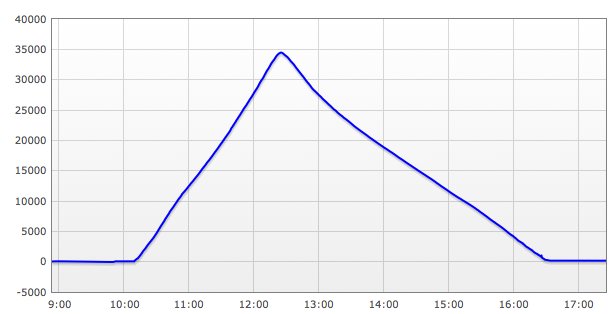
Sometimes the balloon will reach it’s maximum extension but not burst immediately, and then you get something like this:
One of the games you’ll see some folks playing uses mylar balloons rather than latex ones, and they’re deliberately flown at super-pressure, where the membrane is taut and the balloon ends up flying at a fairly constant altitude. Mylar doesn’t stretch but can remain inflated for a very long time, and a few such balloons have been tracked flying around the globe many times.
With my pilot’s hat on I am curious about the regulatory situation with a balloon floating through the open FIR and potentially transiting controlled airspace. I didn’t see any NOTAM for the event and the CAA web site seems to be unclear on the matter. It would be a bit scary having an airmiss with a 7ft diameter balloon in a small aeroplane!
Most amateur flights are in the “Light” category (according to the total mass & density of the payloads and the use of suspension cords with a breaking strain of <230N).
Useful info, thanks. It’s been many a year since I’ve needed to delve into the mighty tome that is the Rules of the Air, especially that deep into the appendices, but I should have thought to look there. It confirms the obligation to advise local ATC units but, somewhat surprisingly, no NOTAM requirement. Every day is a learning day here at WGV Towers!
Hi-impact did a full submission to the CAA for the launch, and received back full permission; so no idea why it was not on the NOATM website when you looked. Permission was also sought (and granted) from Welshpool airport (which is close to the launch site) on the morning of the launch. This is standard practice in case there are any aircraft in the locality, or if the Air Ambulance is about to fly.
Hope this helps reassure you that the correct CAA reporting procedures were followed.
Last I heard, to get below the NOTAM requirement threshold you have to have a balloon and payload which will be less than 2 metres in size (including the payload) at all times during its flight. In practice that usually means using a foil balloon rather than a latex one (because latex ones expand considerably as they ascend), with a very small payload attached at the balloon’s neck. Many of the “Round the World” pico-balloons would satisfy that requirement, but they’re also usually flying at relatively low altitude (tropospheric rather than stratospheric).
…so there should have been a NOTAM issued. Maybe the CAA slipped up?