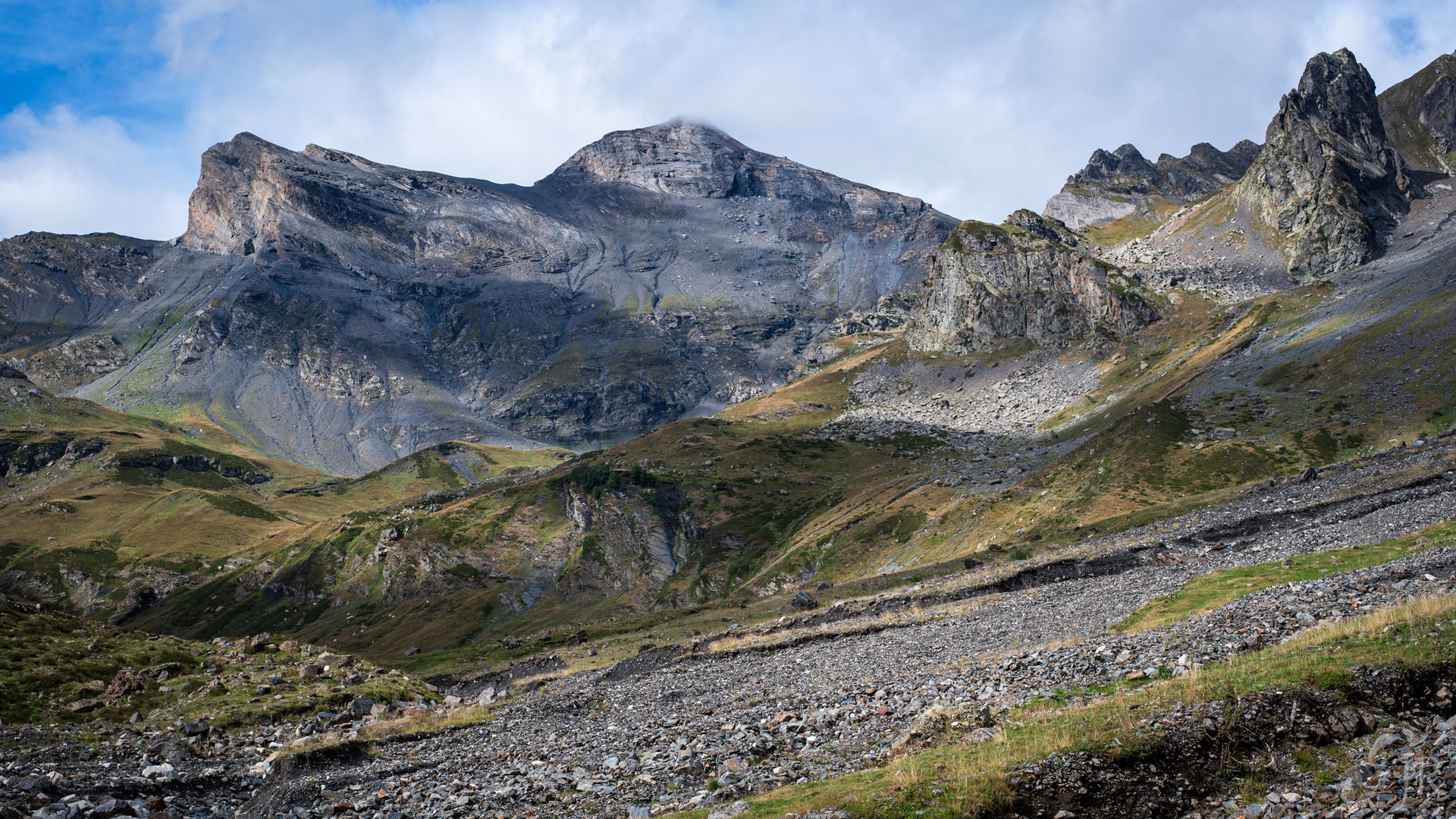
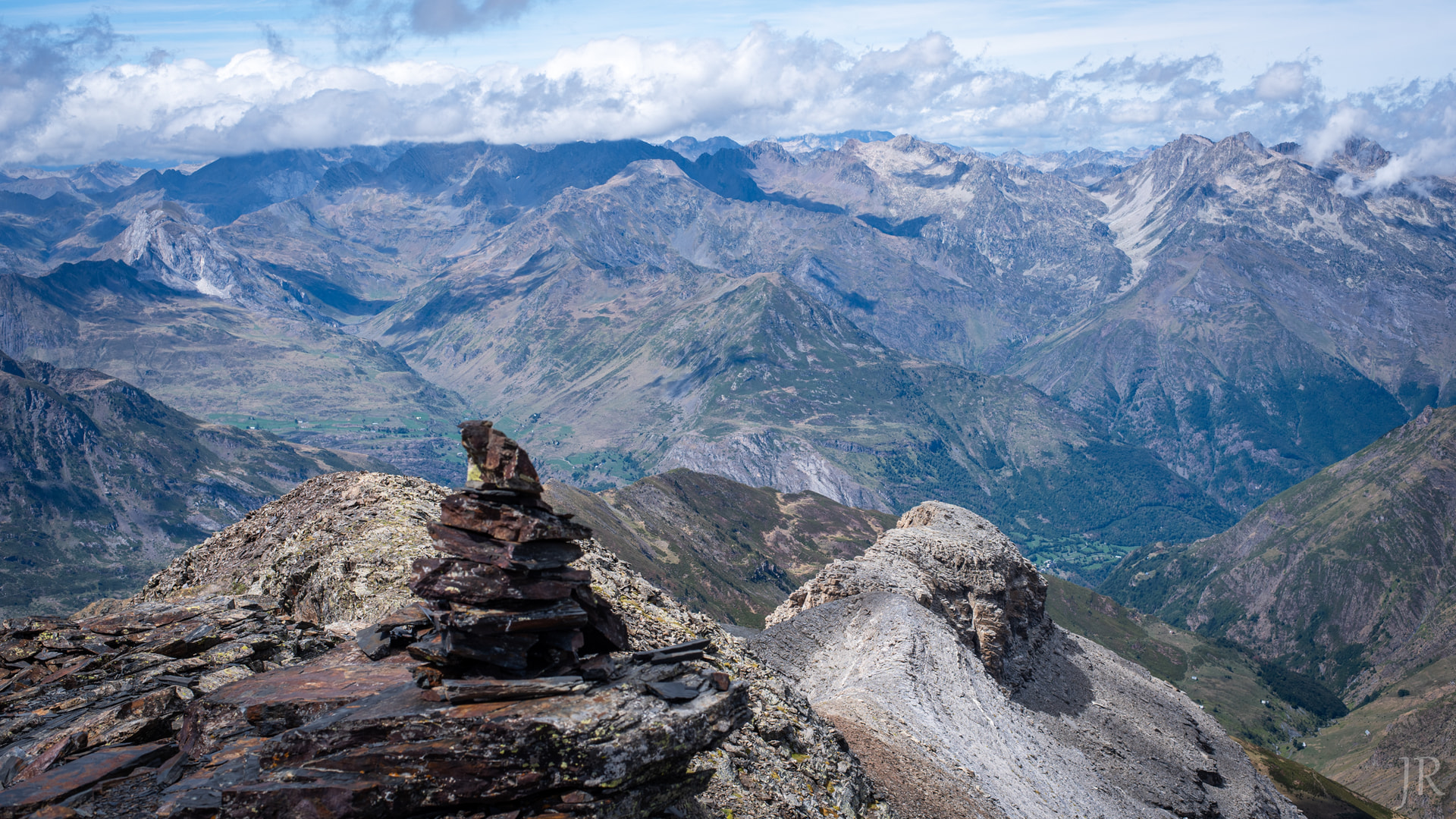
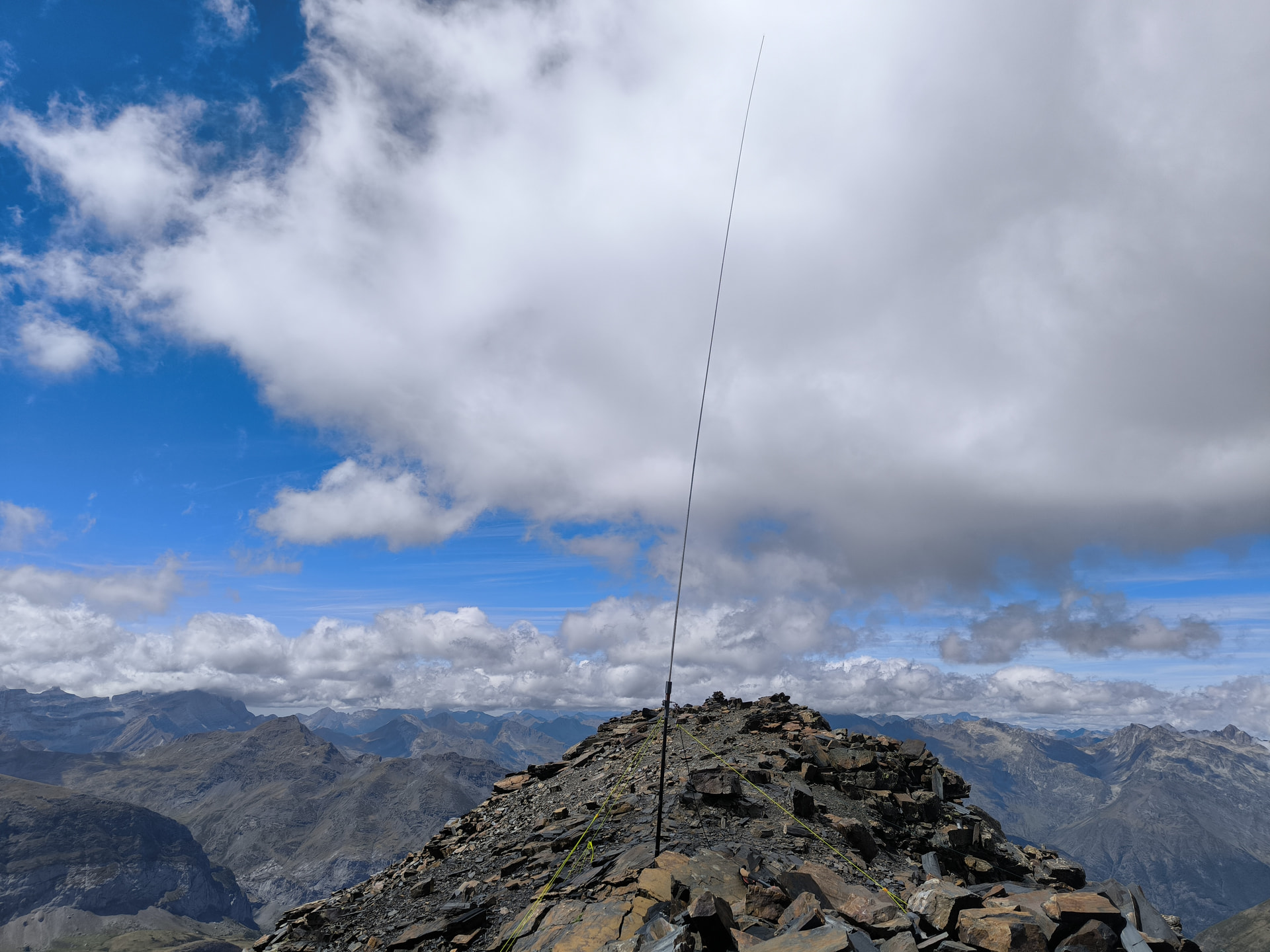
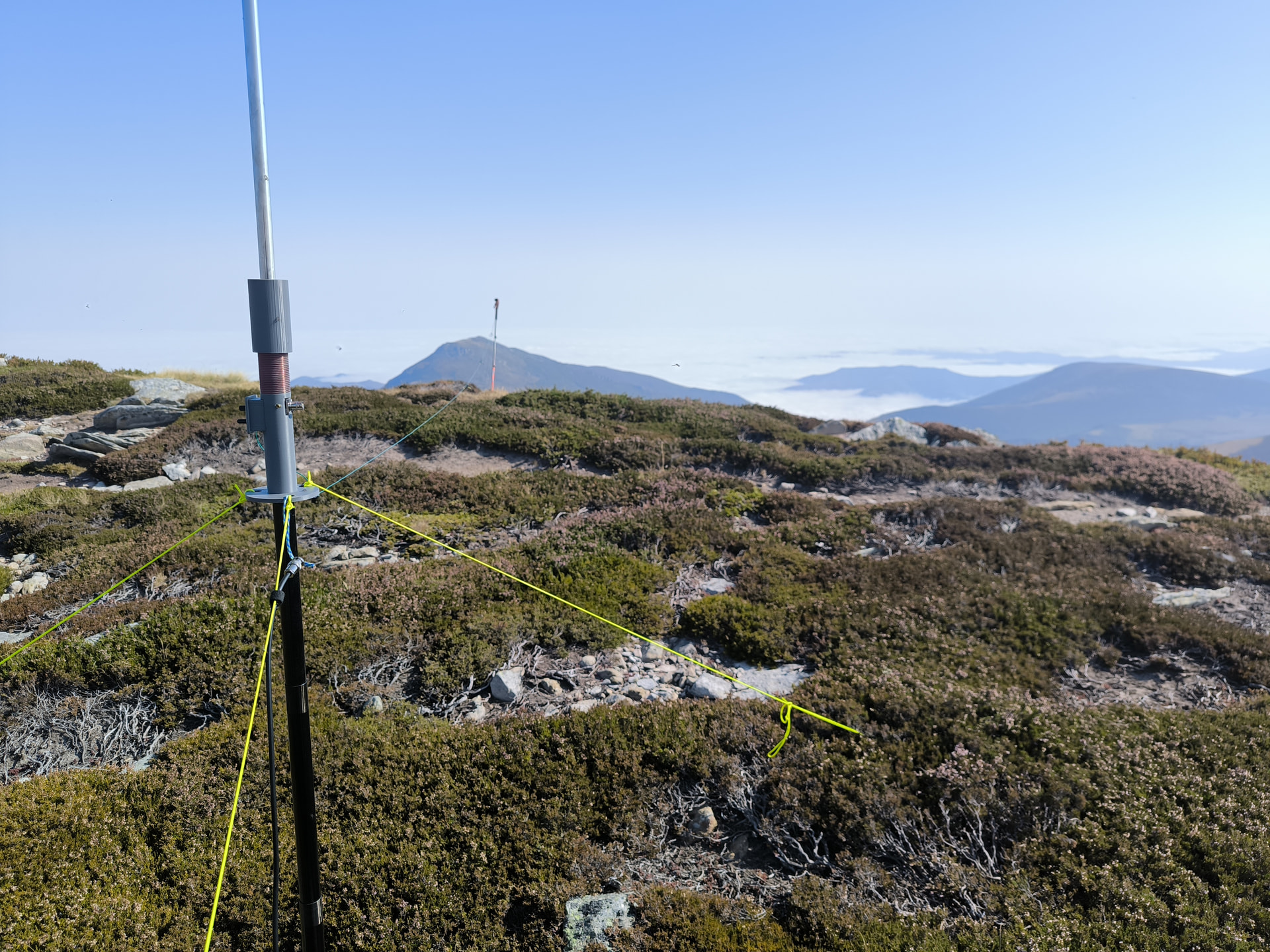
I spent two days exploring the mountains around Piau Engaly. The first day took me to Soum des Salettes, with incredible views over the Cirque de Troumouse and towards Gavarnie. The weather was excellent and the activation went very smoothly. I was particularly pleased with my new lightweight vertical setup, using a 5 m whip with a single elevated horizontal radial. The antenna performed remarkably well and I received some very good signal reports throughout the activation. I prefer it over the normal GP and the multiple radials (details at the end).
I then spent a very comfortable night in the van at Piau Engaly before heading out again the following morning.
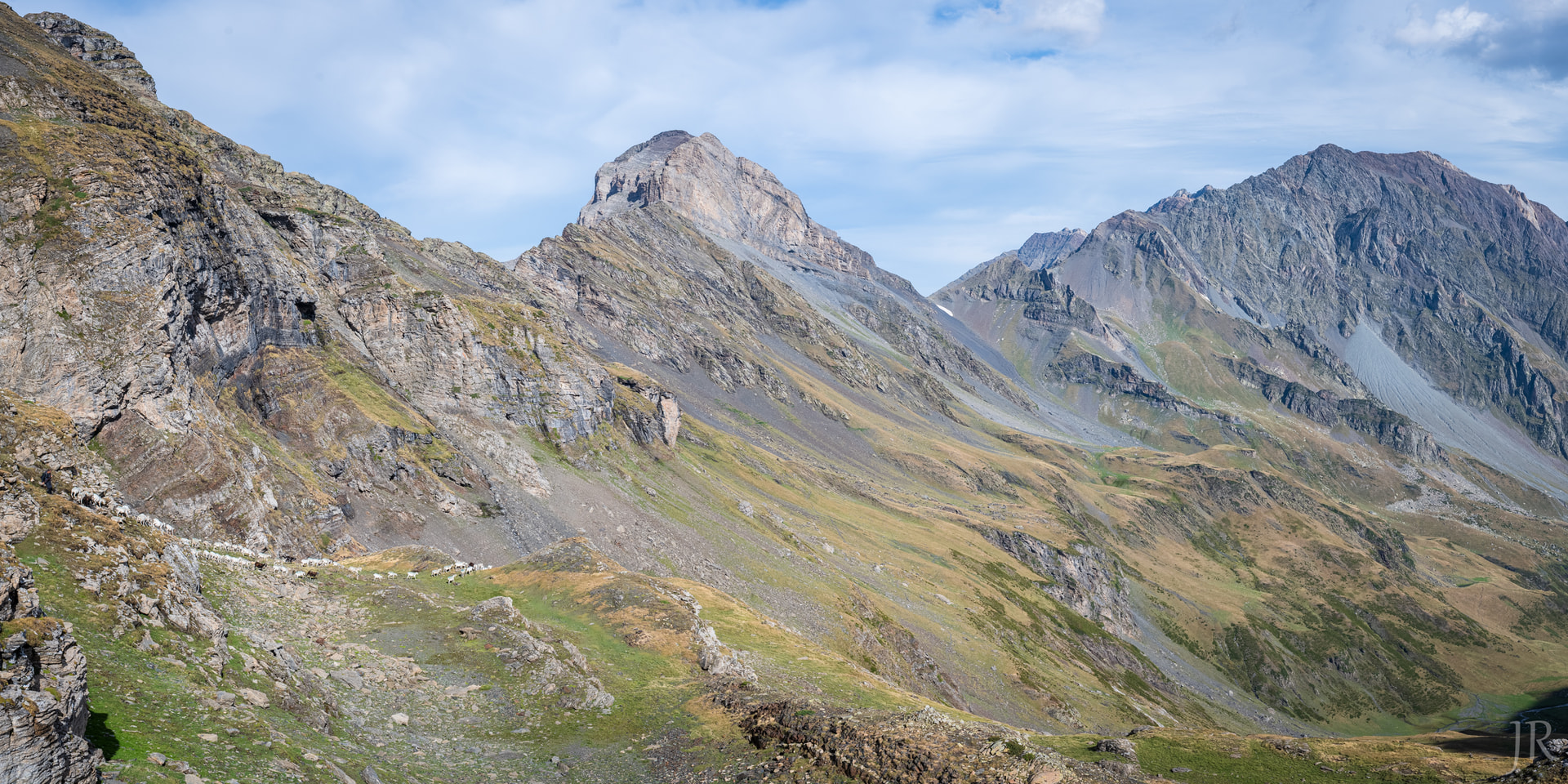
For the second day, I climbed Pic de la Géla via the Hourquette de Chermentas. This time, I had the mountain almost entirely to myself, apart from a shepherd and his flock.
Shepperd going down with sheep, in the center Soum des Salettes F/PO-025 and on the right Pic de Campbieil F/PO-006
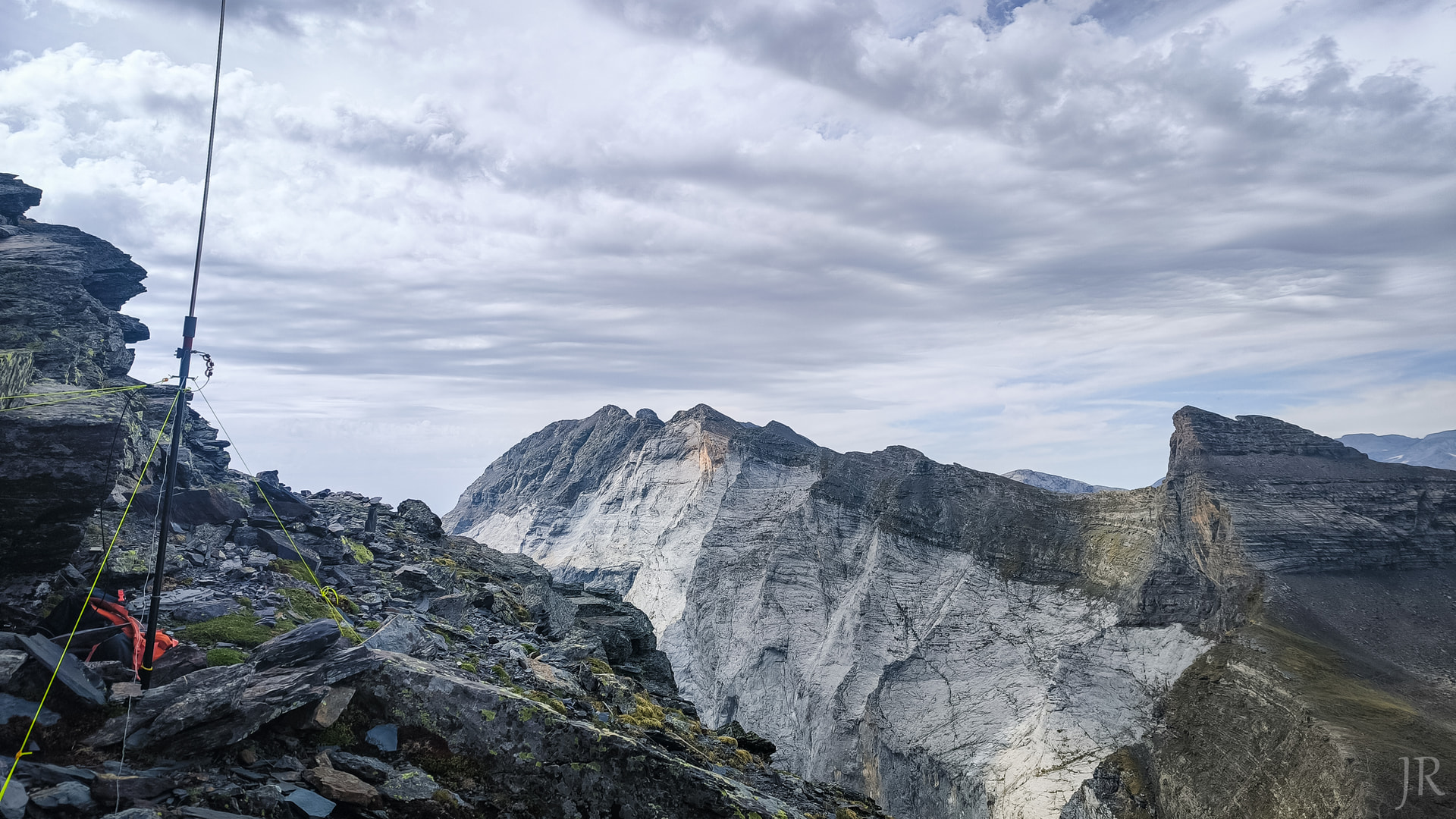
The conditions on the summit ridge were quite something. The wind was absolutely brutal, strong enough that I had to crawl at times to avoid being knocked off balance. Setting up the antenna on the summit was simply not realistic, so I moved down a little and installed it against the cliff, trying to get as much shelter from the wind as possible.
The activation was therefore very short, with only about five minutes on air. Signal reports were understandably poor, given the compromised antenna position and the terrible conditions. Still, getting a few contacts in those circumstances was enough to count the summit activated.
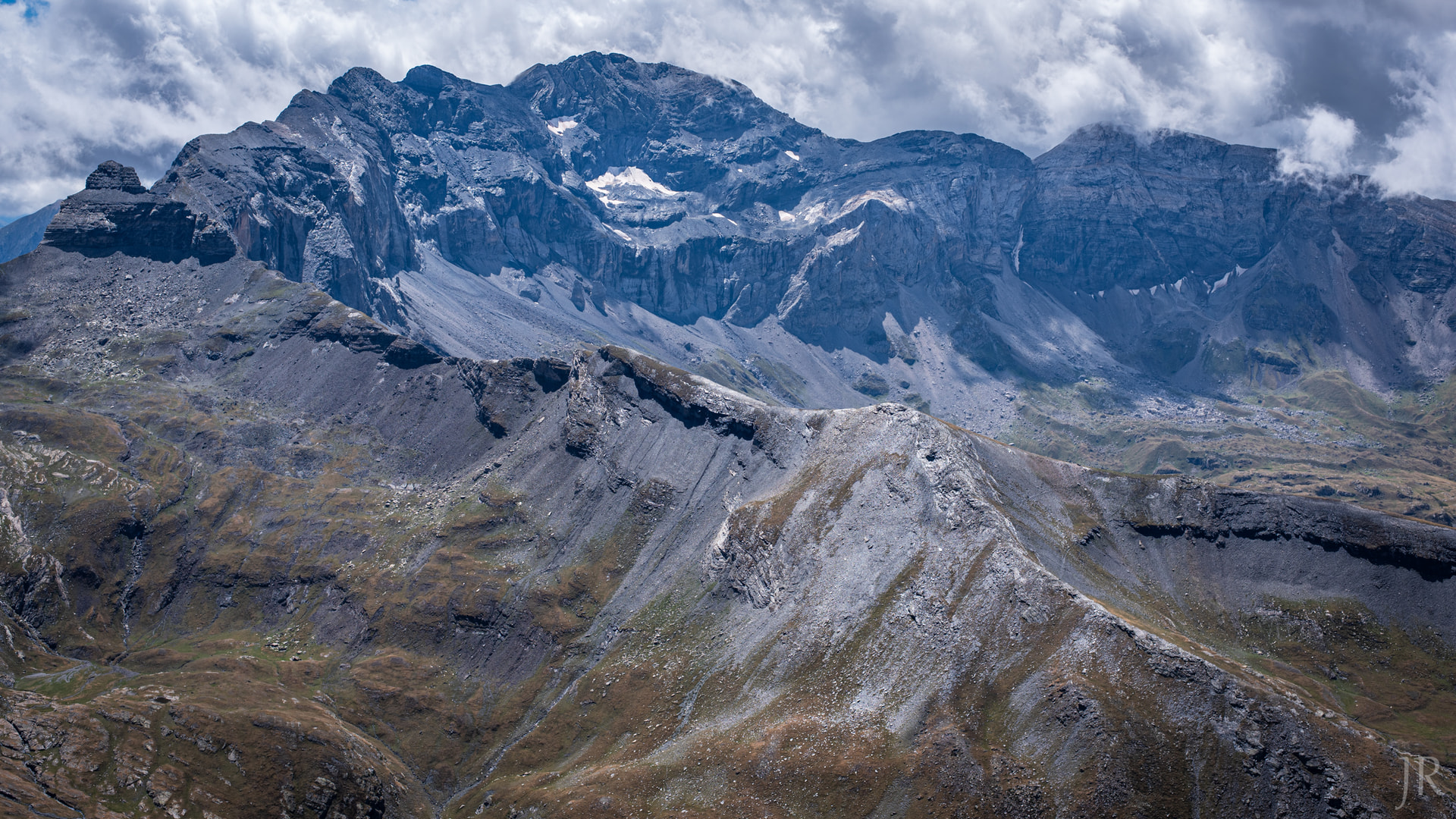
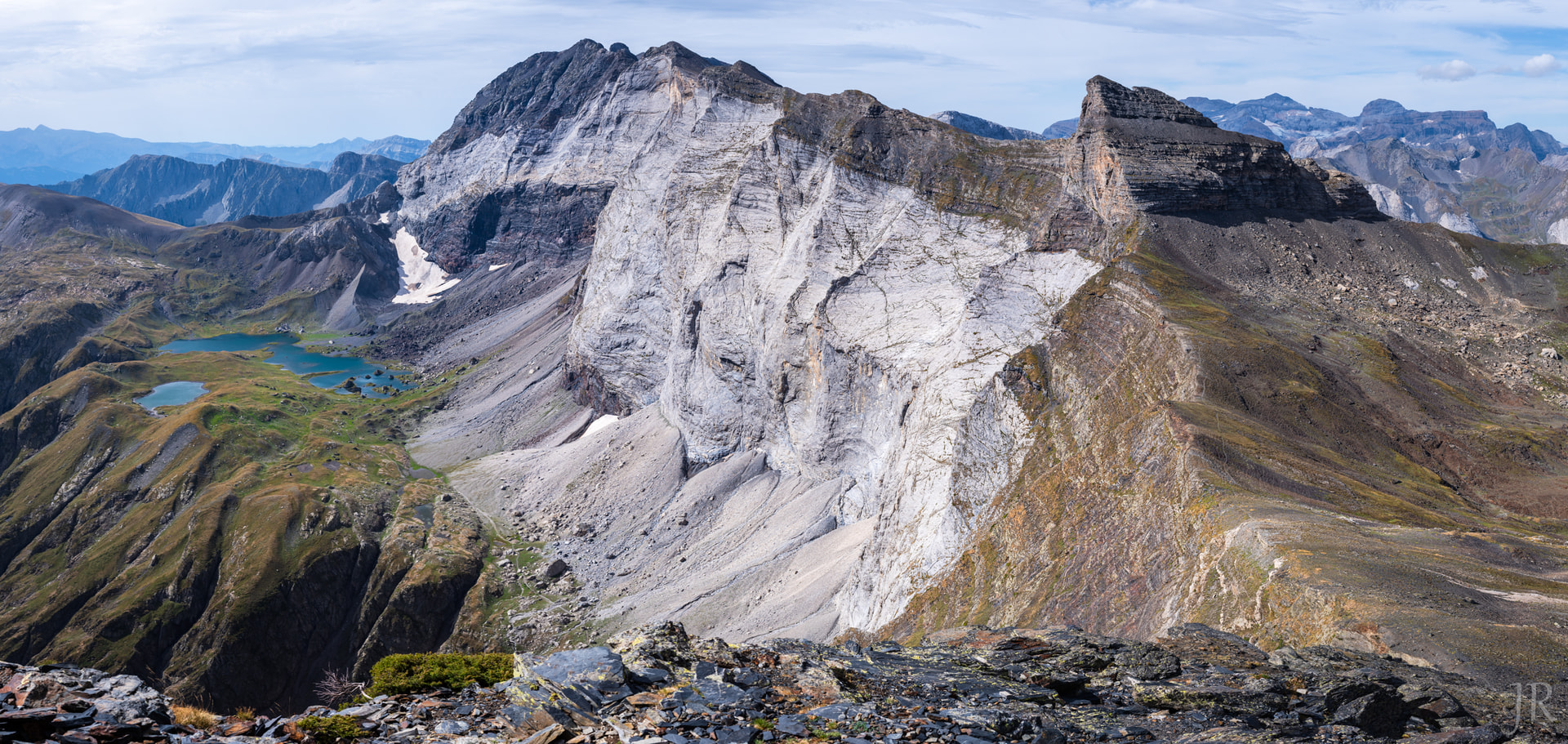
And the reward for the struggle was the view. The Muraille de Barroude looked absolutely spectacular from the ridge.
Thank you, SOTA, for giving me the motivation to break out of my lazy routine and get back into the mountains.
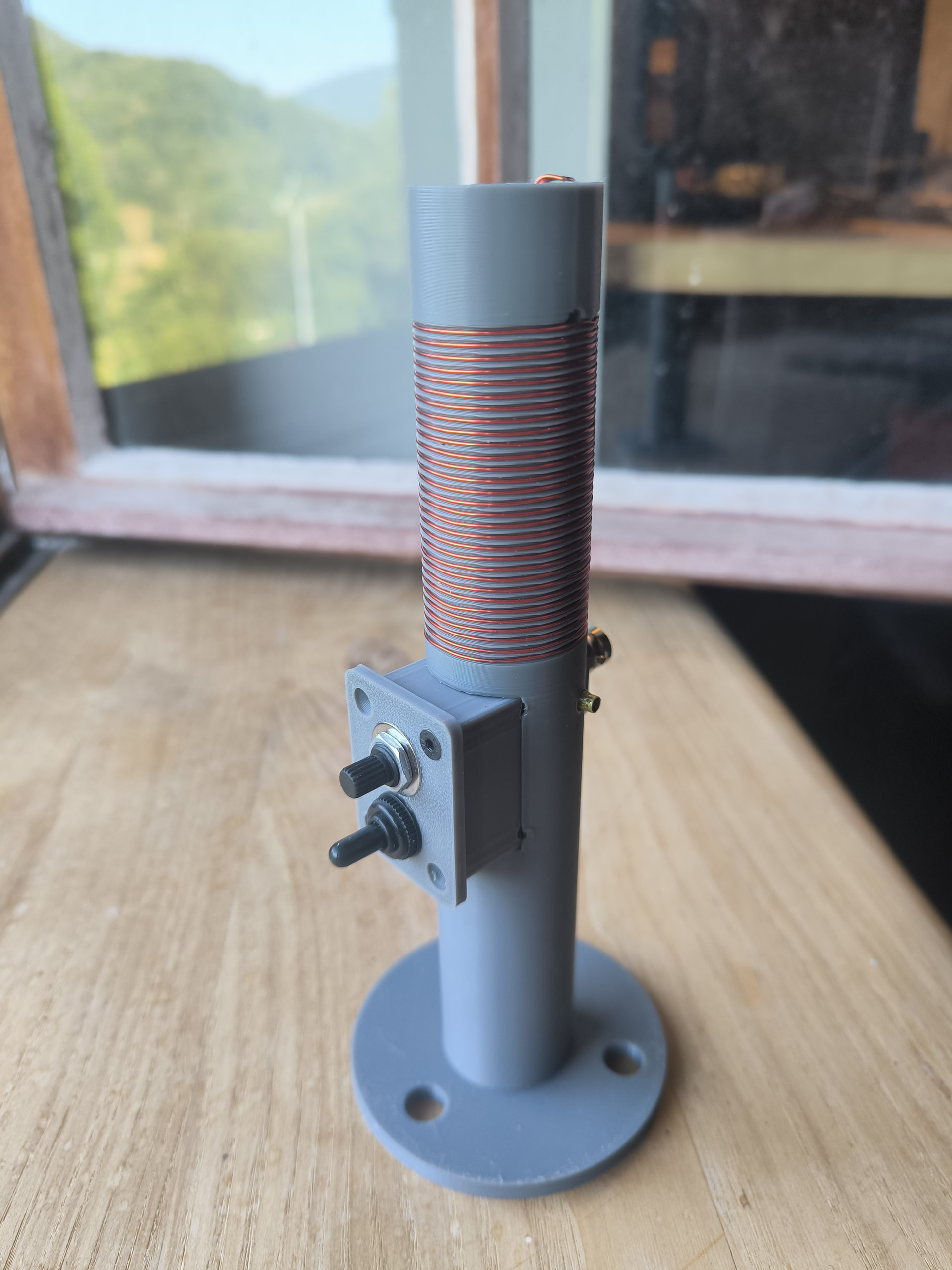
Here are some details of the 3D printed base for the 5 m whip. It contains a coil with a rotary switch to select the appropriate tap, along with a 100 pF capacitor that can be switched in or out. A basic CL tuner.
Combined with a linked horizontal radial, the setup tunes across all bands from 40m and up, and is much less sensitive to ground conditions compared to normal GP.
First of all, I’m very envious of your exploration of the Pyrénées and doing SOTA activations there.
Your choice of an HF vertical makes perfect sense where the rocky summit excludes large ‘footprint’ long-wire antennas and especially given the high winds. Your horizontal radial would have gone some way to compensate for the poor soil conductivity of those rocky summits. The vertical’s low-angle take-off will have got you some good dx.
I don’t use my (Chameleon MPAS Lite) vertical very often but it is well suited for those kind of summits or in very high winds, and performs well on 10MHz and above.
I feel like with enough radials, say 8, you can make a decent ground plane. However, I sometimes find deployment difficult when the feed point is at ground level. On very uneven terrain, having some radials higher than the feed point is hard to avoid, and that can lead to strong RF returns despite having a good choke.
With the elevated radial, none of that seems to happen. The audio is always super clean.
When I first got the MPAS Lite I used a single 16m-long counterpoise wire. After reading that “more short ones are better than fewer long ones”, I changed it to 2 x 8m CP wires, and finally to 4 x 4m wires (in a star shape). I can’t honestly say I have detected an improvement, what with so many confounding factors.
Apparently, a wire length of 0.1λ to 0.125λ for the lowest-frequency band (30m, in my case) is best (so 4m is fine). I know that I could probably improve the ground plane by doubling the number of wires, but it already takes me almost as long to lay out those wires on the uneven ground (unwinding them from a single plastic winder) as it does to erect the vertical itself.
And while I getting and giving good reports (using my KX2 with internal ATU) I’m not motivated to spend more time on summit in adverse weather putting up and taking down the antenna.
The radial is made up of four sections, which I connect using links. I designed it to cover 40, 30, 20, and 15 m. The total wire lengths are 1004, 694, 492, and 336 cm, respectively.
The feed point is sitting on the 4 first sections of my carbon mast, around 1.40 m high I would say. The end of the radial is quite randomly elevated, from 0.50 to 1.30 m, depending on the mood.
So you basically have a dipole, with the radiator element shortened but compensated by the coil, and the radial being a normal leg. A very efficient up-and-outer arrangement. I will try the tuned elevated radial. My arrangement is the radial on the ground, and the reports I get are poor - so I am not using that antenna…
With a single radial lying on the ground, you essentially have a very poor ground plane. A significant part of the return current is coupled into the ground, so ground losses can be quite high, especially depending on the soil conditions.
That’s one of the reasons I’m now experimenting the elevated radial. The return current flows along the radial rather than relying so heavily on the ground, making the antenna much less sensitive to the terrain and soil conditions.
Some years ago, I tested multi band up and outer antennas, extending the radiator and radial with alligator clipped wires extensions. This antenna is really working well, but the tuning of the antenna is really sensitive to the height of the radial, and the quality of the soil. When properly tuned in my garden, a tuner was needed in real sota conditions.
F4LEK, the coil system you showed to enable the adjustment of this up&outer type antenna, is really a clever idea, especially for /p, since this tuning system can easily be accessed. Thanks for sharing. Also, your pictures are showing an amazing landscape. I may need to explore this région.
I’m really not sure about that. The whole concept is to take the ground out of the equation. And in my experience, it worked flawlessly without any further tuning, from the flat grassy ground in my garden all the way up to rocky summits at 3000 m. I consistently got an SWR of <1.2 across all the bands considered.
This is exactly what I found with my Buddistick clone. (Simple 3 band vertical (20m/17m/15m)) Depending on the ground type, vegetation, height of the radial then the tuning would change. After using it for a while I could look at the ground and know if the tuning would match the calibration marks or not. The radial need shortening a lot of volcanic ground (Madeira, Canary Islands) but it was repeatable and predictable.
First of all let me tell you I really enjoy your reports and I consider you an inspiration. We share some common activations, some are only activated by both of us! Like Aygues-Cluses, but you climbed it in the winter time. You published a very beautiful trek report! I took a different route: starting from the famous Tourmalet, camped near Pic de Bastan, activated Bastan and Aygues-Cluses, then back to the campsite. As always, together with my wife and dog.
I absolutely love the north (French) part of the Pyrenees. Is just mind blowing. The valleys are huge, accessible, infinite! And the water… so many green forest, lakes and rivers. I think our part of the Pyrenees (Huesca, Cerdanya, with the exception of Vall d’Aran) is much dryer and no so “vast”. Still beautiful but different.
This summer I was able to climb Pic de Rulhe and Pic de Malcaras. A nice radio and mountaineering summer. Let me recommend Malcaras! The views from the top are so nice… +1250m in just 3.5km though. Not technical but steep. The parking lot is also beautiful. You might know it (Riu dels Orris or something like that).
For small summits I use a lightweight fishing pole (around 4.5m) and a 10m long EFHW. I feel in my comfort zone using this antenna. Otherwise, the QMX sometimes fails with the vertical (many times my dog step on the counterpoise and I needed to reboot the QMX, hi hi).
Please, keep inspiring us with more incredible activations and reports.
(We will try to activate Pica d’Estats in two weeks, you might want the complete
Thank you, Alberto, for your kind words. I really appreciate it.
I also realised a few days ago that you were activating in the region when I was looking at the area around Mont Valier! There are still so many first activations to do! I hope we can share one at some point !
Being able to drink straight from the stream is such a privilege. I usually study the map beforehand and only bring enough water to get past the grazing areas, then I can enjoy the crystal-clear mountain water