Marat your Smena 8M was certainly better than my first camera - A Kodak Instamatic. How great to have a parent that encouraged your interest in photography. It wasn’t until I got my hands on a second hand Exacta 500 that I had any control over exposing film emulsion. I got that camera for primitive astrophotography. My parents would pay for half of anything I could save for my interest in photography and astronomy. It was a good deal!
In my work, I’ve done a lot of color correction on old photographs used in film montages for opening credits of feature motion pictures. Don’t do too much of that anymore, but I still have some tools. Old color film often goes magenta as it ages. Here is my attempt at your picture with your mother:
As others have observed, I am somewhat surprised by the results of this little poll. I would’ve figured that most SOTA folk found mountaineering through an interest in radio and not the other way around.
When I first got my US Technician license in 2002, I would take my little 5 watt handheld up to local mountain tops with an aluminium lawn chair and a copper pipe J Pole that I would stick in a 6’ 1x1. I would tie my funky home brew antenna to the back of the lawn chair and see how far my signal would go.
One day I was on High Peak in Pacific Palisades grooving on the fact that I was making contact with San Diego on 2m when a radio buddy - an elmer really - came on frequency and said “Hey, if you get a kick out of 2m DX you should really upgrade to a General class license and get on HF radio.”
I vowed then and there to learn CW (then required for a General) and upgrade.
[Quote British Museum] This rhyme was first written down in 1820 and – you guessed it – it’s about a muffin man working on Drury Lane, found in London’s West End. Some Victorians worked 12 hours a day with only Sundays off, which didn’t leave much time for cooking. Few had kitchens and cooked on open fireplaces, which was hot and smoky. Many people chose to buy food from street sellers instead. The muffins in the rhyme are a bit like modern English muffins – a type of bread and not the fluffy cakes.
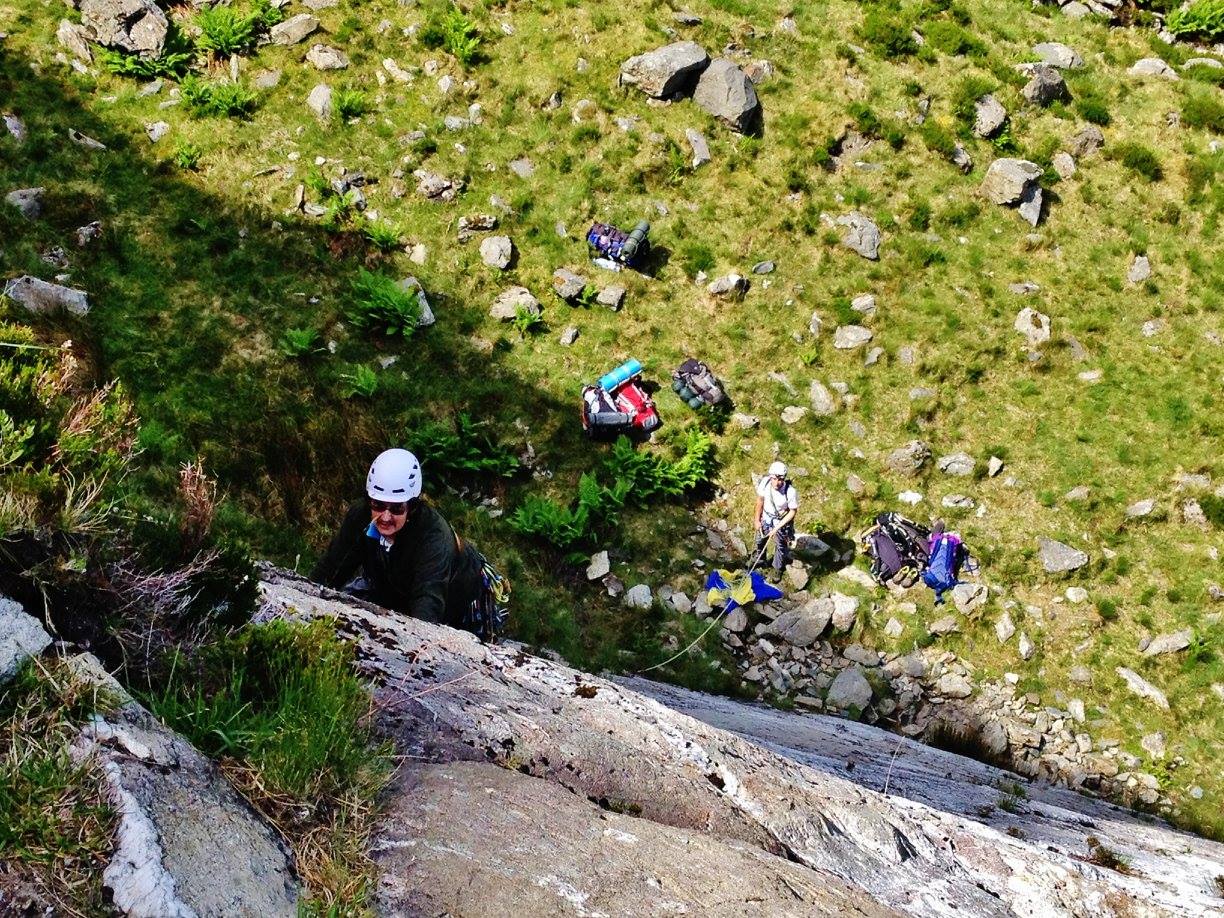
Started Rock Climbing at University and was out pretty much every weekend up in the Peak District and a bit of North Wales. Really pushed my climbing grade too! Got up to HVS (Hard Very Severe). Was interested in Shortwave listening at the time, so when I was still at University I started to study for the Foundation Licence. Not been rock climbing for at least 10 years now, most of my climbing friends have moved away. Would love to do it again but haven’t got much time for anything at the moment!
Dom, I grew up reading about the exploits of Whillans and Brown and Bonnington. When we finally graduated from swami belts my first real sit harness was a Whillans. Those guys were probably long before your time, but their books gave me a real taste of how you did it over there back in the day.
Whillans, Brown, and Bonnington were way before my time! Met the Welsh Climber Eric Jones at his Cafe in Wales on one of our climbing/camping trips. Been watching documentary’s on some of the early Climbers doing the high altitude stuff recently. North face of the Eiger etc. Great days.
I did a climb in the Lake District about 40 years ago. Bonnington was on the same route. He dropped some gear on the first pitch and shouted down to ask us to put it in his rucksack… never seen such battered old carabiners!
I find it some how heartening to be reminded that sometimes even the pros make goofy mistakes like I do.
I’ve had a few brushes with climbing royality. Rick Ridgeway spotted my sister on a beach in Malibu and asked her if she wanted to model for this little startup company’s catalogue. She had no idea who Ridgeway was and was used to fending off these kind of advances, but something about the name of the company prompted her to take his info.
Ended up that me and my then-girlfriend got to spend a weekend at Joshua Tree climbing with Rick and shooting a few pictures along the way. Very funny guy.
I guess I overlapped with them, but missed out pn the pre-war greats. The routes put up by the various generations of great climbers remain, we can follow them and get an insight into how they solved problems - and try and imagine how the routes looked in their pristine condition, greasy, vegetated and with plenty of loose rock to be removed! Some of those early routes are so polished by the passage of hundreds of later climbers that they may well be harder than when they were first climbed!
I climbed a few Joe Brown routes on various visits to the Peak. Valkyrie (HVS) at Froggett Edge is as hard as I’ve climbed at the grade. So, I’m going to suggest Brown used brute force to solve problems!
My favourite has to be Great Northern Road at Millstone. Also HVS, originally an aid route, but freed by Brown. It must be one of the longest routes in the dark peak.
I did some climbing in the white peak too. Wasn’t so fussed for the limestone. The gritstone is something else!
Derbyshire used to be my local go-to climbing area as I was born andf bred in Nottinghamshire. I was often out with a friend on Stanage Edge or one of the other crags and once met Chris Bonnington leading a group. Of course, as with many things, it all came to a halt when I got married,
I don’t think I’ve ever felt so queasy reading a thread! My legs stopped working anytime I got within one metre of the edges part way up Little Orme yesterday as we watched the seals.
Can’t believe I’ve never explored Little Orme before yesterday. It’s much nicer than Great Orme GW/NW-070. But no reference of course!
I read quite a bit of Whillans’ and Bonnington’s writing back in the seventies, but mountaineering was never more than a theoretical interest. Scrambling is OK, but go past a certain point and the vertigo hits me. Always enjoyed walking up hills occasionally, though, so I guess that came before the radio.
I remember as a small child seeing the odd bit of climbing in feature films and it, being in a film, meant it was often dramatic and full of tension. Then I remember the amazing live OB the BBC did from The Old Man of Hoy as it was climbed for the second time in July 1967. OT: It’s worth reading up just how incredibly involved it was to send live video from Hoy to I think Glasgow where it could be carried over the existing networks. 9 separate uWave links, all Klystrons and such, huge generators and mobile towers to be got to remote parts of Scotland. Nearly 60 years later it’s hard work driving to some of these places so then it would be much more “fun”. I was glued to this watching them make their way up. Till I realised it took a long time to do not much. Now that’s because never having done it, I don’t know what’s involved.
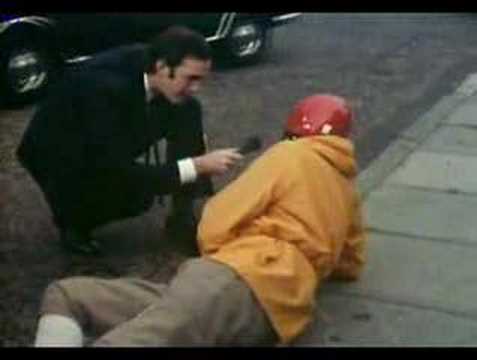
But since then I’ve never had the desire to climb, with or without ropes, up cliffs or whatever. Now I have seen some amazing examples of physical strength and agility and amazing views of people apparently glued to rocks like Spiderman. It’s just not for me. And it’s not helped by a certain skit from 1969 by a certain G. Chapman and J. Cleese. Possibly one of the most accurate yet silly parodies there are.
Whether you are climber or not, you have to admit it’s a nearly perfect parody.
I used to shy away from all forms of exposure when walking but having done the bad step on Quinag last October maybe I’m cured. Especially as I had to do it both down and up. I think it was worse going up. Still, a reason for bonus chocolate to calm the nerves!
As I mentioned before, hillwalking and radio have always been things, right back to the pre-4 ages that are before when memories generally start! I remember getting a clock radio for my 8th birthday and being thrilled to be able to find BBC Radio Manchester, Piccadilly Radio and Radio Luxembourg on it. I remember listening to The Grumbleweeds on Radio 2 on a Bang & Olufssen portable with my mum and dad on camping holidays in West Wales in the 70s. The same holidays on which I would hike public footpaths all day with my mum. Back at home, my dad took me for early morning expeditions up Teggs Nose and Shutlingsloe.
In pure amateur radio terms, I guess the radio came first. I was licensed in 2001 aged 30, and discovered SOTA in 2002 aged 32. Jimmy @M0HGY had been tagging along on all my hikes until he got licensed in 2005, so I suppose the walking came first for him!
That all said, for a decade or so before SOTA and amateur radio came into my life, I had been taking my radio hobby into the hills several times every week. I was driving up to high points with a good take-off to listen for DX FM broadcast stations (community stations, pirates from Dublin or Birmingham etc). I then started taking a portable short wave receiver out with me and stringing bits of wire from my car to a footpath signpost and trying to RX DX broadcast and amateur stations - Antarctica, South America, USA etc.
When Alan @M1EYO (SOTA’s 1st ever Mountain Goat) contacted me to tell me about SOTA, it seemed such a natural thing for me to do - a mere variation on what I had already been doing for nearly half my life! But that’s when I started learning about how to do hillwalking properly, and how to do amateur radio properly!
Whether or not the step on the (easier) South ridge of Tryfan counts as a “bad” step, I doubt - but nonetheless it was bad enough for me (in the down direction) to know that I am not cured!