This is the key point, what gets logged is what the activator heard the chaser’s call to be, not what is decoded, so decode ambiguity is avoided. The realtime clock timestamps the record in memory.
This feature could be added to many MCU-based rigs, as long as the MCU includes USB for downloading the data file, or, even Wifi, in which case the radio could be ‘queried’, but I think the latter is beyond a low power MCU. Can you transfer ASCII / text data over a Low Energy Bluetooth link?  (The answer is ‘yes’).
3 Likes
I thought that was just me. How can I be able to communicate with others if I cannot send a simple CQ was my first thought. After 20-30mins I gave up and used the USB lead to program the memories.
@K7GUD I might have misunderstood your point. If your comment is about the recording of internal memories from the paddles, this of course is likely to be similar to what is logged when recording a QSO.
However, for the limited number of KX2 logs I have seen so far, I could not notice major issues, except maybe many spaces between characters (and this could be an issue when recording memories).
I suggest you give this experimental KX2/KH1 log decoder a try. This would allow us all to make our mind about the usefulness of the internal TX logging 
1 Like
FYI: I posted a video yesterday performing a POTA activation with the KH1. It was a true trial by fire for the wee KH1 speaker, but it was a success.
Here’s the field report: My First POTA Activation with the New Elecraft KH1 Handheld QRP Transceiver! | Q R P e r
Also, I hope to activate W4C/WM-003 around 15:30-1600 UTC today, if the stars align. I’ll be using the KH1 and its whip on 20M and, if time, 17M.
Best & 72,
Thomas
K4SWL
8 Likes
No it’s not just you having trouble recording CW memories using the paddle. When I first got my KX2 and tried to record a memory message using the paddle, the recored message was always incorrect. I thought there was something wrong with my radio. I contacted Elecraft support and this was their response:
Hi Pat,
Thanks for contacting Elecraft.
Entering CW memories using the paddle interface is a skill acquired over some time.
The precision of code elements is severe, and inflicted by the mercilessness of the microprocessor in the radio.
It recognizes your CW as smaller elements/characters when you are sending larger element letters.
For example C .. is perceived as _ ._. or TR
Q _ . is perceived as _ _ ._ or MA
We encourage you to keep up the good fight and keep practicing, and if necessary, use the KX2 Utility, Windows version linked here, to program the CW memories with a keyboard and computer.
We want you on the air,
Doug
Elecraft Customer Support
Also, I found a thread on KX2 / groups.io about trouble recording CW memories. One suggestion was to turn the keyer speed to around 12 WPM. That seems to work. But I don’t want to activate a peak at 12 WPM so the logging feature is useless. You’d have to send “machine code” for it to record correctly.
So now, I try to use the KX2 utility to record messages before I go out in the field. If I forget, I just send the summit reference manually because it takes too long to record it correctly.
1 Like
What’s strange is it seems to do a better job decoding off air. Glad it’s not my sending, which is hardly stellar anyway!
1 Like
Pat, I did quite a bit of testing and submitted logs for Christophe to use for developing his parser. I really didn’t have much trouble sending calls that were correctly decoded by my KX2. Timing is everything.
I think we all develop our own timing after years of sending code (our ‘fist’). Very often I can identify who I’m hearing before I ever hear a callsign. Sending code that the KX2 can understand is like speaking with a different accent - it takes some practice, but it can be done.
I really like the concept of electronic logging by capturing the outgoing text. I will definitely be trying it out (and keeping a paper log!). My goal isn’t to eliminate paper logging, but to reduce the post-activation data entry work. My workflow would be:
*Connect rig to USB cable and copy the log that was captured
*Paste it into Christophe’s parsing webpage
*Copy the output into a text file and then compare to paper log and make corrections
*Upload to SOTA Data
If I can manage to send the chaser’s callsign cleanly, it will save me typing it in later. And the KX2 automatically inserts the times and bands, so that is more stuff I don’t need to type in later.
73 de WU7H
5 Likes
OT:
When I got my KX2 last May, I could not get the Windows version of KX2 utility to work over USB. I do USB software for a living so I was somewhat annoyed. Downloaded the Linux version, just worked. Today my Linux laptop is on the fritz (often wont boot, but once running stays running, I think there’s a dry joint to the BIOS EPROM, it’s 10yrs old and owes me little). I installed the KX2 utility on the Win10 PC and it just worked. Not sure if it’s a new version since I last tried but hey, go figure. So I can configure CW memories now.
2 Likes
I have used KX2 internal logging for a few years and it does work, although I now prefer VKportalog on phone. But I will continue to use internal logging in poor weather, which is quite often in GM!
The converter by ON6ZQ is an excellent tool, but does and always will need some manual corrections. The KX2 internal keyer is not the best and as other have said very timing critical, its hard to get your sending perfect on a simple little key like the Palm Pico which I use. I tried it today with my shack Begali Sculpture paddle and was much better. But thats a precision key.
So people can see what the internal log looks like and the limitations, here is a snip I shared with Christophe.
1046C7.01047
OM7ZM OM77 M 5NDBK ON7ZM 5NN OK ON7GO ON7GO 5NN TUGM0GAV/P GO ON7ZM ON7GO
1048
BKG4OBKGMPHIL5NNBK OKTNXCU GM0GAV/P F4WBN F4WBN5NN TUGM0GAV/P OK G4OBK F4WBN
1049
2 PDT OK2PDT5NN OK2W T ? OK2PDT 5NNBK TUEE DK1EMI GMED 5NNBK TOK OK2PDT DK1WI
1050
CU GM0GAV/P DED3NM DED3NM5NNBK OK73 GM0GETV/EG GHT G4? G4EMTF G4 DL3NM G4WTF (GM0GAV/P!!)
1051
WTF 5NNBK OK73TUGM0GAV/P DEO2MXGM MAENIO5NNBK OK73TUGM0GAV/P F6 DJ2MX
1052
I F F6 E K R F6 E KR 5NNBK OK73GM0GA4/EG I E I 5 H E E I 5 H J F6EKR EI5HJ
1053
5NN BK OK E I 5 H JIZ RRTUEE ON3YB ON3YB 5NNBK OKTU GM0G AV/P G4 ON3YB
1054
Y T K GHT YT K 5NN G4 Y T K TU GM0GAV/P 2E 0 AGB 2E0 AGB 5NN OK G4YTK 2E0AGB
1055
73TUGM0GAV/P HB9CLT HB9 CAST 5NN OKTUGM0GAV/P M0 M 0 ? OK M 0 O HB9CLT
1056
The C7.0 at the start is 40m CW, then a time stamp. The correct callsigns worked after manual correction are in Bold Italic. You can see my problem, errors but significantly I am not forming some characters fast enough and they are being decoded as two characters.
I use a Winkey 3 in Iambic B at home, tested with my Palm Pico. The Winkey Echo which prints back what you send, was near perfect at 28wpm. Ok thats in a warm shack, but I think the winkey does a much better job.
Perhaps Elecraft needs to buy some Pic code from K1EL
73 Gavin
GM0GAV
4 Likes
For illustration, this is what the converter produces from the above log:
# Fast Log Entry (FLE) log template created by ELECRAFT2FLE ( https://www.on6zq.be/w/index.php/SOTA/ELECRAFT2FLE ) on 2023/11/03 17:57:12 UTC
# FLE format reference: https://df3cb.com/fle/documentation/
# FLEcli Multi-platform FLE processing tool: https://github.com/on4kjm/FLEcli

mycall     GM0GAV/P
operator   GM0GAV/P
# mygrid   AB12CD
# mysota   AB/CD-123
# mywwff   ABC-12346
# mypota   A-1234
# nickname Home QTH
# qslmsg   Please QSL via bureau

cw

2023-11-03

########################################################################################################################

### 1046

### 0104

### 7 OM7ZM OM77 M 5NDBK ON7ZM 5NN OK ON7GO ON7GO 5NN TUGM0GAV/P GO ON7ZM ON7GO
0104 OM7ZM
0104 ON7ZM
0104 ON7GO

### 1048

### BKG4OBKGMPHIL5NNBK OKTNXCU GM0GAV/P F4WBN F4WBN5NN TUGM0GAV/P OK G4OBK F4WBN
1048 G4OBK
1048 F4WBN
# HIL5NNB

### 1049

### 2 PDT OK2PDT5NN OK2W T ? OK2PDT 5NNBK TUEE DK1EMI GMED 5NNBK TOK OK2PDT DK1WI
1049 OK2PDT
1049 DK1WI
# OK2W
# DK1EMI

### 1050

### CU GM0GAV/P DED3NM DED3NM5NNBK OK73 GM0GETV/EG GHT G4? G4EMTF G4 DL3NM G4WTF (GM0GAV/P!!)
1050 NM5N
1050 DL3NM
1050 G4WTF
# DED3NM
# DED3NBK
# GM0GET
# G4EMT

### 1051

### WTF 5NNBK OK73TUGM0GAV/P DEO2MXGM MAENIO5NNBK OK73TUGM0GAV/P F6 DJ2MX
1051 DJ2MX
# OK73TU
# DEO2MXG
# NIO5NNB

### 1052

### I F F6 E K R F6 E KR 5NNBK OK73GM0GA4/EG I E I 5 H E E I 5 H J F6EKR EI5HJ
1052 EI5HE
1052 GM0GA
1052 F6EKR
1052 EI5HJ

### 1053

### 5NN BK OK E I 5 H JIZ RRTUEE ON3YB ON3YB 5NNBK OKTU GM0G AV/P G4 ON3YB
1053 EI5HJ
1053 ON3YB
# GM0G

### 1054

### Y T K GHT YT K 5NN G4 Y T K TU GM0GAV/P 2E 0 AGB 2E0 AGB 5NN OK G4YTK 2E0AGB
1054 G4YTK
1054 2E0AGB

### 1055

### 73TUGM0GAV/P HB9CLT HB9 CAST 5NN OKTUGM0GAV/P M0 M 0 ? OK M 0 O HB9CLT
1055 HB9CA
1055 KM0O
1055 HB9CLT
# 73TU

### 1056

########################################################################################################################
# 2.31 seconds
1 Like
Wayne just said in an interview on YouTube this morning that the KH1 logging format is going to be easier to parse than the KX2. So, it won’t be the same as the KX2.
4 Likes
My ‘field test’ KH1 arrived a few days ago, and I have been dying to take it out. Unfortunately I have been busy with work, so the best I could do was a little KH1 play in the shack in between meetings. I have family stuff going on Sunday, so TODAY was my day. The WX forecast was grim: our National Weather Service (NWS) had an advisory for high winds, 100% chance of heavy rain, and a chance of thunderstorms. I looked at the KH1 and it said “screw the WX, let’s go!!!”. So we went =)
Darryl WW7D went with me. We decided to hit Squak Mtn W7W/KG-122 because it is close to us and a fairly short hike. The trail was a river. The NWS nailed that WX forecast! We arrived on the summit and quickly put up a tarp. I screwed the whip on, tossed out the CP, and we were QRV! Our first contact was an S2S with @KX0R in CO on 20. We also had S2S contacts with: @AA7OY in AZ, @K6EL in CA, @W7CBR and @W7SKH in AZ, and @W5RST in OK.
While I was taking a run on 20, DJ put up his trapped doublet (which was designed and built by Rich AC7MA, using twisted pair feedline) and we used it for some runs on 30/40. I had to stop a few times and put the KH1 in my pocket because the rain was so heavy that I couldn’t hear anything. When the lightning started up we decided it was time to QRT!
It was a pretty short activation due to adverse condx on the summit, but between us we got 11 QSOs on the whip and a total of 23 QSO (5 S2S). One QSO with France (thanks @F4WBN) on 15.
Fun little radio!
-Josh WU7H


16 Likes
awesome report, looked wet and rather fun still. I was listening for you guys but couldn’t hear anything in my shack s9+++++++ noise s3 attenuated. but look forward to hopefully hearing you guys on my next one. I do have to say the esthetics of that KH1 are not growing on me its ugly as hell, but I can’t deny all the field reports all saying how awesome it is to use.
73 de VE6JTW, Jesse
It really suits our style of activating… we almost never sit down because of: rain, snow, mud, bugs, etc. The form factor is really great! I don’t love the paddle, but I’m getting used to it and it works just fine. It uses sealed microswitches, so it shouldn’t develop ‘dirty contact’ problems like some of my other paddles. It’s not painted black, which is GOOD… I suspect it won’t overheat in the summer. My pack was so light this morning when I was leaving, I had to stop and make sure I wasn’t forgetting something important.
5 Likes
Being light is most of the battle!
1 Like
There is already information about the circuit structure of the KH1?
Because of the reference to a adjustable cristall filter, I suspect that the KX1 was used as a basis.

73 Chris
2 Likes
new SOTA #Activation Video with KH1
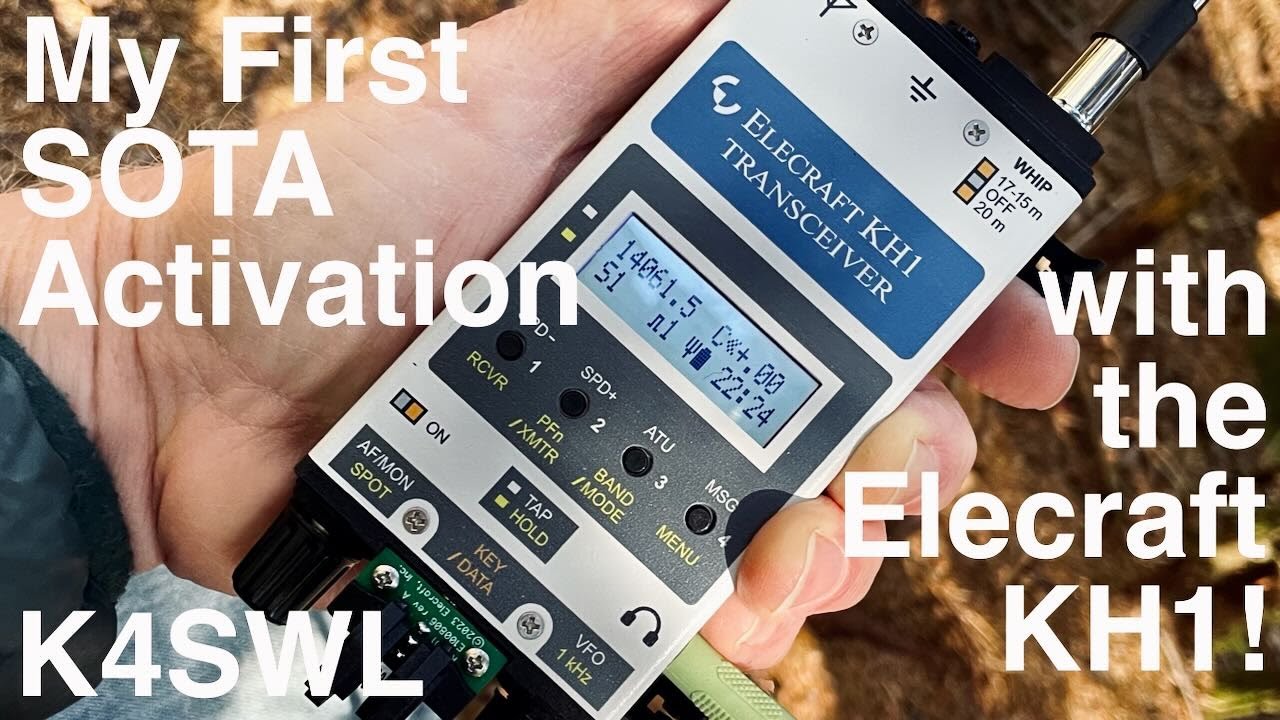
and
73
klaus
oe6kyg
2 Likes
I believe Wayne mentioned in his talk at Pacificon that he drew a lot of ideas for the KH-1 from his KX-1, and that they (Elecraft) had received lots of requests over the years for them to bring back the KX-1. So guessing you’re right in that he used the KX-1 for initial ideas. Think he mentioned too that the KH-1 was on it’s 30th or more revision since he first came up with the concept. Guess he’s been working on it for a couple of years now 
73, Todd KH2TJ
1 Like
Has anyone opened up and photographed the KH-1 circuit board?
Would love to know what is used in lieu of the venerable NE602 given the superhet design and belief it’s probably “built/draws inspiration”
on the KX-1
2 Likes

