The title could also be ‘How I struggled with my first SOTA activation in Japan and received useful advice for the next one’, but I will talk more about that later.
With reference to Visit to Japan - Kanazawa in May, I will share some cultural and SOTA impressions from Japan, which I am visiting for the first time.
Fortunately, thanks to the help and advice I received from my partner, who lived in Japan some time ago, I didn’t have to start from scratch.
Shinto Shrine and Akihabara in Tokyo
The day after I landed in Tokyo, a visit to Akihabara was high on the priority list. In this district, you can find all kinds of electronics, as well as manga, anime and all kinds of vintage stuff these days.
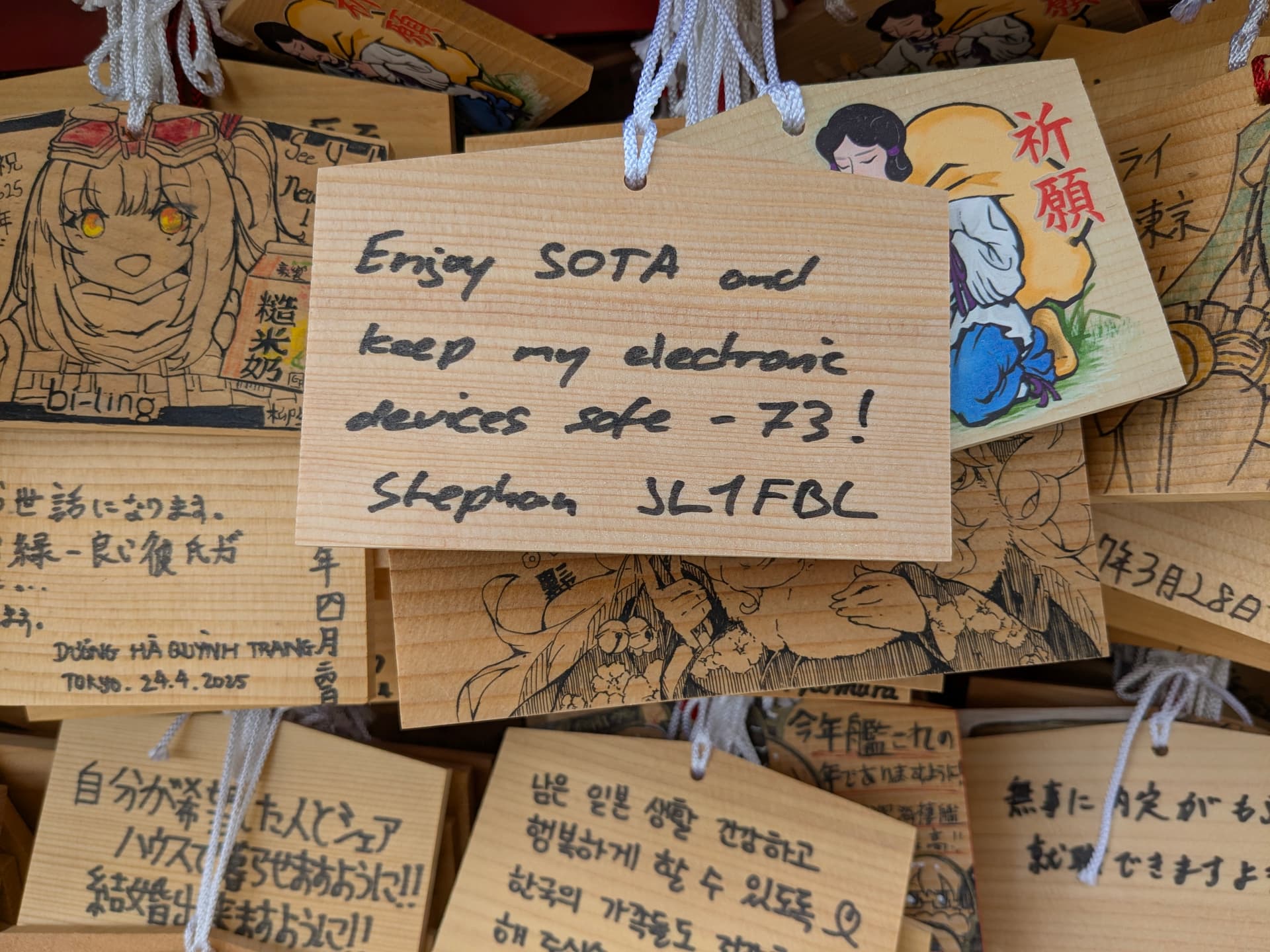
However, before visiting the electronics mecca, my partner directed me to a nearby shrine called Kanda Myojin, where I could receive a blessing for all my electronic devices. What a useful and great idea! I followed the protocol to the letter (purifying myself, throwing a coin, bowing, clapping twice, making my prayer and bowing again).
The highlight, though, was buying a votive picture tablet on which you write your prayer, called an ‘Ema’ (see below).
After all the blessings, it was time to head to Akihabara and look for treasures! The first shop I visited was the well-established Rocket Ham Radio, which sells Japanese ham radios and related items (see below).
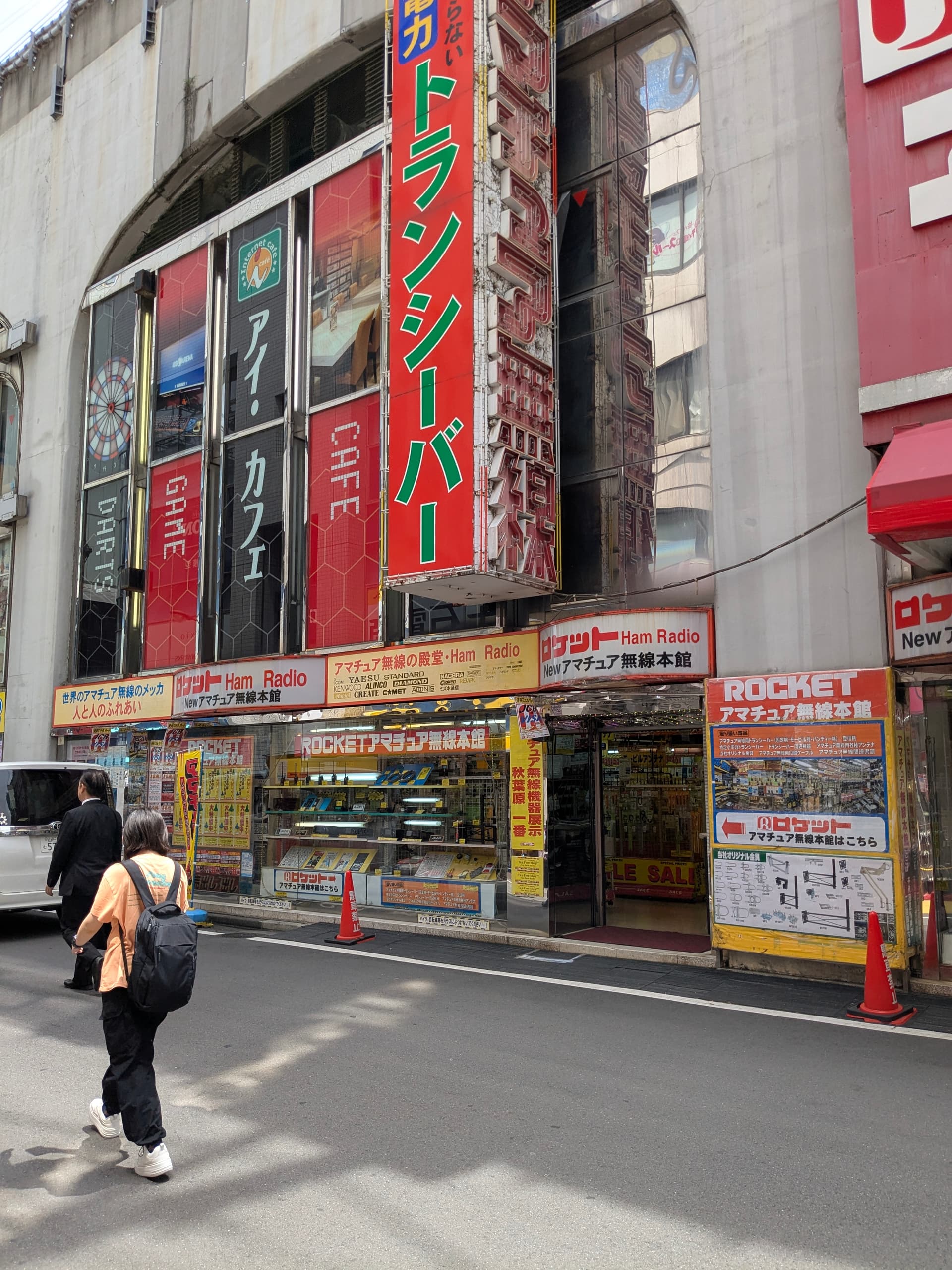
In Japan, ham radios are severely locked down, so I was only interested in a 2m/70cm handheld radio with the same frequency range as in Europe. As direct-conversion handheld radios, such as the FT-2DE or FT5DE that I own or have owned, are useless on many Swiss summits, when using with an antenna better than the original rubber duck antenna, I was interested in a more robust (in terms of reception) handheld radio.
Note that the Swiss pager network transmits on 147 MHz, and thanks to their high TX power, the pager signal can be reliably received deep underground in bunkers. Go figure…
Based on my several years of SOTA in Switzerland, I concluded that an old-fashioned superheterodyne receiver is the way to go.
After visiting several other amateur radio shops that were open in Akihabara (note to self: many shops seem to be closed on Thursdays), I decided to buy the well-known Yaesu FT-60 tax-free for 18,000 yen (about €110). The seller was very helpful, and moreover, gave me a Yaesu baseball cap as a gift!
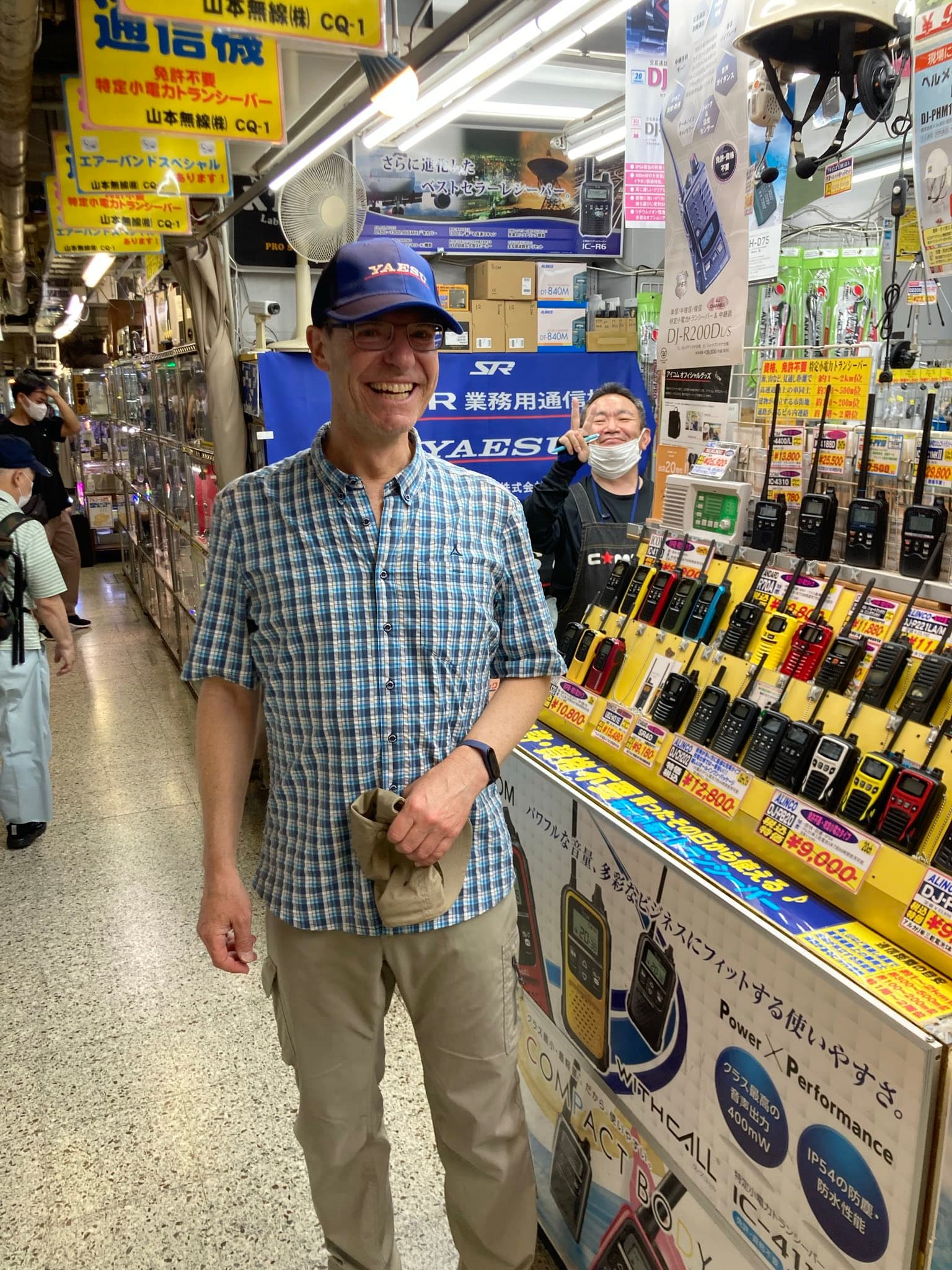
According to its serial number, the FT-60 was manufactured in Japan in May 2024, and the printed manual was from 2025.
POTA equipment test
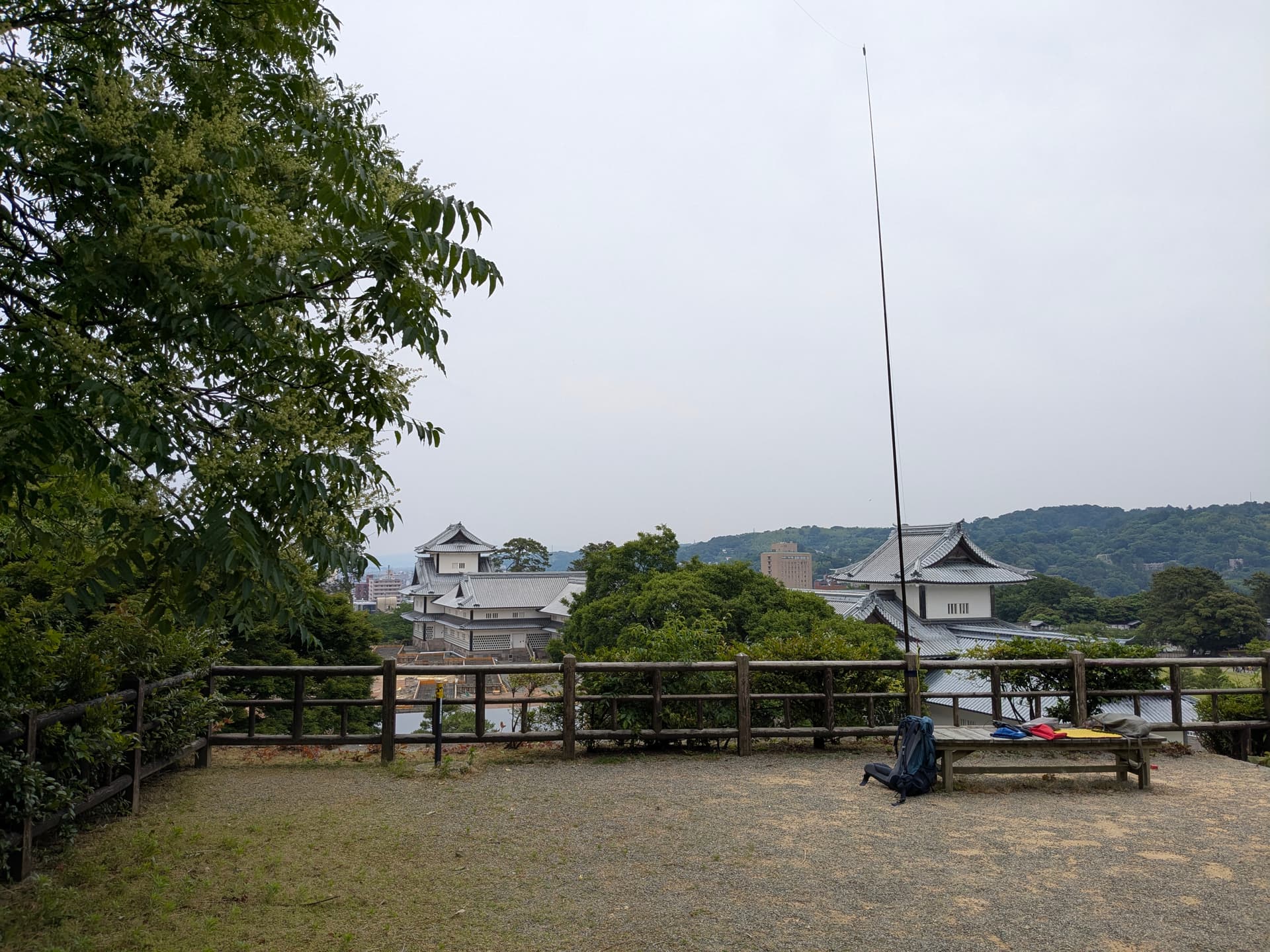
As the weather in Kanazawa was not looking too good, I activated the nearby POTA JP-1399, Honda no Mori Prefectural Park, which was within walking distance from the AirBnB.
The HF bands were suspiciously silent, and issuing several POTA spots on different bands led to only two contacts on 40m SSB. I assumed this was due to the current poor HF conditions.
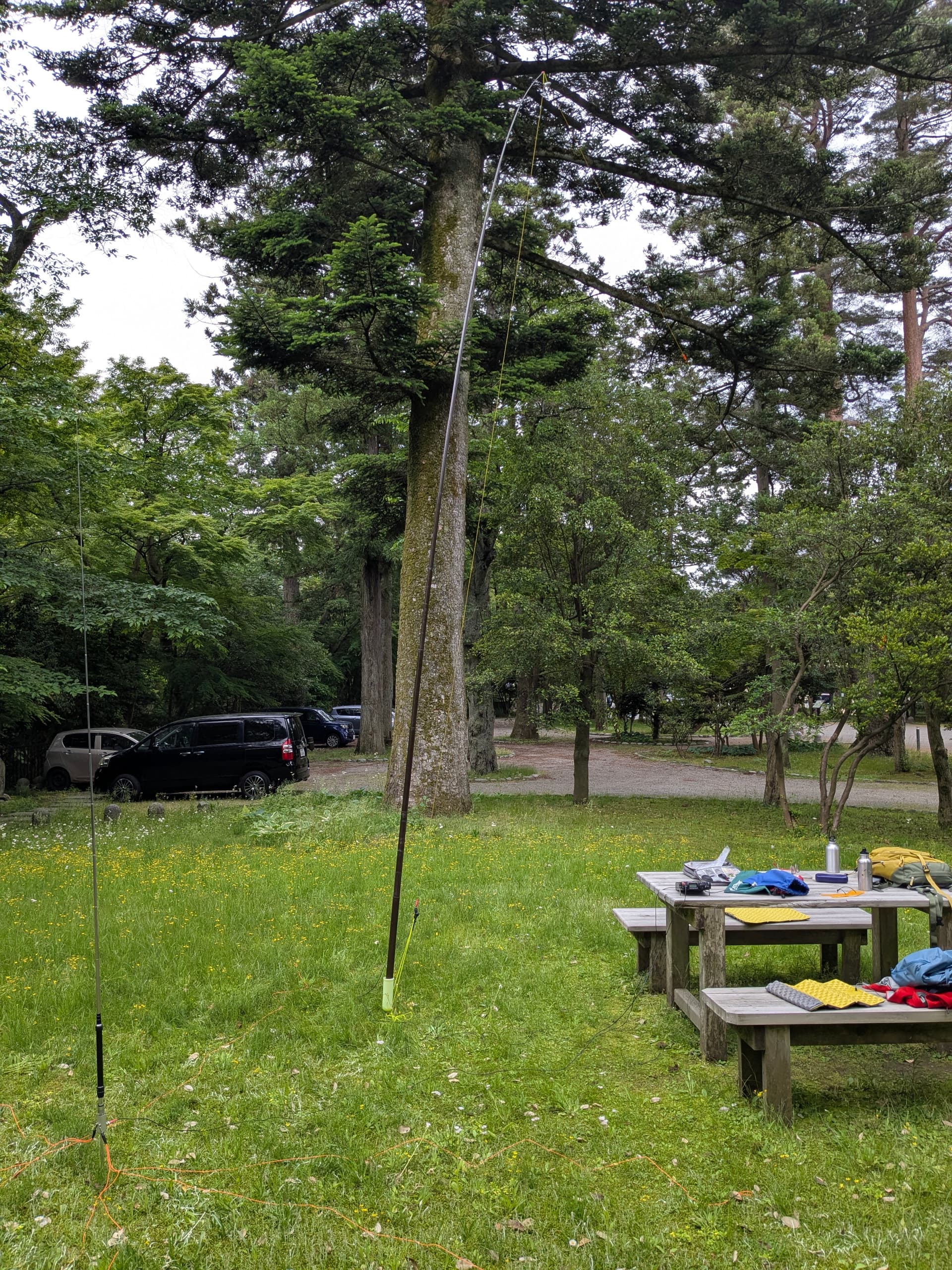
After it started to rain, I called it a day and visited one of Japan’s most beautiful gardens (Kenrokuen Garden), as well as a modern art museum nearby.
My first SOTA activation in Japan
I was looking for a SOTA summit near Kanazawa that could be reached by public transport. I chose Tomuroyama JA/IK-029, an easy two-point summit that can be reached from the terminal bus stop in about an hour.
Finding the correct bus timetable was not easy (e.g. the bus stop names on Google Maps don’t correspond with those of the bus company; different schedules and bus stops depending on the season, etc.), but thanks to my partner’s help, everything was solved easily.
Description and photos are available on SOTLAS.
At the trailhead, the bear warnings made me think twice, even though we had attached bear bells, which we had already used for SOTA in Canada.
Along the way, in the mixed tree forest, there were several old tin cans hanging from the branches, presumably to make a loud noise and shoo the bears away.
After setting up my FT-818 at the summit, the bands were silent again, even though the HF conditions had improved in the meantime. This is a world of difference compared to central Europe, where it’s difficult to find a free frequency on 40m SSB. As I could hear several Japanese stations on 40m, I started to spot on this band first and made three contacts in about 15 minutes.
I sometimes struggled to understand the call signs, so my Japanese-speaking partner’s help was invaluable! I then tried 20m, 17m, 10m SSB and 2m FM. I stayed on each band for at least ten minutes, but there were no takers at all.
After about an hour of unsuccessful spotting and CQing, I spotted on 40m SSB again and finally made the fourth and last contact!
Only one other hiker arrived briefly on the summit, equipped with three bear bells.
Tips and tricks
Before leaving Kanazawa, I received an email from Christian @F5MMP, with whom I had previously completed a joint activation in the Vosges.
Having seen my pictures on sotl.as, he was able to give me valuable tips as he had already activated in Japan. “Contact Toru JA1CTV/@JA1CTV, who can drum up some chasers, and use FT8.” Thank you, Christian!
Once I had finalised my plans for the next activation in the Nara area (again using public buses), I contacted Toru with the details. He had to work that day, but he informed his colleagues, which was very helpful. Thank you, Toru!
After we arrived in Nara, I configured the latest FT8CN app on my Android phone using the settings Christian had suggested. I had already tested this app some time ago, but mainly for decoding messages. I find the FT8 mode as interesting as watching paint dry, but having another tool in the toolbox is never a bad idea.
Second SOTA activation
I chose the summit Kunimiyama JA/NR-048, a four-point summit, which can be reached by bus from the Nara train station. It takes about an hour and a half to walk from the bus stop to the summit. Description and photos are available on SOTLAS.
The first part of the hike offered nice views of rice fields and tea plantations. The rest of the route was pretty much all through the forest, mostly consisting of Japanese cedars.
We reached the summit, which had two tables, but there was only marginal mobile network coverage.
Listening on the bands was the same as during the first activation. There were only a few stations on 40m SSB and maybe one or two on 20m, 17m and 15m SSB.
As I was early, I answered a CQ caller on 40 metres, but after several attempts, he still couldn’t understand my call sign correctly, so we both said 73 sayonara and gave up.
Thanks to Toru, the 40m SSB spot led to three consecutive contacts with JM1OZP, JA9MJR and @JG0AWE. Spotting on the higher bands was unsuccessful, so I tried FT8 on 20m in calling mode on my smartphone, which resulted in a fourth and fifth contact. A spot on 2m FM resulted in another contact, and I tried some more FT8 on 15m. I even could decode European stations, but I had no luck with DX.
The way back was difficult, and I wouldn’t recommend it. We followed a sign pointing to a shrine we wanted to see, but after losing some altitude, we got lost in a bamboo forest. Thanks to the GPS, we found and followed an overgrown path through the forest which sometimes got quite steep. Once we were out of the forest, we reached a tall fence that probably protected the crops from wild animals. Climbing over this fence required some coordination, and we were happy once we reached a street.
We didn’t see another hiker all day.
Learnings
- Christian F5MMP and Toru JA1CTV were really helpful!
- FT8 is your friend when looking for the fourth contact, even if it’s boring.
- Better operating: Back in Kanazawa, when I skimmed through my notes, I realised that I had made a major mistake. I always called JL1FBL/n portable instead of JL1FBL portable n – what a stupid error!
- CW is probably the best mode to use in Japan. I definitely have to give it a go after doing some more training back home.
With these lessons learned, I’m pretty sure that my next Japanese activation(s) in the coming days will be even more successful!
73 de HB9EAJ/JL1FBL

 .
.