Miracle Whip / Wonder Wand

Hi Ed and Matthew,
it appears that I am a late comer to the idea of using the tuner section of the WonderWand or its variants as a tuner. I had in the first instance considered using it for a random wire antenna, if not even use it with the Band Springer as you have done Matthew. I had never considered using it as a tunable Unun on an EFHW Ed, but then again why not. I have just completed turning a builders chalkline into a wire reel for use as a variable length EFHW…this could be the ideal candidate to experiment matching the tuner to.

Cheers
Phil ZL2VTH

4 Likes

I’ve just discovered this thread. Reading through it, there’s a lot of “negative waves” [cultural reference to Kelly’s Heroes] in the early posts and a lot of show & tell about non short-whip antennas later on.

As a long-time user of wire dipoles and EFHWs I was a cynic about short (e.g. 1.3m long) HF whips thinking of them as toy antennas. Then in 2023 I become a sceptic after reading activation reports and watching YouTube videos of SOTA/POTA activators using them. Then I tried it myself late last year and since then on a number of activations [always 10W CW on 30m using an old MFJ-1830T monoband whip and counterpoise wire]. I’ve had pile-ups and decent reports received and given with it [Yes, not as good as with full-sized antennas, but critics are missing the point of their occasion use].

I still use CF linked dipoles, EFHWs and 1/4-wave verticals 97% of the time but there are times occasionally where I want or need to do a quick activation with a minimalist setup.

Read about my conversion …

3 Likes

Great stuff Andy! It’s good to be reminded that contacts are still possible even when our antenna options might seem heavily compromised!

2 Likes

Not only possible but with decent reports (albeit not super strong). See my log RSTs for my first minimalist antenna activation (in Nov-23) at the above link.

For me, the minimalist set-up is for adverse weather / very-quick activations. In these situations one is not trying to set Dx records. The moaning minnies chasers should bear in mind the alternative would have been a 2m FM-only activation or no activation.

2 Likes

This my testing to date, albeit I only had a 40 minute window of opportunity. First thing I had to do was get away from my QTH as it is situated in a small valley and is not kind to portable setups. So, I drove to a nearby village about 25 km away and set up on a small reserve from which I have had good success with previous portable antennas.

The antenna I used today was just two 42’ lengths of wire, one as a radiating arm in a reverse ‘V’ over a 6 meter SOTA pole and the other length running directly underneath as a counterpoise. I was specifically try to replicate SOTABeam’s recommended way of setting up their Band Spring Midi, as this is the antenna that I have on order and hope to use with this tuner.

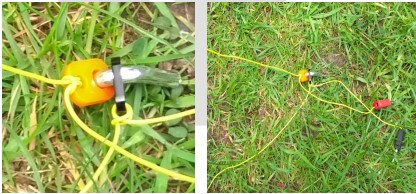
This is a picture of SOTABeam’s recommended way of securing the two wires at the ATU end.
attachFull1103228

This is how I had had it set up…

​​​​

This actually had the wires approximately 4 " of the ground whereas SOTABeams seem to have them right on the ground. Will this have any effect? Not sure; further testing required.

So anyway, I started to go through the bands and try and get a match. I only managed to try 40, 20 and 10 meters.

I set the mode to AM and ‘ear-balled’ each band, then I started a SWR chart and made adjustments to the variable capacitor as required. I was able to get under 1.2 SWR on 40 and 20 meters but only 1.4 on 10 meters. The bands appeared to be in reasonable shape as the digital signals could be heard strongly, but just not a lot of phone activity. Not surprising for mid afternoon on a sunny weekday.

Anyway, on 40 meters ZL3RIK came booming through as he was doing a portable activations of a lake in the north island. I know Rick and his portable setup and it would have been an FT-891 on 100 watts, normally through a sloper or dipole raised on a 6 meter pole.

We QSO’d. I gave him a report of 59, he gave me a report of 53. I wasn’t too surprised considering I was only using 5 watts. Below is a picture of our signal path.

I was quite happy with that, 714 km. Anyway, time was running out for me. I tuned in on 10 meters and could hear activity in the States but nothing local. I heard a ham in Nevada calling CQ and getting little response, so I thought even though only running 5 watts I would throw my hat into the ring. I called and he heard my signal but couldn’t get my callsign out of the noise level. After 4 attempts he wished me 73’s and carried on.

So for my first field test using the Chinese equivalent of the Wonder Wand Tuner, 5 watts on the IC-705 and 2 random wires setup in a prescribed manner for the SOTABeam’s Band Springer, I was happy. A lot more testing required and some further refinement but overall I am satisfied enough with the initial results to continue further testing. I shall keep the thread updated.

Cheers
Phil ZL2VTH
5 Likes

Well, things have changed a little and moved up a notch with me in the quest to use the Wonder Wand variant as a tuner on a 42 foot length of wire.

Today I watched a video by Peter Waters @G3OJV on his Waters and Stanton Channel on Youtube. The video was entitled “AMAZING WHIZZ WHIP - Pocket QRP Whip Antenna Covering 80m to 2m”. In this video he was reviewing and looking at other ways of using the Whiz Whip which is the third iteration of the original Wonder Wand.

Apart from Peter explaining the different way this works to a loaded coil the two big take aways of the video were these.
1/. it will work well with a length of wire though don’t make it too long.
2/. it doesn’t need a counterpoise and he even went to suggest that it works better without a counterpoise.

The lack of counterpoise I was a little sceptial of, but thought why not give it a go; what did I have to lose. So I went to work. I laid out my SOTABeams tactical mast and roughly measured a length of wire against it, deliberately making it approximately 6 inches longer. I then attached one end to the top most tip of the mast and secured it with a piece of gaffa-tape. I then attached the other end to the top terminal on the Wonder Wand, already mounted on the IC-705. Bringing the mast to the upright and with the IC-705 at its base I then rotated the mast to wind any slack around the mast to keep it from flapping in the wind. I now effectively had a 6 meter vertical antenna. Next I then tuned it from 40m through to 2m and was able to get a workable SWR on all bands. The highest SWR was 1.7:1 the lowest 1:1 I didn’t try listening of making contacts as my QTH is in a serious dead zone; even the longwire leading from my shack running to 60 feet into the trees can struggle at times.

Early evening I climbed approximately 50 meters up one side of the valley and on to a small ridge. Here I setup and the immediate thing that struck me was how the waterfall just lit up and the amazing reception I was getting. I participated in two net’s, one ZL based and the other in VK. I was getting better reports from VK than I was getting for local stations. I put this down to the vertical propagation having little to zero NVIS component. Then Europe started coming through on the long-path. I responded to a couple of CQ calls and while being heard they weren’t able to get my call-sign from out of the noise. I then had a partial QSO with an operator in Japan. It was a struggle but then the band faded and we lost contact.

Some might say an unsuccessful evening. On the contrary I would suggest it was reasonably successful.
This antenna, in its present form is very quick to setup and simple to tune. From the contacts that I was able to make this antenna shows enough potential to consider taking on my next SOTA sortie…my only reservation is that local HF chasers will miss out due to lack of NVIS and relying on overseas contacts during the middle of the day when only operating on 10 watts is a bit of an ask. I way have to consider taking my G90 instead of the IC-705.

Cheers
Phil ZL2VTH

4 Likes

Hi Phil,
The point about better reports from VK than ZL could easily be propagation-related rather than the antenna.

You didn’t mention which bands these nets were on. I’m presuming 40 or 80m.
Many people talk about NVIS on 20m - that would only happen if the critical frequency of signal propagation in the Ionosphere were over 14MHz which effectively (AFAIK) never happens. The highest band that you could see NVIS on is 30m but it’s normally only 80 & 40m.

As you are tuning a random length wire, what you could try is to lower the mast a little and move away from the mast with the radio, making the antenna into a “sloper” rather than a vertical - this “could” improve local contacts. As always in this hobby YMMV so try and see…

I think the retailers would be well served to supply a length of wire with the winder-whiz-bang tuners exactly for the reason that the tuner inside the box is quite good. Just relying upon a short telescopic whip limits the antenna. I used mine in 2013 with a thin wire simply laid across hedges or high grass on some Yorkshire summits and with the FT-817 got contacts from around the UK and into the continent on 40 & 80m. In my case, I went with a half-wave wire and a counterpoise specific for each band.

73 Ed.

3 Likes

All valid points @DD5LP
On my trip up the side of the valley I only used 40m and 20m. I worked the local net on 40m and then after that moved up to 20m and joined the ANZA net. All other contacts were on 20m. I had a quick look at 15m but there didn’t seem like anything happening there so I stayed with 20m. Now interestingly on 20m the VK contacts were good, but the ZL contacts not so. Another reason for this could possibly be, on the ANZA Net at least, is the ZL operators were on Yagi’s and were all pointing 90 plus degrees to my location.

I take on board what you say in terms of lowering the mast and turning the antenna into a sloper and no doubt that would make the propagation more favourable to the locals on 40m. The other configuration that I would like to try is the EFHW Shark Fin from @WV0H . Yes, I had never heard of it until I happened upon his blog. Well worth reading.

What he has named the Shark Fin configuration appears to have a very good propagation pattern being both omni-directional with a reasonable NVIS component added in. My ultimate goal is to have a reasonable performing antenna in the smallest possible footprint for use on small-real-estate summits.

Anyway, this is straying far from the original question - Miracle Whip/Wonder Wand…anyone had any success? The answer is a resounding yes, but not in its original configuration. The tuner appears to work well but is rather limited with the small sized whip. Throw it away and add a wire…final length and configuration yet to be determined :+1:.

Cheers
Phil ZL2VTH

3 Likes