I’m seeking ideas for an antenna for a KX1. The KX1 has the 30m and ATU options fitted.
I’d like an antenna that the KX1 could use from within a tent. In the past I’ve used a coax fed EFHW cut for 7MHz with a link for 10Mhz. The EFHW works well but to use 30m, I have to leave the tent to change the link.
I made an EFRW for the KX1 and the rig handles it OK, but the feed point is right at the rig itself. I’d like a bit of separation with a short(ish) section of coax - a few metres maybe.
Is there a coax fed option that would work on 40/30/20m?
I’m not fussed about loss etc - convenience is the main factor.
I made a trapped 20/30/40 EFHW using one of K6ARK’s nifty transformers that is built right in to the BNC connector. There are various ‘tiny trap’ kits around - I used some from N7KOM.
Works great with the KX1 (mine also with 30m and ATU) and also with the KH1 on all the bands that rig has.
Put the transformer on the end of a coax if you don’t want the feedpoint directly at the BNC.
I built a trapped EFHW for 40/30/20 this year. A side effect of the traps is the antenna is much shorter than my link EFHW. It seems to work ok but I can’t help thinking the shorter wire means it’s less efficient.
Be aware that traps for a dipole won’t work for an EFHW due to the hugely different impedance.
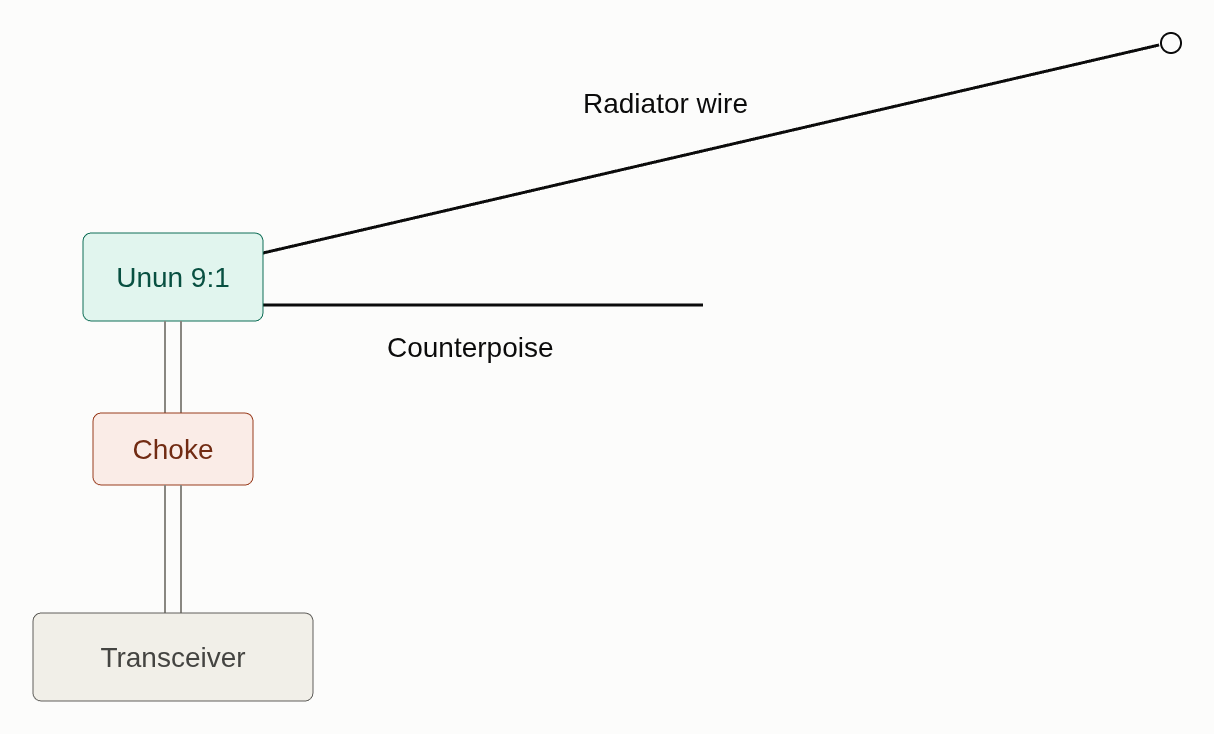
I haven’t used my KX1 for a while, but for many years I followed elecraft’s suggestions and used a long wire about 26’ with a couple of counterpoise wires around 12’. It worked well with the KX1’s excellent little internal ATU. Info from the elecraft web-site.
I have built an antenna in that style but I wanted an antenna with a short coax feed to get the feed point outside of my tent.
I think a trapped antenna is the way to go. Either that or stick to 40m and 20m with a 7MHz EFHW. To be honest I struggle to find the time to play radio when I’m camping, everything seems to take forever!
I have a trap dipole based on sotabeams pico traps, it seems to work well. I made 20m and 30m traps for a 40/30/20m dipole fed with light coax. I just followed the instructions on the sotabeams website for winding and adjusting the resonant frequency of each trap.
It is fine with my ft817 for “local” contacts on CW and SSB.
I used this antenna on my ZL trip earlier this year and had numerous contacts on 40 and 20m, mostly CW but some SSB, both within ZL and over the 2000 km to VK. It would be an ideal antenna for a tent based operation, methinks.
An advantage of using a symmetrical dipole is that it works without a tuner and in my case without a balun, but a few turns of the coax could be wound through a toroid if the antenna wire is close to your tent. I prefer to have antennas up in the air where ground losses are minimised.
The pico traps use SMD capacitors to resonate the traps, so there is a power limit based on the breakdown voltage of those capacitors. Sotabeams rates the traps for 20w IIRC. My 817 and the MTR3B do not produce more than 5w. I found by accident that the antenna returns low reflected power on 21 mhz one day, which made me wonder whether the traps were intact.
It returns a < 1.5 SWR on each of the 3 bands. The AA600 analyser says it has defined frequency bands where the SWR is usable, so I think it is OK.
I may build a higher power version using the other traps from SOTABEAMS which I bought at the same time but are still in their packaging.
I’ve successfully used my 40m EFHW on 80m through to 15m with my KX3 with internal ATU. 2m of coax to 49:1 mounted at around 1.5m above ground with the wire in inverted L format and counterpoise beneath. Whether the ATU in the KX1 performs differently to that in the KX3 is an unknown. I guess you will have to just give it a go.
Snap. Traps for 20m/30m using the Sotabeams recipe. I got the lengths by measuring the lengths on my commercial 40/30/20 EFHW trap antenna. I haven’t tweaked anything and obtained the following results using a 1:49 match
I don’t yet know why the 40m match is so bad but it looks like miniscule tweaking is needed to get a better match on 30 and 20m. It would be nice to get them “sorted” so I can use it with my collection of QCX radios. But as of now the KX2 ATU and the ATU10 just laugh at how easy that is to match.
So yes Colin, Sotabeams Pico traps and a 1:49 unit and you’ll be sorted. Bonus points for winding and tuning the match and traps and trimming the lengths on a summit
I use an EFRW that will work from 40m through 10m. My KX1 is fully loaded and hasn’t an issue tuning it up.
Only difference with my setup is I chuck the wire in a tree, then use about 5ft-ish of coax and just before the KX1 i plumb in an LDG choke (the blue one).
Works a treat (for me) and could be adapted to your tent setup. I am disappointed you are using a KX1 and not a Micro Machines City playset with a homebrew transceiver in it, or an artificial limb, or a wheel nut from a Triumph Herald with a microwavable liver casserole for a CW key!
That’s the kind of setup I was hoping for from you!
Could be a trap (!) there, the L/C ratio of the trap determines the effective inductance on frequencies lower than its resonant frequency. Unless the values in the traps are the same, the length of wire needed on the next band lower will vary.
A trap is a parallel tuned circuit and when measured at lower frequencies than its resonance, it is always inductively reactive. In other words it behaves as a loading coil on the lower frequencies. That’s why the length of trap dipoles is normal for the innermost band, then as you go down in frequency the length needed is less than its unloaded length. It’s not a loss, it’s the way tuned circuits work. So in my case the 20m trap presents a certain reactance at 30m, which affects the length needed for resonance on 30m. Then you go to 40m and both the 20m and 3m trap act as loading coils so the length for resonance on 40m is even less than the shortening on 30m.
I find it best to set the length without the trap connected, then attach the trap without any other wire, measure and trim, then attach the next bit of wire. Eg if adding a 20m trap to a 20m dipole, before adding (or guessing) the length of wire for 30m, get the 20m section working right first, adjust when trap connected, then attach 30m wire, and so on. Same as when making a linked dipole. Work from the inside.
I used several times a 51ft radiator and 12ft counterpoise as an EFRW. My feed line was about 1.5m of two runs of rg 174 in pieces of heat shrink to make it like 100 ohm ribbon “sorta”. The radio end fixed via a BNC to banana binding post and the antenna end clipped on each wire with alligator clips. The connection to the wire was via the centre wire of the coax and the two braids where just left disconnected along the coax outer’s. KX3 loved tuning it on 40 30 20m.
I built two trap-loaded end-fed antennas: one for 17m/30m/60m for the 3 QCX Mini, and another for 20m/30m/40m for the SW-3B Venus.
They work excellently.
As always, my unun ratio wasn’t exactly 1:49 or 1:64, but somewhere in between. And as always, I used the coax shield as a counterpoise.
After the unun, I left a length of coax equal to 0.05 lambda of the antenna’s lowest frequency band, followed by a choke… and then another 30 cm or so leading to the BNC connector.
If you use a radio without a built-in tuner, you’ll find that the mounting style and height—whether it’s configured more like an Inverted-L or an Inverted-V—can affect the SWR on specific bands, just as the installation height or the surrounding environment can… but usually it is below SWR 2. An internal tuner can compensate for this easily.
The routing of the coax cable isn’t critical; it can even lie in loops on the ground.
I have various coax cables and antenna wires. No matter how I connect them, the readings always vary. I’ve concluded that the feed line and the antenna wire work best as a single, tuned unit. Plus, you save yourself a connector pair.
Yes, I was aware of the fact the traps “detunes” the lengths. At the time it was more important to get a back up trapped EFHW built and usable rather than build a perfect backup antenna. A KX2 hides a multitude of sins! It’s on the list of things which currently starts with
Build 23cm transverter relay control electronics
Prove some 122GHz equipment with fellow club member
Make list of what I need to complete 122GHz gear chez LLD
to be done before 1st Nov.
The list then continues ad infinitum one of which is measure where backup antenna is actually resonant (is it long or short) with view to getting a good match on 20/30/40 with no ATU.
Somewhere on there is also climb some mountains and play with all the toys