Yes. Really we use them to stop fires from long term over current. Peter PJT’s mention of BMS made think maybe there’s a market for an electronic fuse using a few FETS. Over current in either power line causes the FETs to open almost instantly before damage occurs and you reset it by removing the power and trying again.
1 Like
Apologies for the wait, but I have some preliminary results for the Turnigy Rapid 9.5 LiHV battery Pack.
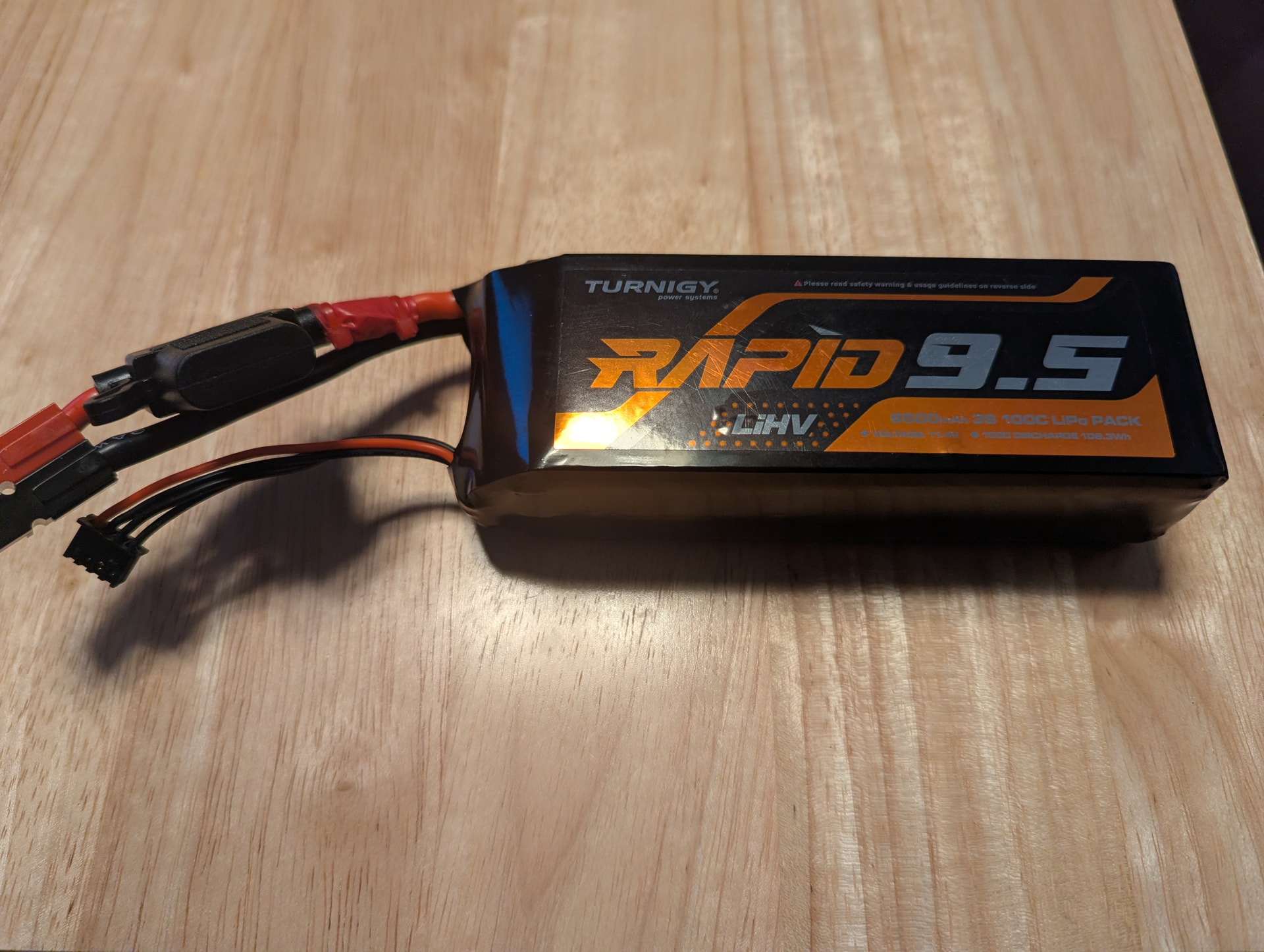
I replaced the standard connector with a 45A Anderson Powerpole connector and put a blade fuse holder in the positive connection, which I installed a 25A fuse.
The battery was delivered with the correct storage charge (3.8v per cell), and has remained stable since I received delivery over a week ago. I charged the pack using the ISDT 608PD charger at a rate of 5 amps (0.53C). Fully charged, the cells read 4.35V each for a total pack voltage of 13.1V.
I’ve done a single discharge this evening, so consider these results preliminary until I can get some real field data, however it is encouraging. I discharged the battery at a constant 15.5 Amp rate. This resulted in a voltage sag of 0.2V, dropping from 13.1V to 12.9V under load. The 0.2V sag remained consistent up to the point I stopped discharging. I discharged 4.5Ah until the voltage dropped to 11.4V (3.8V per cell), at which point I had to drop the discharge rate to 10A due to a limitation of the equipment I was using. I discharged another amp-hour to for a total of 5.5Ah, finishing at a battery voltage (under load) of 11.28V (3.76V per cell).
From this I conclude that I can easily get an activation out of this battery; Using a transmit to receive ratio of 1:1, I estimate I can operate for about 45 minutes to a cell voltage of 3.8, but I think I can get around 80 minutes down to a cell voltage of 3.5V. This would be operating at 100W SSB or 50W VHF FM. Dropping to 50W HF or 25W VHF FM I’d expect to get 2 hours.
I’ve got some plans to do some more tests next weekend, but I won’t really know for sure until I do some real field testing. I’ve not activated my ‘local’ summit this year, so I could drive along to Detling Hill next weekend if I can find a couple of hours to spare and it’s not another scorcher!
73s Dave G7SAT
1 Like
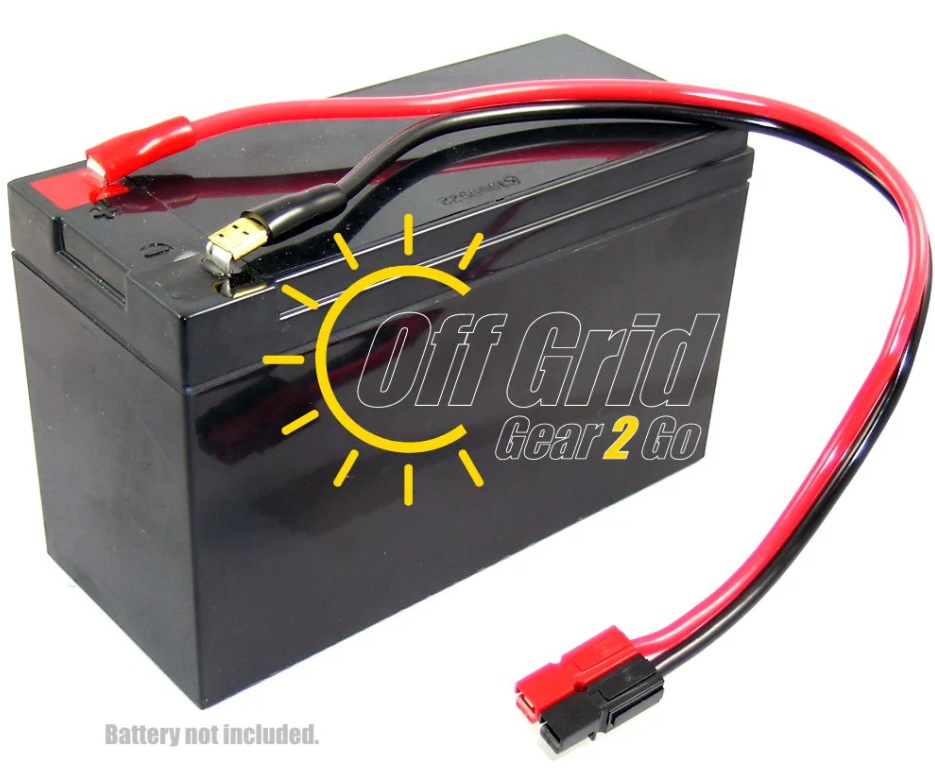
I’m sure that people actually don’t know what I’m talking about. On a Temu advert, there was a LiFePO4 battery that had power poles fitted on top, encased so no wires were visible. I don’t use Temu, so I couldn’t see how much they were. Never seen anything like it. The best I can do is these; however not sold in the UK/Europe, only the US, which means a stupid amount of shipping charges! $9.99
1 Like
Whilst for many it would be simple to make one of these, if constructing (or adapting) is not an option, then you might want to consider a spade-sae and then a sae-powerpole, both of which are common on eBay. The spade-sae cables usually have fuses in at least one line, but you need to be very careful not to reverse the polarity when connecting the sae-powerpole cable!!! An adapter is often supplied to invert the gender for this reason.
That said, honestly, if it were me, and I had neither the facilities / capability to make (or adapt) the cable, or a friend who could do so for me, then I’d pay the shipping from the US.
if you have a local repair cafe, they may well be able to knock up a cable for you from parts you provide … great opportunity to put fuses in both lines also 
1 Like
I well recall when powerpoles became popular. Forever the sceptic, I didn’t think they would catch on, but nevertheless decided to give them a try and I use nothing else now. Having a connector you can actually hook up without the fear of getting the polarity reversed, especially when setting up your station in adverse weather conditions, is to my mind essential.
On the subject of batteries, while not for the FT-857 level of transceiver, I have been looking for a solution for the lower power level requirement of the FT-817, essentially something to provide around 2AH. Preferably LiFePO4 as like some others I am moving away from LiPO technology. With packaged 4S LiFePO4 batteries (for example Zippy brand) seemingly no longer available from Hobbyking or similar outlets, I have opted for using 18650 LiFePO4 cells in a 4 cell holder assembled with a balancing lead rather than a BMS board which I will charge from my iMax B6AC charger. At around 220g with 20mm fuses in both leads and a cost of around £20, I think this is a reasonable solution. As to ruggedness and practicality, well that remains to be seen.
1 Like
If you don’t want the hassle of crimping the powerpole connector, the path of least resistance would be to purchase this from amazon: Link
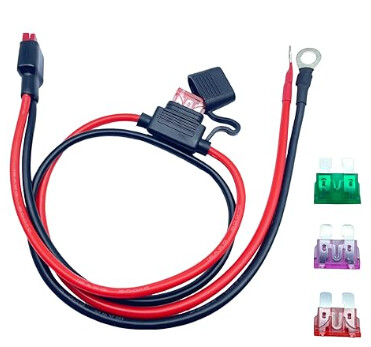
It’s a Powerpole connector with in-line blade fuse to ring terminals. The wire is quoted as 12 AWG, so should be fine to use up to 25 Amps (a fuse of 25A or less should be used to ensure you don’t melt or set fire to the wire insulation). All you would need to do is to cut off the ring terminals and install spade connectors, which can be done without specialised crimp tools; Pliers and/or mole-grips can be used in place, but be careful not to crush the connector or break the insulation. You may wish to also solder the wire to the spade connector if you want a more robust joint.
Please remember that spade connectors are not meant to be disconnected and reconnected many times. The connector will become worn over tens of uses and may result in overheating if the fit becomes poor. I would recommend you install the cable and then insulate the spade fittings on the battery to prevent inadvertent short circuits. I personally use hot-glue, as it covers the terminal, insulates and provides a positive retention of the spade connector.
Regards and 73s
Dave.
1 Like
I can see what power-pole adaptor you want, but I have never seen one for that type of battery terminal. I have seen similar for powertool batteries and they are usually 3D printed.
Perhaps a combination of these items (with additional fuses) would be a start.
West Mountain Radio Powerpole to Blade Gel Cell Connectors, 12 inch - Radioworld UK
1 Like
Hi:
I like that the 817 can accommodate an internal battery, and there are some interesting options, like the Windcamp. For backup, I built a battery with 21700*9 cells and a BMS; it weighs 600g and can last much longer.
1 Like
Apologies for the long wait, I’ve just not had the opportunity to get out and test the battery.
The verdict is in; it’s a pass with flying colours!
I have used the LiPo in anger earlier this week, activating Le Champ Du Feu LF/VO-019 with the FT-857 running HF SSB at 100W. I’m pleased to say that I used just less than 2Ah of the 9.5Ah capacity and the voltage was at 12.4V. I used it a bit more today and after consuming around 5Ah, the voltage was 12.0V.
I am confident that the Turnigy Rapid 3S 9500mAh LiHV battery is good for most activations for the FT-857 or indeed any high current devices that need to be powered in excess of 11.7V (15% drop on 13.8V). I personally would expect to be able to operate the FT-857 for well over 90 minutes with a normal duty cycle for SSB on HF.
I will report back the next time I use it in the UK doing an activation on 2M FM. Whilst I expect the operating time to be less than what I have experienced on HF SSB, I would still expect to do at least 30 mins of 50/50 duty cycle on FM before draining the battery below 11.7V, probably closer to an hour.
I will acknowledge that this battery isn’t for everyone, as it needs to be maintained carefully; most significantly it shouldn’t be stored with a significant charge. The tech sheets say to store at a cell voltage of 3.7V, or 11.1V, and needs the be checked periodically. If left too long the battery may become un-chargeable and present a fire risk when you start to charge from a deeply discharged state.
73s
Dave G7SAT
3 Likes
I wonder whether this is more onerous than for a standard LiPO. I used to keep my 3S LiPOs at 11.1V for storage when I used them for activating. Now they are old (2009 vintage) and have reduced capacity, I must admit that I now charge them fully and use them as convenient shack power for odd bits of kit. They could be in a fully charged state for a few weeks, but I have not experienced any problems. I guess the issue is… define “storage”.
1 Like
From what I read, 100% charged LiPo’s shouldn’t be left in that state for more that 24-48 hours otherwise the battery chemistry can be come degraded or even damaged. Charging the Turnigy 3S pack takes about an hour at a rate of 10C with my charger, but takes nearly 5 or 6 hours to discharge to the storage voltage (it can only discharge at a rate of 1A). I would agree about the definiation of storage though; if I were using it every day with a significant discharge (on a SOTA holiday for example) then I’d probably keep it around 80% charged at the end of each day and only discharge to the storage voltage when I have no immediate plans to use it.
Time will tell if I persist with it, but there is certainly a use case for it with my FT-857.
Dave.
2 Likes
That’s what I settled on for my QMX (1100 mAh 60c 3s LiHV regulated down to 12V).
It discharges from 13V to 12V after approx 30 QSOs - ideal for my use case.
3 Likes