30m SOTA antenna options

What do people use to give them the option of 30m on activations?

  • Must be resonant (no ATU)
  • Must be compatible with thick bush / scrub deployment & retraction - so end-fed (or close to it), and no prominent traps, links or other snag-points in second (far) half of antenna.

Keen on all ideas compatible with the above.

Also pointers to a 60m+30m+(17/15/12?) solution using (near-)feed-point inductor, or LC. The only such I’ve found online uses a mid-point capacitor which I feel would be a serious snag-point / break-point when retrieving the antenna in scrub.

Matt, ZL4NVW

1 Like

I use a linked dipole or an Inverted L with an L match. https://youtu.be/JwVuvu-C30c

2 Likes

15m of wire

3 Likes

Might be a somewhat limited activation given the lack of harmonically related bands.

So ideally giving me a similar range of bands (and thus distances) as a 40m EFHW. e.g.60m, 30m, plus one of 17/15/12m

1 Like

…and a 1:49 transformer, more precisely EFHW on 30m and incidentally a EFFW on 15m.

73 Chris

2 Likes

Really?

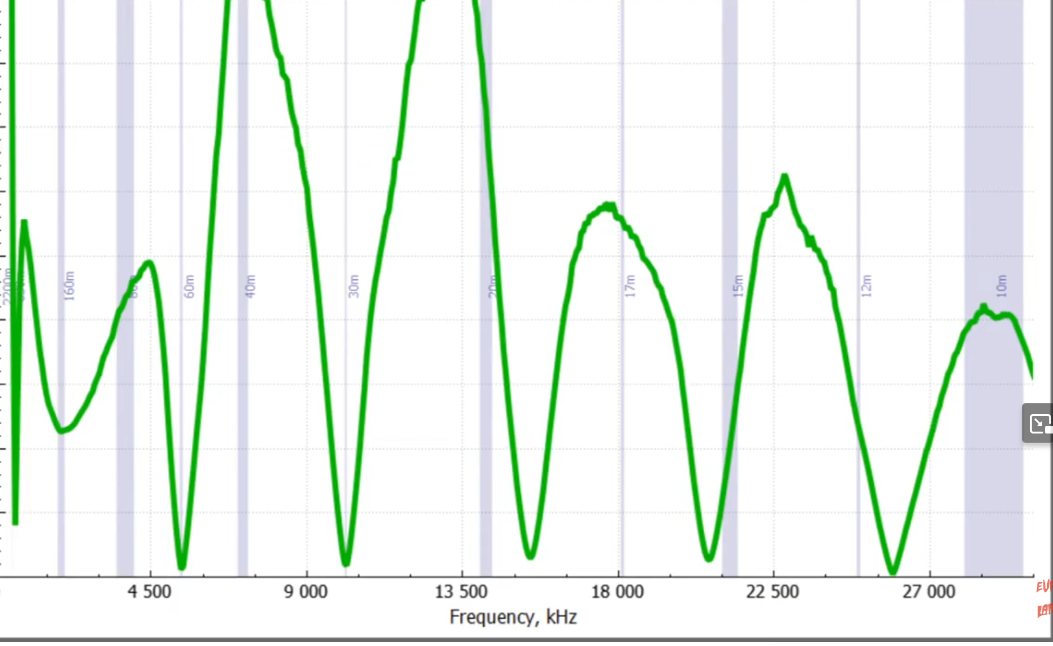
The modelling makes it look hard to get both bands to match with just a wire. 2x10.1 = 20.2Mhz. Quite a way from 21Mhz.

So some inductor, capacitance or LC seems necessary to tweak the harmonics into the higher bands. Or have you managed to get this to work with just wire?

And if we go for 60m too - 2x 5.36 and 4x 5.36MHz are even further out.

I have a trapped EFHW for 40/30/20, On 15m the KX2 tuner goes brrt for a second or 2 and I’m good to go, it’s tuning the 20m length. Using it on the QCX with an AA5TB tuner/match it wont match on 17m and is iffy on 15m. So there is a link to open at the 17m halfwave length and tuning on 17 and 15 is easy them.

Also both my link dipoles have 30m sections.

2 Likes

30m is my favourite band and default choice for most activations.

• My default antenna is a 40/30/20 EFHW [with link for 30m] as inverted-L on 6m pole. I’ve recently retuned it and - as 30m band is so narrow - I wouldn’t need an ATU (although I have a great one in my KX2).
• When wanting to work all bands 10MHz – 28MHz I use a Chameleon MPAS Lite vertical (ATU needed)
• I have a quad-band 60/40/30/20 linked dipole as inverted-V (no ATU needed on 30m) but it has a big footprint (so don’t use it unless I want 60m)
• For very quick activations, I use a MFJ-1830 1.4m-long telescopic whip with 7m counterpoise (ATU needed)

1 Like

Am I worrying for nothing about trapped options? Are they scrub / tangled bush compatible? I find even the knot used to attach the far-end guy line to my EFHW is capable of snagging irretrivably (usually 4m+ up in a tree at the far end of some unclimbably thin branch) when pulling/winding the antenna back through scrub / branches and so has to be detached before attempting antenna retrieval.

Can traps be made so low-profile and smooth and strong (heat-shrinked?) that they can be pulled back over tangled branches/ through scrub?

1 Like

Any wire antenna (trapped or not) that starts on or is allowed to fall onto that kind of ground can be a nightmare. Each time I take a wire antenna to those kind of summits, I wish I had taken my Cha MPAS Lite vertical instead. It has four short-ish counterpoise wire but less troublesome than antenna wires that you are trying to raise up in the air and the scrub and bushes are trying to stop you.

1 Like

I would check with suitable antenna magic tools that covering the traps with heatshrink etc. does not upset/detune them. Mine have the solder joins covered with hotmelt glue to protect from moisture but nothing else.

Now your vegetation is quite different to mine so my experience may be complete nonsense for your locations. I only stand still and wind in the antenna and pull it over the ground if there’s no heather/long grass/ scrub etc. If the ground is like that I walk and wind so the wire isn’t pulled through the vegetation.

I’m sure you can make ZL-veg proof traps/antennas etc. just make sure you have the tools to measure if your “armour plating” detunes things.

1 Like

In addition to the above-discussed options, still chasing the elusive 60m/30m/15m coil-shortened EFHW solution also. The design I referred to above is here:

https://youtu.be/m3QzlatFcdg?t=186

Sadly it’s a u-tube video rather than a clear written design intended for others to follow, so it’s very hard to use as a reference. But at 3min 06 he has it tuned for 60m, 30m and almost hitting the bottom end of 15m - using just a 150pF capacitor at the mid-point. The closeness on 15m suggests that some playing with the capacitance and shortening coils might achieve all three bands. He states that he manages to bring in 12m (but does not say what coil he uses or at what position), cannot manage to bring in 17m, and does not mention trying to tune it for 15m.

1 Like

A simple L network using one coil and one capacitor should match such a wire on many bands. I had an 80m EFHW using one that ran from my barn out to a tree, and used it on all HF bands. But, of course, that is an antenna tuner.

However, one approach that I have found useful is to make a band-switched tuner. After all, if you are always going to use it with the same antenna, the tuner settings will be the same each time for each band. So I just used a double pole rotary switch with enough positions for the number of bands that I may want to use.

In this case, as long as the wire is longer than about 3/8 wavelength on the lowest band, you probably could use a switch to choose the required coil tap for each band, with a common variable capacitor adjusted for loudest background noise. Or a second pole on the switch to choose the required fixed (or adjustable trimmer) capacitor to match the antenna along with the coil tap selected.

(The further the length is from 1/2 wavelength, the more the length of the counterpoise will affect the tuner settings.

It takes a bit of work to get it set up initially (likely in a local park where it is more comfortable), but it gives you more leeway in wire lengths and usable bands than the standard EFHW high-impedance transformer or monoband matching network.

3 Likes

A random wire of 11m and a small L-match will give you all bands from 60m up. If you use steel fishing line (eg 30kg breaking weight) you will be able to retrieve it under almost all circumstances. See QMX antenna

2 Likes

Matt, I suppose it depends who you’re hoping to work.

The ham population-density in ZL is even lower than GM, so you’re probably looking mainly for DX rather than the locals. Indeed, a quick look at the map confirms for Poms etc that, outwith ZL, everywhere else is a long way off, even VK.

Conventional wisdom suggests NVIS propagation is minimal at 10MHz. As such, it is probably reasonable to conclude that much of what is radiated at a steep angle ‘upwards’ largely goes ‘through’, or gets absorbed, by the ionosphere. If true, then low horizontally-polarised antennas may not be the best choice.

Vertically-polarised inv-L or ground-plane (GP) antennas, with lower angles of radiation, are probably the better call.

I used to have regular skeds on 30m with my pal in Southern Spain, which is some 2000km from here. We found that GP antennas were consistently good performers. He would typically be S6-7 running just 5-10 watts; with low-level QTHs at both ends of the path.

YMMV

73 Dave

1 Like

The 30m band is great for daytime working pan-Europe if you’re in Europe. But, for New Zealand, if the ZL 30m community is small (I have no idea) then you’re talking about 2200km (1400 mi) from Auckland to Sydney, which I would have thought was better suited to 20m during the day (when most SOTA activators are on the hills).

2 Likes

In my experience I have found that that is not always true. I often work inter-G on 30m and some quite short distances too. However, most of the contacts do come from around Europe and I have even worked across the Atlantic from a few summits. No wonder it is the preferred band of quite a number of activators that use CW.

I have found 30m is on the cusp with respect to antenna polarisation. Below 10MHz, in general horizontal polarisation seems to work better; above 10MHz vertical polarisation seems to work better This is a general finding based on the ease of getting a decent amount of contacts in the log. Of course it is not a black and white situation…. there is a huge grey area.

For SOTA I generally use inverted vee linked dipoles, either 60/40/30 or 40/30/20. I also have a 40m EFHW fed via a 49:1 unun which to me seems to be less efficient at higher frequencies, whereas my vertical, which is based on a Slidewinder coil, works better on the higher frequencies.

So, thinking about what might best suit the situation in ZL, both on terms of propagation and the physical arrangement of the antenna, something like my vertical with a variable coil might be a reasonable option. This would allow flexibility across several bands. Andy’s comment about 20m being more appropriate from ZL seems to have merit.

1 Like

@g8cpz, @gm4evs

The 30m band is currently perfect for east coast VK1,2,3 from ZL4.

My experience of ZL operations in mid-high solar cycle:

Intra regional contacts:

60m. We’ve had quite a few occasions when skip on 40m has been too long to hit the big pool of chasers in ZL3 from ZL4. So I really should get back to taking my 60m compatible antenna.

40m is currently the only reliable / useful band for daytime intra-ZL (though I’ve not tried 60m for some time). VK comes in after dark (ZL-time) so we get to chase the late-afternoon VKFF activators.

30m. I often check out the VK SSB spots on 30m, and lately the signals for east-coast VK1,2,3 have been stronger on here (even though I’m listening on an untuned 40m EFHW) than on 40m or 20m. At present I cannot reply, but come Nov 1st and the trial of the new VK-aligned ZL band-plan for that band …

20m: I do sometime work the far north of ZL1 (I’m far south ZL4) in 20m, but for the most part, I can hear the VKs that ZL operators are working but not the ZL operators. 20m has traditionally been the main band for VK from here, with occasional trips to higher frequencies when conditions permit. But lately has been very poor.

15m / 17m: Often useful for VK when 20m skip is too short. 15m especially is handy as you can get the VK foundation license holders who can’t use 20m.

True DX:
My main bands for true DX are 20m greyline which is either wonderful or absent. And 10m, when it happens. The EU ‘contest setups’ such as F5PYI or F4WBN seem to come through reliably on 40m greyline, but I don;t think I’ve ever worked an EU SOTA activator on that band.

===

So 60m, 30m, 15m should - I believe - technically give me reliable intra-ZL, VK east coast and a higher option when needed. It would not be my main ‘go-to’ set of bands, just due to the limited number of chasers with antennas set up for those bands. But it would provide a) a nice change on occasions, and b) a good option when skip is just too short or too long for the more typical 40m/20m/15m combination.

Of course, 60/40/30/20 would be even more ideal. But then we’re back to the robustness / tangling problem with solutions giving all those bands.
1 Like

Verticals (@G4OIG):
I waste a week or so every year or so, heading down the shortened vertical rabbit hole. It should be so ideal. But as of yet have had just frustration due to differing ground conditions meaning nothing is ever stably tuned with the fixed, tapped coils I can make myself. I’d need to start taking a tuner, or buy a robust commercial solution with a built-in tunable base coil, I suspect …

1 Like

I use a resonant quarter wave vertical + elevated groundplane on 30m. It needs a 10m pole to hang it from, and the radials are much closer to flat the the supposedly optimal 45 degrees. So it is rather large and somewhat unwieldy- but it does work well and has delivered some great DX. In fact I think it’s time to dig it out and do a few activations with it!