2m/70cm SSB/CW only? What about 2m/70cm FM simplex within the same Maidenhead=One point or None?
Cheers and All the best in 2026!
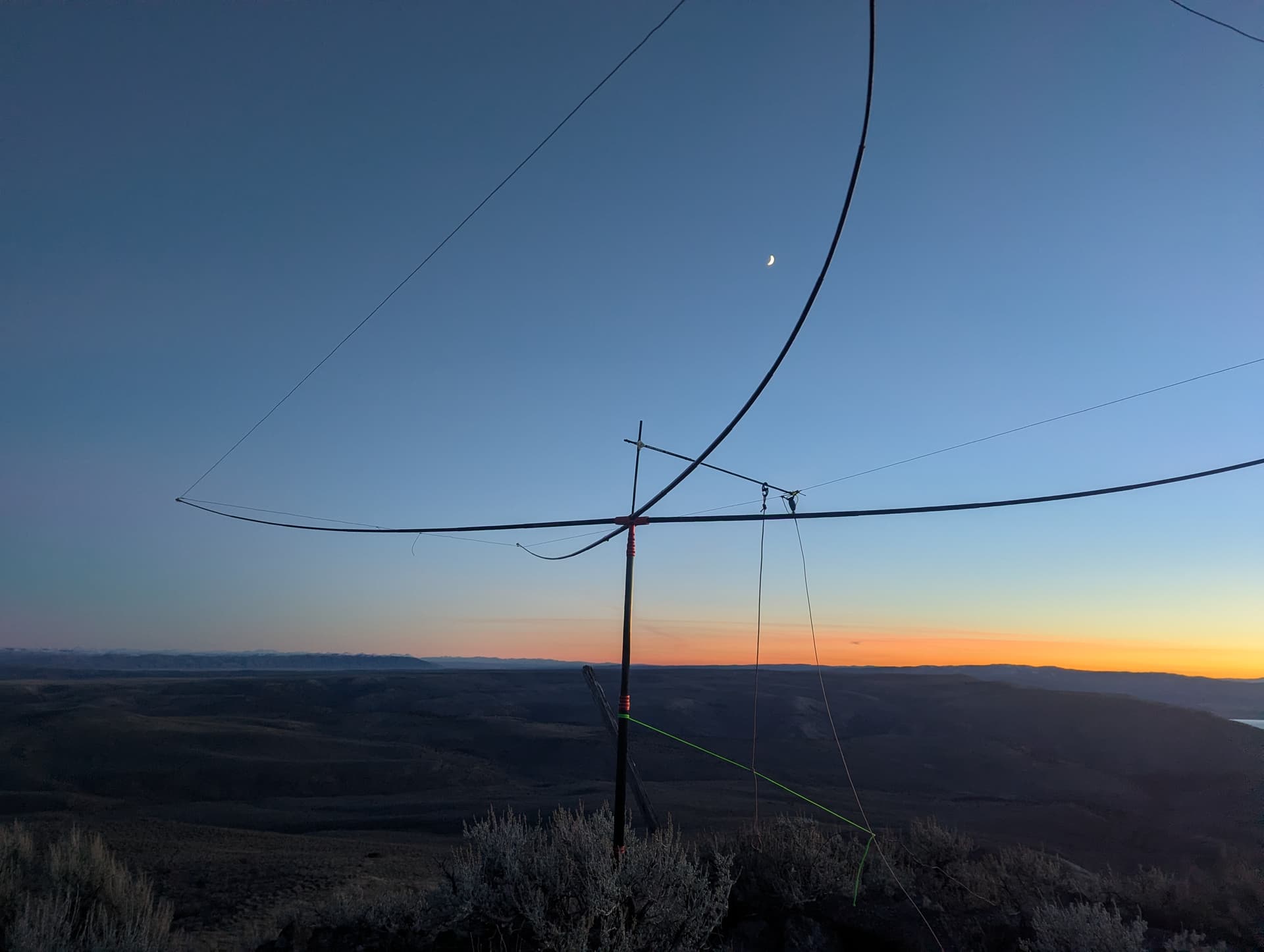
Funny anecdote about challenges in general. I’m still a noob overall but for 2025 I thought the 10m challenge was a thing. I had no idea about reading the reflector. I saw that I had points albeit they were from 2024. Well, I built a 10m moxon after seeing the few points that I had accumulated aided by the fact that 10m was golden this year. Along the way I had a blast and all the while thinking that the 10m challenge page would get updated eventually. LOL! I even built a 6m dipole out of carbon arrow shafts for the 10m/6m challenge although I never got a 6m contact.
I’m still in that steep learning curve phase and very glad I’m on the reflector now. The mistakes were still fun and thinking of gear for 2026 already. I see a wire/carbon yagi in my future.
Please add a few more details about the events to the tabs if possible.
As explained in the very first post about the challenge.
“The purpose of challenges typically is to encourage activity on under-utilised bands or modes. This year, this band and mode combination made up less than 1% of all QSOs logged by activators, and so we are choosing to make the challenge…”
I just created this poll, to see what peoples thoughts are around polarisation for 2m SSB
My first thoughts are, that vertical will be more practical, for both activating and chasing, although clearly a compromise.
What do you think?
When chasing, what polarisation will you be using for the 2m SSB?
Vertical
Horizontal
0voters
When activating, what polarisation will you be using for 2m SSB?
I think this needs deeper thought and more information before answering a poll. Horizontal polarisation is known to be more effective for DX operating which is why it is extensively used for the DX modes. OTOH most operators today will be mainly FM orientated and equipped for vertical polarisation. They need to consider whether the advantages of horizontal for DX would need them to change to get the best results in a challenge where greater distance gets higher points.
I just wanted get a feel. If the majority of people are using horizontal for chasing, the I would probably build something over Christmas. On the other hand, if the majority of people are using vertical, I will just use a vertical antenna.
I am sure that I am not the only person currently pondering on the vertical vs horizontal question
I doubt any poll on this reflector will give us a clear answer nor persuade many to use a different antenna / polarisation than planned. I think there will be two camps:
One camp will use horizontally-polarised antennas e.g. a Yagi, because they want to a) combine their SOTA activation with VHF/UHF contests, b) maximise the opportunity for making dx contacts, and/or c) maximise their points and ranking in the challenge – typically more contacts from fewer summits.
The another camp will typically use the same vertically-polarised antennas they use for 2m/70cm FM (e.g. whip, slim-jim, j-pole, flowerpot) because they a) want the fun of using SSB/CW on those bands without having to spend extra (often a lot of extra) time setting up, b) would like to motivate home-based stations with 2m/70cm collinears to get involved as chasers, and/or c) are less bothered about the points and getting a high ranking - typically fewer contacts from more summits.
Some of us will switch antenna type / polarisation from time to time. And in any case, I will say which polarisation in my self spots.
It will be interesting to see how various antenna choices work out. As well as polarisation, there are options of directivity / gain.
A directional antenna eg a Yagi can be an advantage of course, but can also miss contacts if not moved around. I’ve missed a few contacts over the years when I’m waiting for an activator to finish a QSO. “I’ll just point the beam in your direction” they say to the other station. With that, they disappear into the noise, never to be heard again. I guess this is more of an issue in the midlands, where callers could be in any direction.
I won’t get too obsessed with polarity. I will operate with the equipment I have and work those who can hear me as usual.
I have sometimes had better results on FM by turning the radio through 90 degrees (ie horizontal polarisation). I think it might be that the signal gets diffracted over hills and that alters the polarisation. So we’ll see with SSB/cw…
At least here in my part of the world, the few operators who do 2m SSB already use horizontally polarised antennas. Most of them are DXers and participate in VHF contests. I go where the hunters are, so it’s horizontal polarisation for me.
Having chasers listening for 2m SSB/CW with vertical polarisation will make me much more likely to take part as I can use my existing antenna. I’ll need to take the FT817, microphone and battery instead of the FT65 but won’t have to worry about the antenna. If this is a success then I’m more likely to have a go at building or buying a yagi or moxon. I won’t be worried about the challenge points but it will be good to have a go with modes I’ve rarely tried.
Clearly the SOTA community has too much sense for that Nonsense. Commercial. Rubbish.
It’s one thing to increase your rx/tx range by using a directional antenna but it doesn’t benefit you much if chasers aren’t there to QSO with you when you choose to be on the hills.
Now, if you activate at weekends during e.g. one of the five RSGB Backpackers contests or in the evening during a 432MHz UK Activity Contest then of course you will take your Yagi. But I get the impression few VHF/UHF contesters and serious dx’ers bother much with the slim pickings & low QSO rate outside of contest times.
On the other hand, there are many SOTA activators 7 days a week, every week of the year, with 2m/70cm multimode radios with v-pol antennas plus many potential SOTA chasers at home with 2m/70cm multimode radios and collinears, who – with little effort on their behalf – might be persuaded by the 2026 Challenge to move the mode switch from FM to SSB or CW.
It amazes me that there are some operators that have many thousands of pounds of equipment sat there doing nothing except for 5 or 6 times a year ( and then moan that someone using a small yagi and 10W beats them because they have a better position (on a hill) and then call for rule changes).
Maybe some of them will start listening again .
It does seem funny that back in the younger days of sota 2M SSB was a mainstay along with 2m FM (and its not that long ago). HF was barely used at all and that was mainly 5Mhz and 7mhz for inter-G.
Typical of my timing though that I’ve just acquired a 23cm transverter and that was going to be one of my focuses in the new year
Total value? Priceless. I always seem to find I get far more satisfaction and that buzz of excitement from QSO’s on 270 than I do on HF.
All from a very simple setup and a no frills HT. That is before you then start delving in to meteor scatter, aircraft bounce etc. Way outside of my league and current skill/knowledge level.
Yes you can get deep in to it and remortgage your home and go down the microwave and EME (EVE anyone?) rabbit hole. The simplicity of grabbing an HT, chucking it in a bag and heading outside and making QSO’s while admiring scenery from up high, inhaling coastal air or getting a whiff of pine needles in the thickest of forests, for me, simply cannot be beaten.
…and then there is the gold standard. Chucking an FT-290R in a leather case, lobbing the official carry strap over your shoulder, plucking out the telescopic whip, chucking in a mic and a key and flexing your VHF excellence to the parish like the amateur radio superhero you are!
Never heard of them Maybe you should do some post about them
Mostly agree with your post but I would add the Ft-817 and a small yagi (3ele) for 2m is my preference. Although I would add that my 290 is 3kc off frequency and I don’t have the inclination to fix it (probably more the skill to fix it, it would be 6kc off when I had finished).
Or the methane from the ex-rubbish tip below G/SP-017
Its not that difficult. I built a 3 el yagi for 70cm in less than an hour using three lengths of brazing rod stapled to a length of wood, a shorter length and small matching trimmer, and a length of coax and plug. The length of wood was long enough to provide a handle for hand-held operation. I actually completed it and made a successful chase while an activation was taking place on a nearby summit!
A good option for 2m is a similar 3 el made out of lengths from a sacrificed tape measure, easy to pack away but the flexibility may cause problems in a strong wind! There is a design on line. I was actually going to try a larger version of the 70cm yagi using lengths of copper-plated welding rod (having run out of brazing rod) but never got around to it having decided I was getting too old for activating.
The combined 2m+70cm handheld yagis sold for satellite work make a good commercial option, you really don’t get a lot of benefit from a mast if you are on the edge of a steep slope, and hand-held makes it easy to twizzle the antenna to match polarisation with chasers!
 The mistakes were still fun and thinking of gear for 2026 already. I see a wire/carbon yagi in my future.