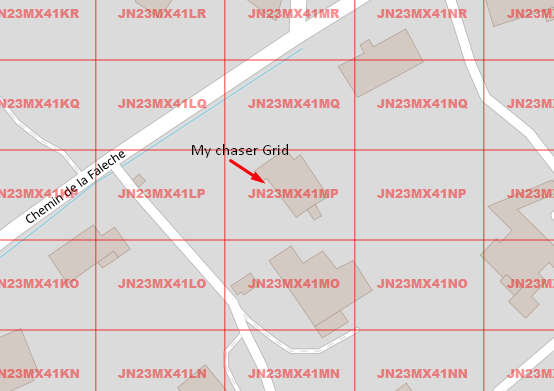
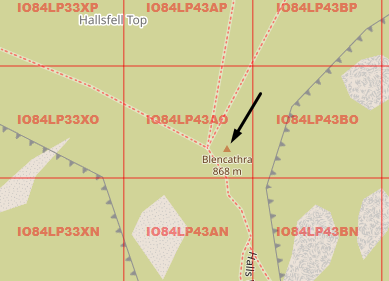
So if I am chasing and just send “home” for my location, that would mean it is the one listed in the SOTA database (that I just updated)?
If so, (asking in a very polite voice) would that information be available to the software for performing the necessary calculations?
As a former software engineer (including prehistoric FORTRAN 2, PL/I, ALGOL, and JOVIAL, among others) I understand it isn’t always as simple as it might appear.
I was chasing from my Mum’s house in Sutherland a couple of weeks ago and called in to the WAB net on 7.160 , they were very keen on a rare square , NC85.
Confusing is that prior to The Maidenhead system being brought in, we VHF/UHF/SHF operators used a grid system called “QRA Locator” which covered Western Europe (but not further afield - which is why, the HF operators brought in Maidenhead). How do I know this? For my “A Level” project, I wrote a VHF and up, Field day scoring system that ran on the local council’s ICL 1900 mainframe, overnight, from punched cards over 50 years ago - it calculated distances between QRA locators to calculate the expected score on the HADARS (Hull E-Yorks) club’s 4m/2m/70cm/23cm contest entry. Nowadays (with Maidenhead locators rather than QRA locators) I can do the same with a macro in Excel!
It’s a shame that the field in ADIF says QRA rather than MDN or something like that.
Definitely going to motivate me to get on 2/70 SSB and CW more and work out how I can maximise my distance. Already loads to think about for me as I don’t activate on 2/70 that much, then @G7ADF goes and drops linear satellites into the mix! At my rate of progress getting going with new things, not sure I will manage to tick that one off in 2026, but you never know…
First on the list for me is flashing the SSB/CW capable firmware onto my Quansheng, which I’ve been meaning to get round to for a few months. And maybe use Gaulfest as a bit of a warm-up, as there’ll be lots of us out with 2m/70cm?
QRA locator itself seemed nonsense to me, as I recalled then and have just checked, QRA means “the name of my station is…” so has little to do with location unless stations were named for their locations. Still, in its day the QRA loc was really useful and the succeeding Maidenhead loc is invaluable.
Why QRA Locator - QTH Locator ?
A bit of the story
Brian @G8ADD can agree ?
Maidenhead Locator System…
The “Maidenhead Locator System,” often shortened to “Locator,” is a location system used by amateur radio operators. Its name comes from the small English town of Maidenhead, where the system was first proposed in 1980 by English amateur radio operator John Morris “GM4ANB” at a VHF operators’ meeting. It replaced the older QRA-locator (1959) and QTH-locator (1972) systems.
It allows for the transmission of a location using only a few characters, which is very useful for slow transmissions, such as Morse code, but is now used for all modes of communication, whether voice or digital modes.