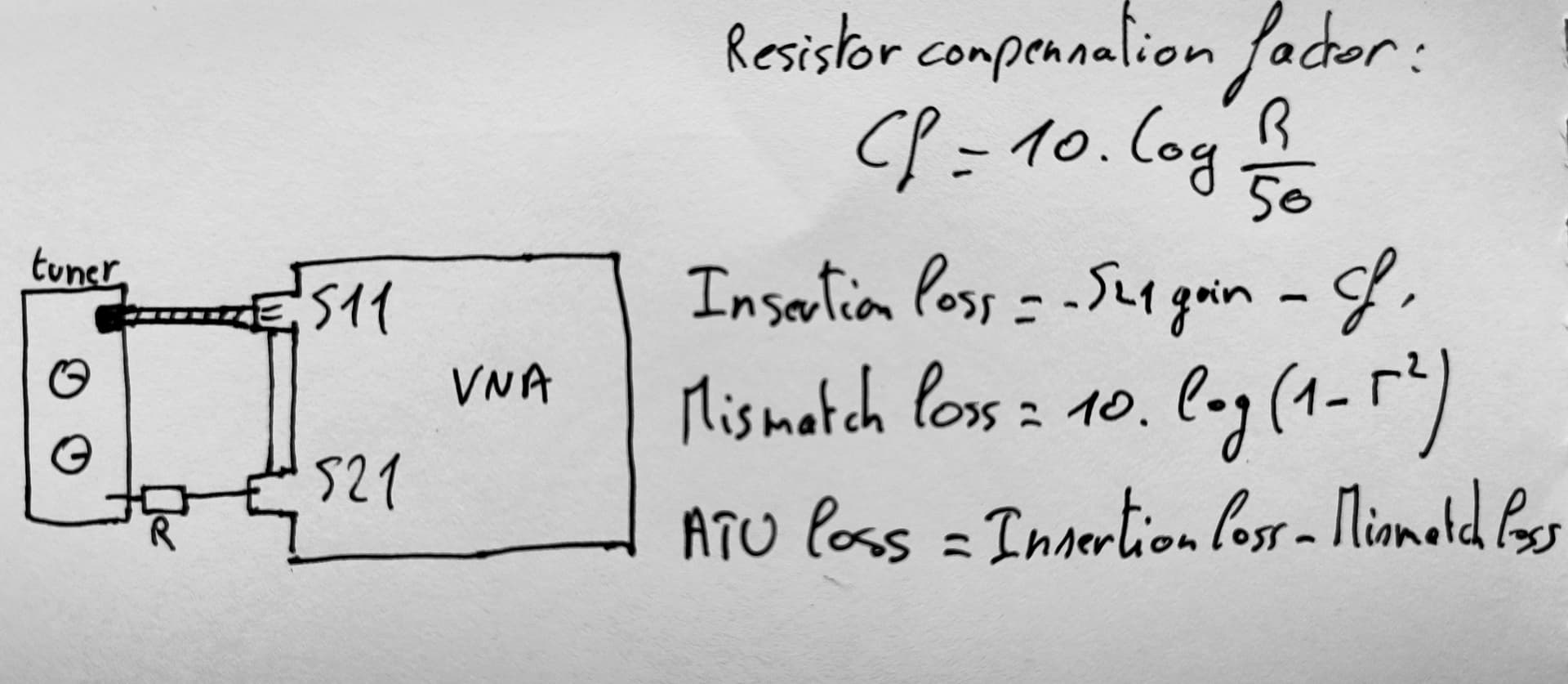
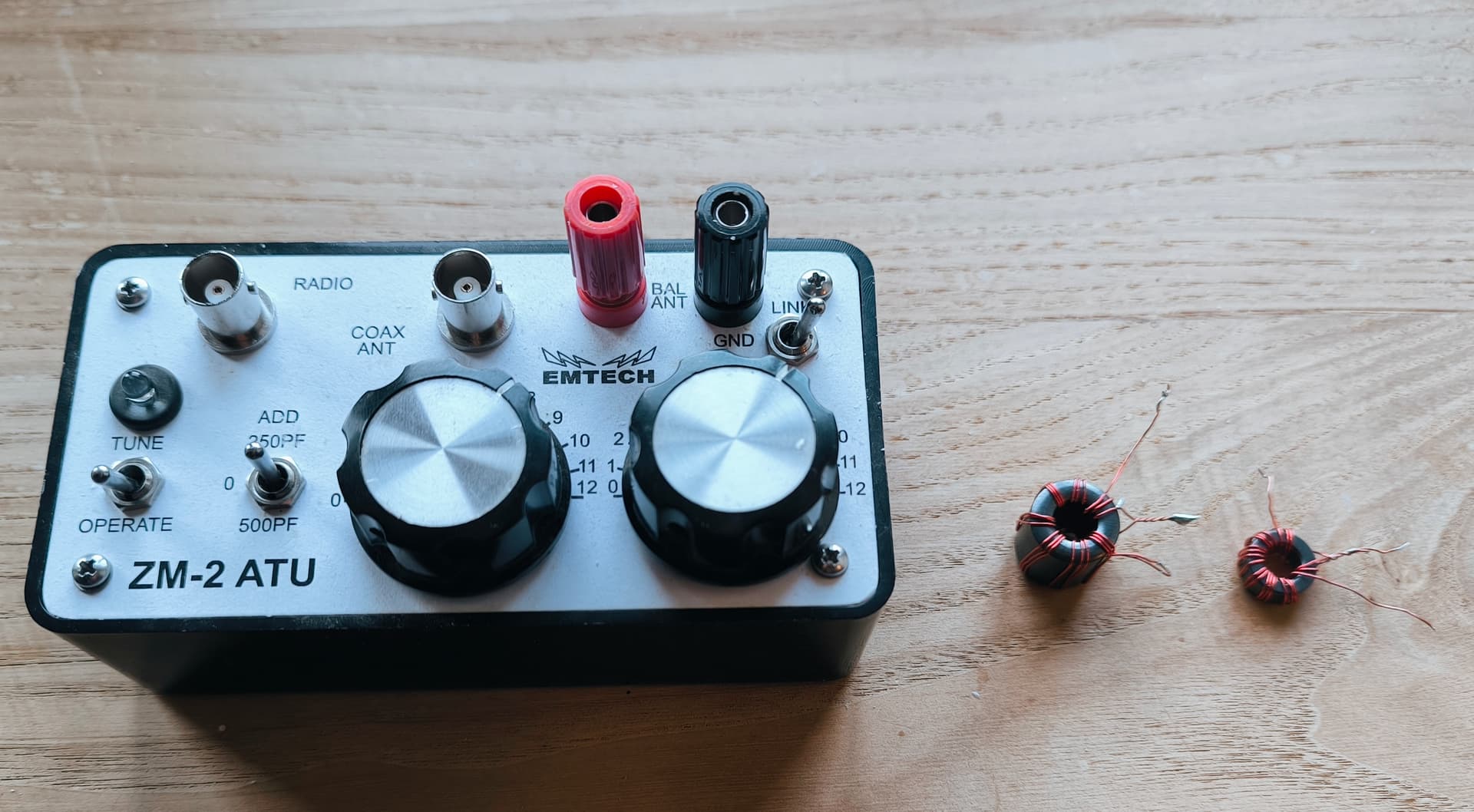
The other day I was trying to build an L-match for a new random wire antenna and I remembered that I had a ZM2 ATU sleeping in a drawer. I recalled how easy it was to tune almost anything with it, so I decided to connect it to a VNA and a 450 ohm resistor. It tuned very easily on 7, 14 and 28 MHz during the test, with a vSWR close to 1:1. After that I wanted to estimate its efficiency.
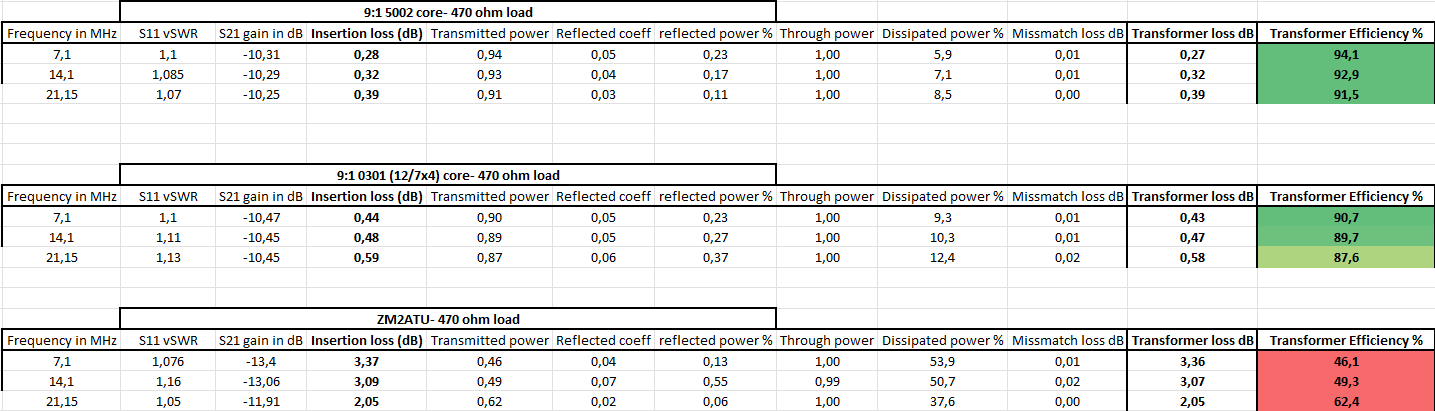
Then I wound two 9 to 1 transformers (7 turns) on two different type 43 very small toroids, used the same test setup and the same resistor, and compared the results.
Did I make a mistake or miss something? I had read that a Z-match was not very efficient, but I did not expect it to be that low. From 5 watts you get about 2.5 watts out. That hurts.
Efficiency has been a problem with some Z-match circuits, depending on the load impedance. I remember one of the early single-coil Z-match articles switched from 1.3mm (AWG #16) wire to 2mm (AWG #12) wire for lower losses.
I did notice that my Ten-Tec AC5 balanced tuner seemed to get better RBN results than the ZM-2 when tuning a 40m doublet on my roof, even though the AC5 coil is somewhat oxidized. But I haven’t tried actually measuring the losses yet.
I would note, however, that in your drawing the tuner is matching a 500 ohm load, rather than 450 ohms, due to the 50 ohm input impedance of the VNA port. As long as your calculations and the tuner settings take that into account, I don’t think they are too far off.
Not sure if this is what you are looking for, but I ran my QMX into my power meter and then ran it through my ZM-2 into the power meter after matching the dummy load. I got about a 15% loss of power. 5.3W straight into the meter. 4.7W through the ZM-2.
When calculating the attenuation due to the load resistance, the input impedance of the VNA must also be taken into account, i.e., -10 log(50/(50+RL)) [dB].
Finding the correct Z-Match setting is often somewhat problematic due to the very narrow dip and the accuracy of the available SWR indicator (LED or SWR display on the TRX).
By the way, there was a thread about Z-Matches on this forum some time ago, which also contained some references; I think these might have been among them
All ATUs have losses which mount up for higher or low load values and higher frequencies. But having half your power lost is better than not being able to operate. Small tuners have higher losses - another compromise for smaller size.
No free lunches folks.
If you have a resistive load then a transformer or balun will have higher efficiency.
Oh yes, my mistake, I’ve always been confused by this. I corrected the calculations and here are the new results. It doesnt change the conclusion though.
It’s kind of striking how variable and “unpredictable” the efficiency can be according to the frequency and matchbox design.
However, if I undestrand correctly, the results of the “QRP single coil” (closest design to ZM2 ??) design are pretty good at 7 and 14 mHz in VK5BR’s experiment, with loads between 50 and 500 ohm
Well, maybe it doesn’t have to be binary. Instead of one tuner that does everything at 50%, I could use several specialized tuners that each perform one task at 90%.
Note that for many current rigs the S meter is set at 3dB per S point, not the traditional 6dB. This is according to the S meter calibration reports in rig reviews in Radcom.
And VHF FM radios are even more optimistic. I’ve measured several that have about a 12 dB range over the whole meter, regardless of how many “S units” and “dB over S9” are marked on the scale.
And some rigs may only have 5 or 6 increments on the bar graph, so don’t really give much resolution. You don’t want to rely on the meter markings to give accurate antenna gain comparisons - I’ve seen a 1 dB difference drive the meter from S5 to S9.
Yaesu does it this way, and also with current devices. Perhaps for traditional reasons, because in classic superheterodyne receivers the S-value was derived from the AGC control voltage. And this is not logarithmic to the input voltage.
Also Icom doesn’t use 6db per S point: for instance in Peter Hart reviews the IC7300 and IC7760 both show two S points for a doubling of input. I drew attention to this because many of us think in terms of 6dB per S point but this is a long obsolete standard.
The KX2 and KX3 have 5 dB per S-step. Most Japanese transceivers have 3 dB. The TS-890 can be switched in the menu between the Japanese standard of 3 dB and the IARU R1 standard of 6 dB.
I think what is needed is to do is “know your S-meter”. A bit like knowing your car speedometer.
Cars sold in Europe are not allowed to report a speed less than the actual speed. But they can report a faster speed. This means all speedometers report you are going faster than you are. Which is good, the speed limit is 60mph and you drive at 60mph, you will be going slower and wont be caught speeding. In my current car it under-reads by a constant 2-3mph. So 30mph indicated is 27mph actual. Once you know this you can drive at the speed posted. I’ve checked my speedo against a few GPS units and have regularly driven at the GPS speed and not (yet) been caught by a speed camera
It’s the same with S-meters. S-meters should report 6dB / S point but many don’t. We should all think in 1 S point = 6dB for any kind of comparison and then convert that to the actual S meters we own. Or vice versa. But it doesn’t matter what the meter reports as long as we know how to convert the actual S meter reading to honest-to-god S points. c.f. honest-to-god-copper
And with all ATU device losses the important facts are: does using this antenna/tuner with its possible losses give advantages that outweigh using dipoles and coax feeders (where the losses are more easily predicted)?
I only look at the KX2 or 705 meter if there is something exceptional about the signal. i.e. it’s a real rockcrusher and then it is fun to see all the segments lit up.
S meters were absent in my first couple of receivers. So I’ve tended to still give my reports as “as heard”. Receivers these days usually have S9 set to a specified number of uV input. Some old valve receivers had good logarithmic response and at least one manufacturer set the zero reading mark as 1. That prevented those 5x0 reports.
Modern SDR receivers should be able to give proper field strength readings, and some do, but with every man and his dog in the sales Dept having an input, all manner of “improvements” happen.
I’m surprised no one seems to have produced a small board to change the FT817 S meter from entertainment to sort of meaningful.
Well that’s a question Ron. This reason for the delay in answering is for many reasons I’ve not been out SOTAing or doing any radio for a while or so until today that is. This call was last used before 1990 as that was when the previous holder went SK. I don’t know if it had been idle for any time before then.
So first use today and it worked No problems having QSOs on 2m or HF.
The only minor issues were
I am so used to the programmed CQ message in the KX2 memory that with the call updated it sounded wrong and I kept looking at the display to see why the call wasn’t MM0FMF!
A few times on SSB I started to say “Mike Mike Zero” but never gave the full wrong callsign.
I didn’t fall into sending MM0… on the key which was good.
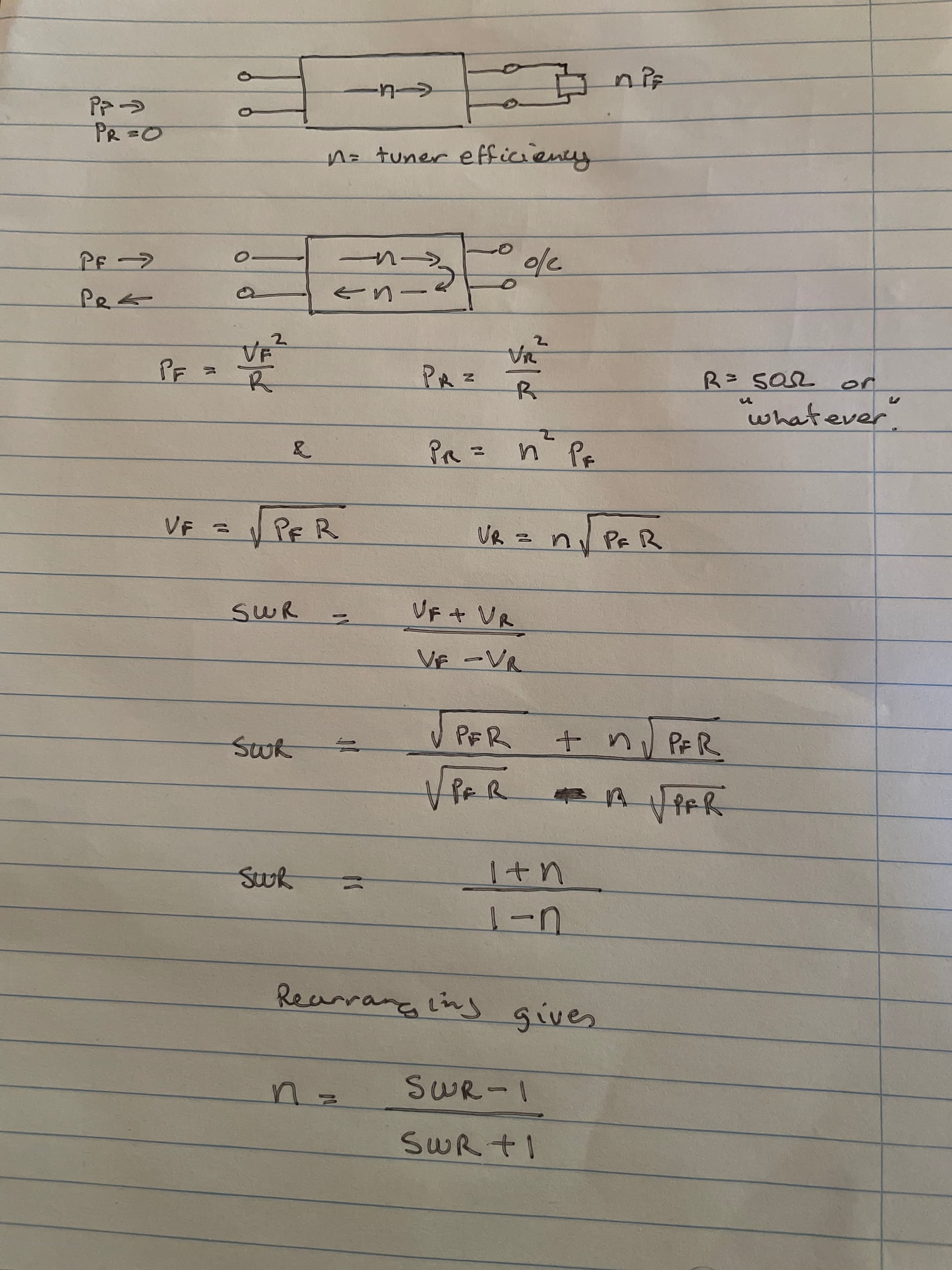
I’m not sure that works, because the current distribution is different in the two cases.
I haven’t gone through the math in detail, but when I was calculating feedline losses by measuring the impedance / return loss / SWR with the far end open- or short-circuited, I got different results, even though the nominal SWR is infinite in both cases.
When the feedline being tested is only 1/8 wavelength, for example, current is maximum throughout the line with a short circuit, and minimum with an open circuit. Because the primary losses at HF are due to the conductor resistance, the high current case has higher losses.
So if the tuner had a large coil in series with the output, the coil resistance would be in the circuit with a load on the tuner (particular one with a low impedance), but not when the tuner was open-circuited.
This would be easy enough to test, of course, by adjusting the tuner to match a 50 ohm load, where the actual losses could be measured with a wattmeter and dummy load and compared to the calculated result. Or using a resistor in series (or parallel) with a 50 ohm terminating wattmeter as the load on the tuner
edited to add: the wattmeter reading would need to be corrected for the series or parallel resistor, of course.
You are right. My approach would not “see” a lossy inductor in series with the output.
Maybe doing “open circuit” and “short circuit” tests, then taking the geometric mean would be a better approach?
My knowledge of circuit theory is a bit rusty. It pre-dates the internet & Arpanet (and probably the research that led to Arpanet). ie. more help needed.




 No problems having QSOs on 2m or HF.