When USA FM Stations were heard in Spain

Found this really interesting piece about FM broadcast stations in the USA being heard in Spain.

It got me thinking if there was any such skip on 2 metres for amateur operators in 2026?

It also reminded me of the fella who bagged BBC television from the USA. That was in 1981 though so not exactly a regular occurrence (that I’m aware of) between 1981 and whenever terrestrial analogue telly was switched off - I forget when.

1 Like

Here’s another rabbit hole to investigate :laughing:

A very brief search didn’t find any more recent references. The challenge was set up by IRTS, I think Aiden EI8CE was involved…

1 Like

Very cool! I had heard mention of someone in EI getting some juicy VHF DX a while back, and also I think there was some EI to USA VHF DX in 2026 but I don’t know if it was 2 metres amateur or broadcast or what it was.

I’ll have a look back through old issues of IRTS Echo Ireland magazine. There’s an archive on irts.ie which might have record of it. Not sure how far back the online archive goes though so I might have to ask someone if they have any copies of Echo Ireland from 2014/2015.

Now you have me wondering about DX distance records on 2 meters, 70cm and SHF!

1 Like

Didn’t take long!

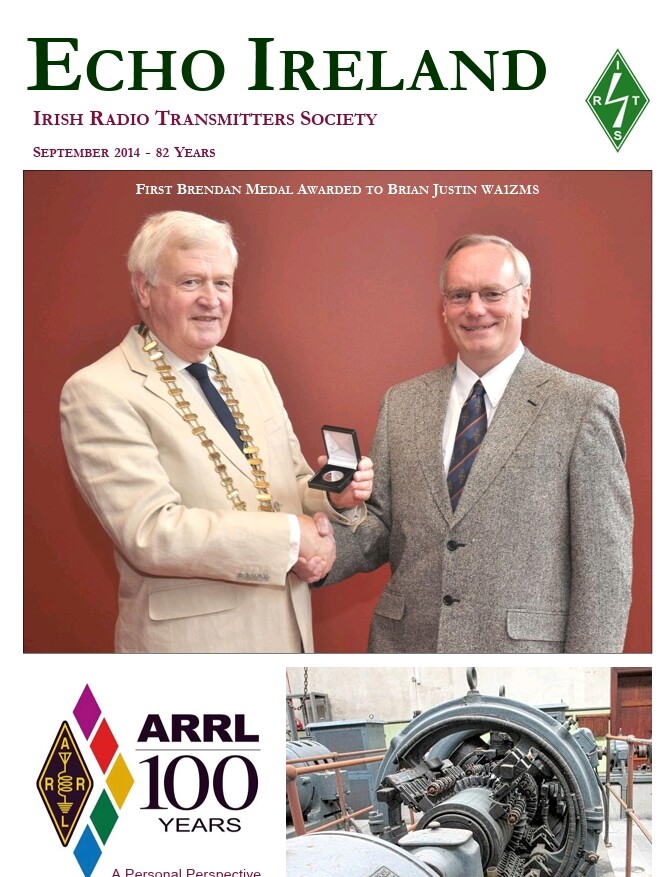
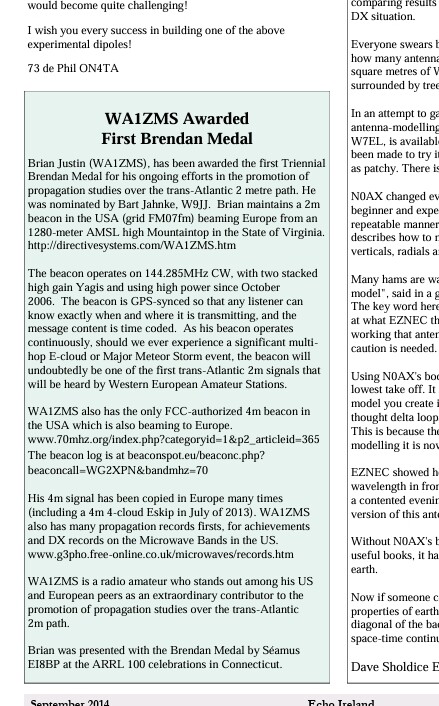
The IRTS Echo Ireland archive goes way back! It’s in the September 2014 edition as the cover feature. See attached screenshots:

Took the screenshots on my blower via Dex so apologies if the quality is a bit trousers.

EDIT: Sorry, hit post before adding the other part. In the December issue, there is another article, but it spans multiple pages so I didn’t screenshot it. Text is here instead:

Brendanquest
The Canadians sent a power point presentation, ‘Trans-
Atlantic Presentation’, to the IRTS AGM in Galway. The
presentation outlined their plans, using the call sign VCIT, to
bridge the Atlantic on 2 metres under the IRTS Brendan
Awards Challenge. A web site was set up see
www.brendanquest.org and a Yahoo group formed for the
event. The attempt was scheduled for the 4th to 12th July. This
was too good an opportunity for LRC to pass up, especially
since the club had already gained some experience from an
attempt during August 2013 from Loop Head, in cooperation
with our twinned club in South Jersey

A lot was learned from that attempt which helped in
preparing for the challenge led by VCIT. LRC’s previous
attempt highlighted the need for a new 2m Linear Amp as the
Dressler 200/S, used in 2013, was beginning to sweat after a
relatively short time of almost 50% duty cycle. Two club
members set about building solid-state linear amps. They
were completed during the final week leading up to the
attempt.

The club operated continuously, from Loop Head, from the
4th to 6th July using JT65B and FSK441. In the true spirit of
Amateur Radio many members contributed various items
such as test equipment, pre amps, coax relays, GPS timer,
Laptops, rigs, PSUs and a veritable ‘mares nest’ of
connections to make up the final system. Two phased
Cushcraft antenna were used on the club’s pump up mast.

During the Brendanquest attempt in July, Brendan EI0CZ
was testing a Cushcraft A3 HF antenna and found that due to
QRM, 20m was unusable. This problem could have a serious
impact on the Club’s IL&LW event in August. A quick rough
check showed that the peak of the QRM transmission centred
on 13.5 Mhz. Further investigation and enquiries proved that
the problem lay with the proximity of LRC antenna to a
newly installed HF Radar wave height monitoring system at

Loop Head called CODAR. Altogether, there are four HF
monitoring units located in the wider Galway Bay area. See
http://marei.ie/coastal-observing-radar-system/ also http://
www.codar.com/SeaSonde.shtml.

A satisfactory resolution was found and the Club wishes to
sincerely thank NUIG for switching off the wave height
monitoring equipment during IL&LW and to the
Commissioners for Irish Lights for facilitating our request for
a resolution to the problem. It should be noted that the
problem was due to the proximity of the antenna to each other
(circa 50m) and consequently direct break through to the two
LRC HF rigs.

The club is also grateful to Clare Co Council whose PRO
used the weekend to advertise our presence at the lighthouse
across local and national newspapers and we also got our ‘10
minutes of fame’ on 3 local broadcast stations.

That report was from Limerick Amateur Radio Club. I’ll have a look at other issues to see if I can find more information.

1 Like

If only there were books and websites explaining VHF propagation modes. :wink:

1981 = top of solar cycle 21
BBC1 audio was on Band I or around 6m. BBC Holme Moss transmitter was about 12kW AM carrier on 48MHz. About 4db antenna gain so 30kW carrier or about 120kW total.
So this will be most likely a wee spot of F2 propagation as the destination was Texas.

BBC video was received in 1938 in New York area. That would most likely be F2 as it was the top of cycle 17. This time from Alexandra Palace.

UK Band I and and Band III TV were shutdown in January 1985.

2 Likes

What the…!? :exploding_head::face_with_crossed_out_eyes:

I had to look that up to see if it was people telling fibs! And not only did it actually happen, but it was caught on film when it actually happened!

Unbelievable Jeff! :exploding_head:

4 minutes of BBC TV DX to New York captured live on film in 1938:

I’ve to go for a lie down after that. That’s unreal. Had to surely be one of the greatest telly DX catches of all time right?

Andy, thanks a million for that. That was one of the best nuggets of history I’ve ever discovered. Thank you. :+1:

1 Like

Moon landings perhaps steals it on distance. :slight_smile:

2 Likes

No chance! According to YouTube they were faked! :face_with_peeking_eye:

2 Likes

What? A high power 41MHz signal being received via F2 over 3000 miles… small potatoes. BBC Band I TV was received by F2 at 10-11000 miles in Australia in 1957. The output power of the TV transmitters was 10x or more the pre-war levels. Ah 1957, the greatest solar maximum in the modern period. Memories of those QRV at the time will tell you how boring it was to work all over the Pacific from Western Europe with 10W AM and wee dipole. Day after day after day with the 50s less than stellar sensitivity radios.

3 Likes

Modern modes and receiver technology did not invent vhf dx. It just made it easier to observe.

Those conditions have been operating from the period of the dinosaurs, which became extinct not because of meteors but because they didn’t have modern receivers.

Or perhaps they did, and got bored with FT8 contacts.

7 Likes

At around 16billion miles, Voyager 1 has to be the best DX ever.

Around 25W on 2.3Ghz is not too shabby. Not a lot to get in the way though.

A supernova is detectable at much further distances across the whole spectrum but at around 10^38 W we will exclude them for being too QRO.

Running the amp upto 10^69W we do get the big bang where the signals are still bouncing aruond to this day, but that was generally thought to have been a bad idea. Licensing conditions and penalties have been introduced to prevent this happening again.

4 Likes