A current balun does the job of preventing common mode current on the feedline, which is what you want a balun to do. A voltage balun doesn’t.
And a current balun is simple: wrap enough turns of coax through your ferrite. If the core isn’t large enough, you can use two parallel wires in place of the coax, using small enough wire to fit sufficient windings onto the core. “Enough turns” depends on the core size, type, and frequency: for small size you may need to resort to RG-178 coax (or 0.25mm wire-wrap wire).
But, to be honest, most of my portable dipoles don’t use a balun.
Like my Portable Dipole Kit, that has traveled half way around the world since about 1980.
Occasionally I might run into a problem, but in most cases, even at 100 watts, it works well enough (even if not perfect) that it isn’t worth the added weight and fragility of hoisting a lump of ferrite in the air.
If I do have a problem (often the SWR changes with coax length, or doesn’t change when I adjust the dipole wires) then adding some extra coax may tame things a bit. (In one case, plugging in my headphones change the SWR curve.) But finding a suitable coax length to start with may avoid such issues in the field.
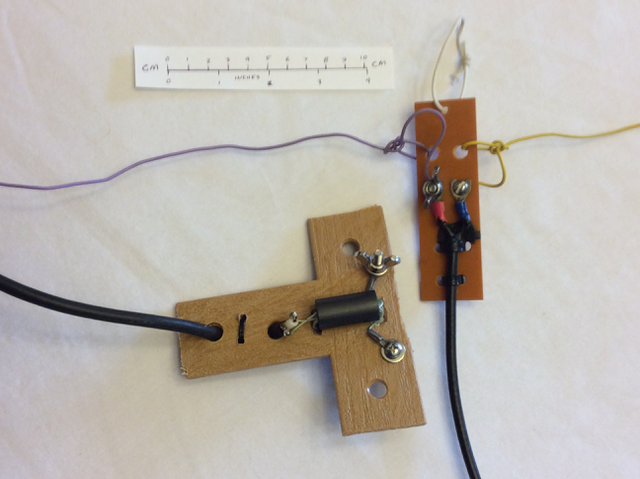
I have started experimenting with putting baluns on some of my cables, especially where I want to take repeatable measurements. A typical design uses two of the cores designed to slip over cables, one on each side of the center insulator, with thin coax wound through them. You can see one in this photo:
(These are larger than the ones I use for backpacking.) But the FT82-43 should also work.
A balun makes performance more predictable. But if you are always using the same wires and feedline, and you don’t have problems due to lack of a problem when testing it at home, then likely you won’t when in the field, either. The balun certainly is useful for reducing noise pickup from all the electronic noisemakers in a modern home, or when using a noisy generator (or switched-mode power supply). For battery operation from a remote summit, that’s usually less of a problem.
Don’t let perfection stand in the way of “good enough”.