Thats it! I very much doubt the laird would have got his hands dirty by doing any of the work.
1 Like
CW or SSB, headphones make a lot of sense - particularly in high winds.
2 Likes
Yes, i’ve started using headphones, mainly because the Xiegu x6100 speaker is not the best but… headphones were super useful in the wet - radio stays enclosed in the dry bag while mic and headphones the ones facing the elements.
Which reminds me, the biggest problem i face with the x6100 is the dial has no purchase and its so easy to touch this and your off frequency quickly. i would love a solution to this…
3 Likes
It is easy to forget how much current is taken from the battery running a loud speaker output stage - especially if the volume is turned up to overcome wind noise. Headphones good for lots of reasons…
.
1 Like
I always use headphones for CW, even at home in a quiet shack. I have to have the sound right at my head. Plus none of my homebrew rigs have speakers.
1 Like
Going off at a slight tangent, I’ve found that a set of line tensioners make the job of setting up guy lines much less of a faff because you can tweak the tension very quickly without having to reposition the pegs.
3 Likes
A good idea.
I guess a short length of elasticated cord/string/ would also work reasonably well. It would also take a bit of strain off vulnerable points of your wire antenna, especially in windy conditions.
2 Likes
I just got myself a few sets of replacement fluorescent guy lines from the local camping shop. They come ready fitted with tensioners, have just a smidge of stretch in them, and they’re nice and bright, so slightly less likely to be tripped over…
2 Likes
I bought a few sets from ASDA a few years back. £1.50 for 4 guys with tensioner. Seen in my more recent activation photos. Here’s one from Scald Law GM/SS-125 with a Decathlon 5m pole and 60/40/30m dipole. The Decathlon 5m pole is very, very bendy and really could do with a top guy to stop top flex in strong wind. Apart from that they’re good poles.

The Trig Point on this summit has massive attraction resulting in there always being someone taking a photo by it and so is not a good place to set up antennas !
2 Likes
Your guys are way longer than I was expecting to cut mine ! Makes sense.
and if i understand correctly thats a cheap 5m fishing pole from Decathlon ? looks just the job providing its light ?
2 Likes
What’s less obvious from the photo is the ground is sloping away from me quite a bit so the top guy is longer than normal to keep the angles at the guy collar “right”. If you look carefully you can see the adjuster is quite near the ground/peg. Normally it’s somewhat nearer the pole. Ideally the collar could be 300-500mm higher up the pole. But it works fine at that point and the collar also fits other poles.
It’s this item: Pole Fishing Starter Set FirstFish 5m Rod + Rigged Line CAPERLAN - Decathlon. The fishing stuff is of no use but the pole collapses to 57cms which is great, it doesn’t poke out above the rucksack and fits in suitcases or air travel. I also have a Decathlon 6m carbon fibre which is minute and super lightweight but pricey at £49.99 and a Lifes-a-breeze 5m travel pole. That last pole is twice the weight of the Decathlon 5m pole but is built like a brick outhouse. It doesn’t bend in the wind  Sadly they’re unobtanium now and I’m so annoyed I missed out on the last chance to order one.

3 Likes
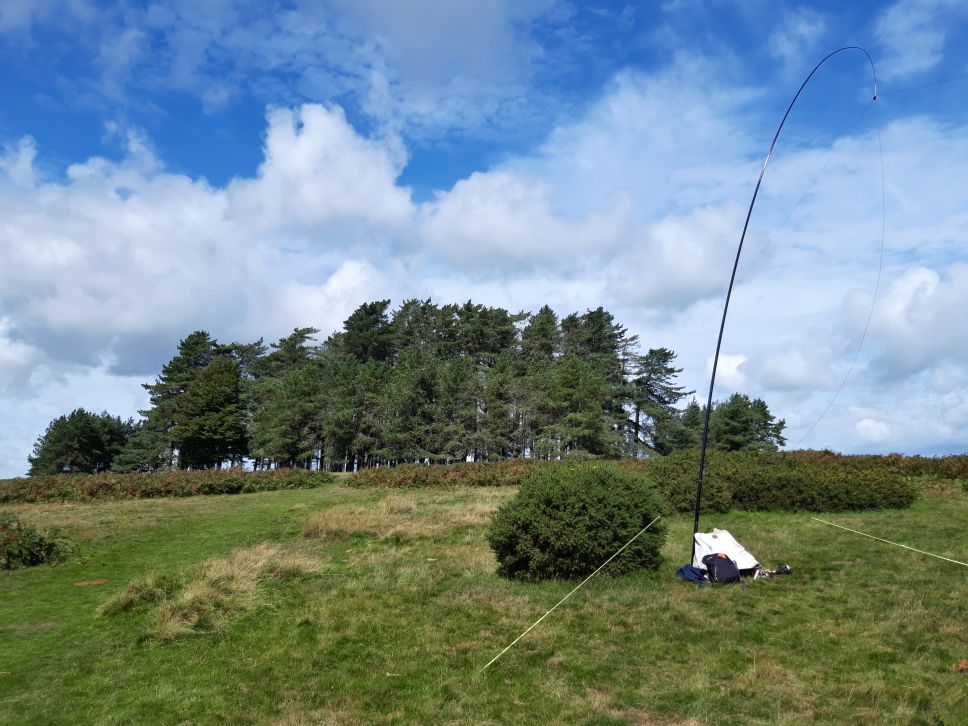
Here’s my set-up on May Hill G/WB-019 back September 2020. The gap between the pole and the fluorescent guys is some black dacron I used to extend the guys because I needed them to be a bit longer for a 20 metres GP vertical I was experimenting with at one time. Since that time the 8 metre pole has lost its tip more than once, and it’s now rather nearer 7 metres, and not quite tall enough to do the 20 metre GP properly, but it holds my link dipole up well enough, and still has enough flex in it that I don’t often need to lower the mast to change the lower band links.
3 Likes
It’s interesting how low down you two are guying your poles. My guys may be a similar length but the collar fits much higher up my pole. I’ll have to try guying lower to see how it works - I’d imagine yours bends more in the wind than mine, but perhaps is less likely to collapse.
2 Likes
It doesn’t happen often, more due to dirty joints. There’ll be a couple at the guy collar… the force from the wind being a function of wind strength, mast thickness (drag) and distance from collar all having to be balanced by the friction of the base on the ground. It seems to work!
2 Likes
My mast doesn’t often collapse. I’ve learnt to make sure all the pole joints are tight - if it’s windy and not too cold I’ll take my gloves off so that I can really tighten it. A few weeks ago on G/NP-032 it was extremely windy (probably the windiest I’ve ever had on a SOTA activation). The wind made my EFHW pull the pole and it collapsed. I got it back up quickly but it was also raining and I think it didn’t stand a chance after that as the failed joint was now wet, so it collapsed several times. In that case I don’t suppose guying it lower would have helped.
2 Likes
reasoning it through:
The pole can be the heaviest and bulkiest item in the kit, so let’s START with the pole. I would like it to be light and to collapse to a small size for transport. The lightest I have found is an 18 foot tall pole (I think it is 17 sections), that weighs about 7 ounces and collapses to just 18 inches. Hooray! I fit a fishing pole tip-top to the thinnest top section, then insert that with hot-glue into the next section down to stiffen it.
Now that we have the pole, what antenna to put on it? Certainly not a dipole with the coax feed located at the high current (highest radiation point) which now must be at the top of the pole forcing the pole to carry its weight. That forces a heavy and heavy duty pole (that won’t double over under the weight) which needs to be guyed to stand straight up if it can’t be bungied to something.
The antenna needs to have just a wire up there, and a light wire at that. At QRP power levels the wire can be #26 or even #28. I use teflon coated for low resistance and high strength. The wire needs to go off to one side so the pole can be leaned to have only a minor bend in it the way a fishing rod is supposed to work. If stood straight up, the bend on top of the pole would exceed 90 degrees and the pole would likely break.
the wire is deployed as an inverted-L such that about the first fifteen feet of it is vertical, reducing the length of the wire that must be support by the pole. The far end is supported by non-stretch 40 pound test fishing braid which looks like a thread, has essentially no weight, and no wind resistance. There is no need for an insulator, but if one feels like it must, it can be a button. The descending wire must not wrap around the pole as it is sufficiently conductive to detune the wire.
If the wire is a so called random length wire, say 42 feet, then the feed point at the bottom the pole is high current and thus ground lossy, not to mention that it requires a lengthy ground radial which is essentially the same as laying part of the antenna on the ground, again lossy.
Thus, an endfed halfwave is called for. This requires very little counterpoise which can be fulfilled by the headphone wire at such low power. Band change can be simply accomplished by placing a tiny SPST switch at appropriate lengths in the wire, or by miniature traps. It does require a high impedance matching device which can be very small at QRP power levels.
The end of the wire can serve as the feedline, no coax at all, no loss from the coax, no connectors to potentially fail, no time to uncoil, and no weight. The end of a halfwave has essentially no current and doesn’t radiate anyway.
The leaning pole will be pulled to one side by the wire. This gets rid of any need to guy it. The pole needs only to be braced. This can be done by leaning it against a small bush. If nothing is growing, then a simply pile of rocks, a cairn like structure, will be enough to support it. If there are no rocks around at all, then either a narrow stake driven into the ground with a rock, the pole mounted over it, or a short perhaps PVC pipe driven into the ground and leaning a bit in the direction of the wire, will do the trick. There are commercially made widgets to support fishing poles standing upright in the sand that could be used.
I have used this on barren mountain tops over 14,000 ft elevation, pole stuck into a rock crevice, in winds over 60 mph without issue. It is light in weight, simple and quick to deploy, take down, and works well.
Maybe this will induce some ideas which are suitable for you!
Have fun, 73, Fred KT5X (1,000+ activations so far)
5 Likes