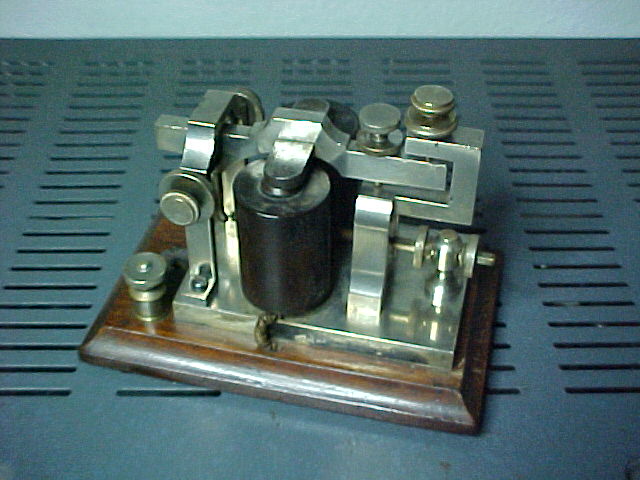
Not wishing to hijack the ‘Enigma Crypto CW Transmission’ thread, I am continuing the discussion about J38 morse keys here.
Those with engineering experience know that a drawing communicates far better than yards of narrative. And while most corporate desktops provide MS Office, packages such as AutoCAD are less common for reasons of need, cost etc.
But all is not lost. Though many use PowerPoint to ‘bore the pants’ off their colleagues with endless ‘bullet-point’ slides, it has a better use. With a little practice, it makes a ‘passable’ engineering drawing tool.
To evidence this assertion, below you can see a PowerPoint drawing of a J38 morse key.
Having done a little more research, it would seem that initially these keys were used for training and land-line communications.
The key is setup as shown in the drawing. In operation, with the CLOSER BAR open (pushed away from the RED contact) the operator is able to transmit her message by keying the land-line. By moving the CLOSER BAR so it touches the RED contact, the key is ‘shorted out’ and the headphones connected directly to the land-line; incoming messages can then be copied.
For use with a radio transmitter, the keying line is connected to terminals 1 and 3. Terminals 2 and 4 are not used. As noted earlier, use of the CLOSER BAR now allows the operator to have both hands free for ‘plate and loading’ a valve/tube PA.
When cathode-keying, say, an 813 (look it up) there will be lots of voltage on the RED contact. Keeping your fingers clamped tightly on the KNOB avoids any potentially life-changing experiences
Probably not for Activators, but still a valuable tool for Chasers
Nice explanation, Dave. In land line telegraph, the sounder (SOUNDER? photo attached) would be connected where you show the earphones in your drawing. Also I note that in many classified ads on QTH, QRZ, etc. folks advertise “J-38” keys for sale, but they really are not J38’s. But they look and function the same. Some don’t have the circuit closer bar, which is OK, since it’s not necessary on radio circuits.
As far as I can tell, “J-38” was the military part number and such keys were made under contract by a number of different manufacturers, with some variations in design. Mine is one that my father brought back from the navy after WWII. It has the shorting bar (handy when adjusting an antenna tuner), but not the Lionel logo. It’s still an authentic J-38, just not made by Lionel.
Another variation is the width of the contacts: mine are pretty narrow (about 2mm, or 3/32” in diameter), while others are at least twice that size. I also have a “SpeedX” key (not on a base) that is essentially the same design.
It’s been my main straight key since I got my Novice ticket in 1969.
The J-38 has a coil spring, a shorting bar and a base with metal strap at the back edge. There are comparatively more J-37 available, and they look the same with no coil, no bar and no strap. The reason there are more available is that they were incorporated in various bases and named J-43, J-44, KY-116, etc. Instead of a coil spring, they use a leaf spring. K6HPX has one similar to the KY-116, which attaches to your leg with a metal clamp, handy for his aeronautical mobile transmitting.
Heh Heh… Yes, all “antiques” now. I bought my first key, a J-38 from Quement Electronics in San Jose CA in 1956 for $1.95 and they had a whole bin of them,
John, K6YK
Yes, my J-38 has a black base plate, clearly marked “J-38”, with a coil spring and a shorting bar across the back (although I have lost one of the contact screws to it) and 3 mounting holes. It also has a screw eye for strain relief for the cable: the hole at least, looks original. But it doesn’t have any markings on the bottom of the base plate, which is why I don’t think it was made by Lionel. (I haven’t removed the key from the base plate to see if there are any markings on the underside of the metal base.)
Didn’t want to flood and start a new thread but hope I might be able to derail ever so slightly for a sec.
I have happened upon an old straight key someone was giving away for free. I can see parts are missing, most obviously the knob, but I wondered could any CW enthusiast here help identify what key this might be? I could at least then get an idea of how it works and even if it might be possible to find substitute parts somehow.
I’d like to restore it. Nothing fancy, just enough to make it work with my radio so it doesn’t end up going in to landfill.
Any knowledgeable folks able to identify what this key might be?
I think I have identified my new (to me) Morse key!
So here is a few snaps of before and after. All i did was run it under a cold tap and wipe off the first and dust with a paper towel.
The knurled screws were stuck solid, so I ran a bit of Lidl WD40 on the stuck bits and wiped clean. Bit of twiddling and they are now spinning freely albeit still very dirty.
Underneath I removed what looked like a big red lump of clay of some sort. Otherwise I couldn’t access the screws holding in the pivot piece.
Also the wire running under to the connectors appears intact but covered in some sort of white wax substance? I removed a couple of these with a micro screwdriver just to get at the brass nuts and bolts etc.
It looks like a few bits are missing but is mostly all there. I wonder was it mounted on anything per the holes one per side? The third connector on top, a piece on the main bar and also the knob.
So i ran the above as an AI image search and it came up with this:
An antique 1920’s Morse Key made, possibly, by Frank’s. Apparently ‘A. Franks Straight Keys used by the British GPO. A. Franks were an Opticians based in Deansgate, Manchester, UK’.
The image seems to closely match my key and also the description is similar. No makers mark etc.
What do you think?
Not bad for a freebie I thought! The fella even popped it through the letterbox for me this morning!
I am definitely going to restore this key as best as I can. Only so it works properly, I’m no pro or anything. I am really glad either way that I saved this key from the bin when nobody else wanted it.
First thing I am going to do with it when it works again? CALL CQ ON 2 AND 70!!!
Actually the thing could be a lot worse. If you can get the thing apart and clean up
the metal parts, put a spring under the lever it will probably work OK. You’d have to move the center connection terminal to the hole with the missing one to make it work. (if you can get it off without breaking something). Find yourself a knob for it. The wood isn’t all that bad considering how old it is. I have some old keys, sounders and signal relays from the early days that have wooden bases and the wiring and such look similar to your key. I was lucky enough to rescue some of my stuff from working equipment before it got trashed at the telegraph office about 60 years ago!
73
John, K6YK
I have it fully disassembled now. Only thing I did was leave the wires in so I know what goes where.
I assume the missing third post means its a left, right, ground? So a three strand stereo cable, bare wire wrap in to those connector posts?
I wonder why the underside bits were all sealed with wax? At least I assume it is wax, its crumbling like candle wax. Should I drip candle wax over all the underside grooves or is there a better way?
I am going to sand down the wood block, just a little bit and then paint it with Ronseal or something. Should I seal it with a varnish or maybe automotive clear spray?
I found the spring. It is well past it I will replace it and try and replace missing bits with near likeness pieces. Difficult ult to find those knurled conical screws though sadly. Also I cannot find a Bakelite knob at all. I might have to 3D print one, perhaps in ABS, when my 3D printer arrives.
With minimal effort, so far its come up a treat! I will post more later once I have more of the restoration done if anyone is interested.
I don’t care if anyone thinks its a pile of junk, I want to see it back on the air!
Hi,
The reason they put wax or whatever over those connections on the bottom is
because in the “old days” of the telegraph and radio, there was high voltage on those contacts. So, you didn’t want those places exposed in case of the key being set on a metal surface or some other accidental contact with the underside of the base.
The only contacts (wires) you need to use is the contact at the knob end of the lever
and the pivot point. 2 wires. It doesn’t matter which is positive or negative.
So, in your photo the bottom of the key, you need to use the top and bottom wires
on the left side. the center one you don’t need at all.
K6YK
I had a feeling it might be there for some sort of non-conductive protectorant. Is it worth replicating the process now I’ve scraped all the old wax out? Or is there an alternative option other than, say, electrical tape over it which wouldn’t look great.
I’ve left the brass soaking in a non-corrosive solution overnight and checked it this morning. It looks amazing! Might get some Brasso today to polish it up a little. The pin holding the pivot and brass spacers together came apart with zero effort too so I now have every single piece disassembled!
The spring is shot to bits. I’m wondering if a spring from a Biro might fit as a replacement. Trying to keep costs down as much as possible.
I’m going to hand sand the wood with 120 grit and then stain it and shellac - between sanding at 350 and 400 grit - to seal it. Should be able to get a couple of tester pots hopefully, it doesn’t need much.
Other than that I think I just need a new knurled thumb screws and a couple of brass pins, one for the pivot mechanism and the other to sit over the spring and adjusting screw - which I assume adjusts the knob travel?
If the wire underneath works, I’ll leave it in place. Otherwise I might try get a scrap of plyable copper wire and replace it.
I have some nice brass ring connectors already that I used on my JPC-12 ground spike to make radials and might have some small enough to terminate the bare audio connector wire and simply cut the middle strand off. It should make for a nice finish.
I hope I can find a replacement Navy knob of some sort as it will look so much nicer than a 3D printed knob.
Totally taken this thread off track. Apologies all.
An update for the minus 6 people that may be interested.
After leaving all the components to soak in lemon juice overnight, I gave them a wipe with a paper towel and a quick light buff with a Magic Eraser.
Some parts are oxidised beyond saving but the majority has come up really well I think in my very novice opinion. It looks more like copper than brass?
Next step is maybe a touch of polish? Then I am going to sand down the wood, stain it and shellac it.
I’ve decided to try and reseal it with candle wax to try and keep it authentic, after it has been tested etc. Also the spring will need replacing as the top part is shot. Not entirely sure how to set it up but I will try!
I also need a knurled thumb screw and a post. Thats for the spring adjustment part. I assume one piece hooks round the threaded post to secure it?
I am going to try and unscrew and use the knob on El Rey just to test. If it works I will leave it there until an authentic replacement appears one day. Otherwise I will 3D print one and try.
Nearly there. Just waiting on the parts now to finish this all off. What do you think so far?
Assembled again (apart from the spring, which is kept in the blue tub) and I need a bolt for that). I need to get a thumb screw and bolt, in brass, and also a threaded bolt as the navy knob from El Rey fits but you cant fix it from the underside alas.