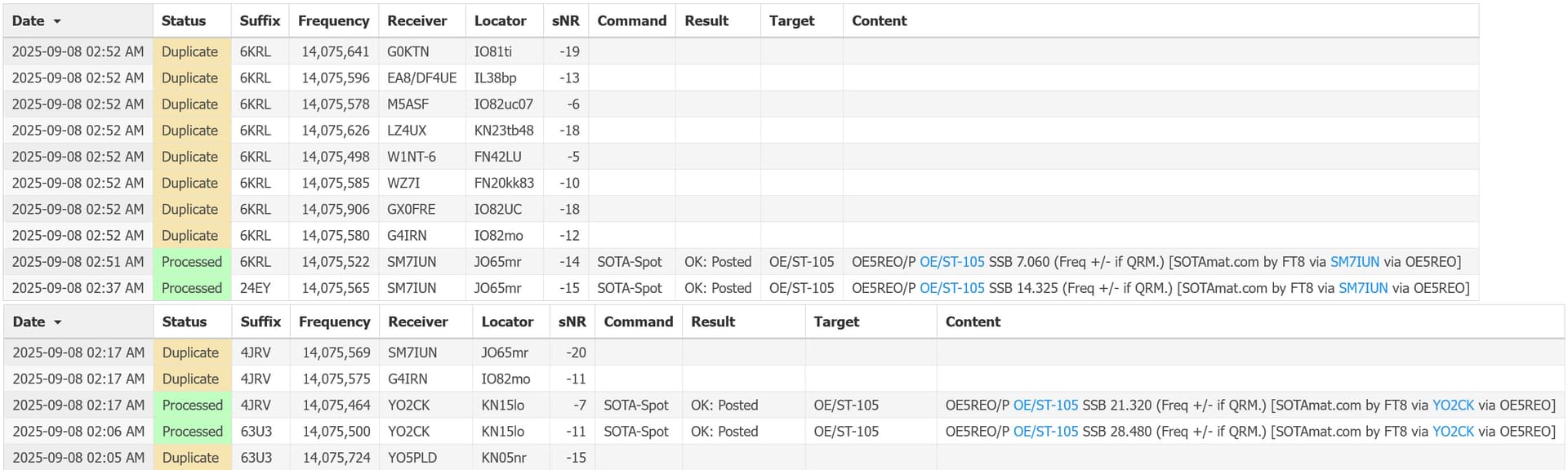
When I first learned about SOTAMAT I liked the idea of spotting myself this way, normally I use APRS2SOTA for spotting. Today I took the time to play around with SOTAMAT for the first time and it was incredibly easy to setup. The first test spots on the 20m band were successful and so I will try to activate OE/ST-105 tomorrow with spots sent only via SOTAMAT.
Even two skimmers in the USA picked up my signal! Probably APRS2SOTA will stay my preferred way of spotting, but it’s good to know that spotting is also possible when mobile phone and APRS do not work! Probably I will make another try on one of my next activations using 15m FT8. Thanks to @AB6D for this great tool.
@OE5REO I am glad you tried it. It is good to see all the duplicate reports from the skimmer network: it shows the redundancy available in the network: you only need one.
Now that you’ve reached Level-1 of SOTAMAT:
Level-2: use some of the other ways to spot with it (SMS, Satellite, direct network, etc.). It supports spotting 7 ways and the FT8 mode you tried is just one of them.
Level 3: Start using it for things besides spotting: get peak specific weather reports, see which skimmers are hearing you with RBN reports, lookup a callsign and verify you heard it right, use the GPS and peaks database to search by distance or keyword, etc.
Level 4: Since you have an Elecraft KX2, use a SOTACAT hardware device for hands-free CAT control of the radio remotely (on the ground, in a tree, etc.). You can then enjoy “click-to-pounce” mode (see a list of current SOTAWATCH spots, click on one to tune to that person), spot via FT8 without audio (direct FSK synthesis), tune the radio from the phone, CW memory keyer, and hands-free control of the voice keyer from your phone.
SOTAMāt is indeed a neat system to spot oneself on SOTAWatch or to send SMS or email messages via FT8 to loved ones when mobile phone coverage is insufficient or nonexistent (this may even happen when mobile phone antennas are in sight, due to frequency collisions, as I found the hard way). I would not use it for CW, as RBN usually works for me when I alert myself in advance, but it may be very useful for SSB.
I used it last Tuesday when I activated EA5/AT-084 Alt de Pere. Even if I was operating on another band, I used the ATU in my Xiegu G90 to be able to send FT8 messages on 14074 kHz and go back to my operating band. Worked a charm!
I find the clever use of “weird” suffixes in carefully-crafted free-text FT8 messages to encode the different messages very interesting, and I had fun experimenting a bit with non-SOTAMāt (but SOTAMāt-looking) messages. Thanks @AB6D for this!
I recommend watching Brian’s video that explains how it works: https://www.youtube.com/watch?v=FG6hO5LgByI