As mentioned, my FT8 SOTA activation about a month ago was only partially successful — there simply isn’t enough activity on this mode.
Yesterday, I gave it another try by participating in the FT8 Activity Contest https://ft8activity.eu/. The 2-meter section takes place on the first Wednesday of every month, from 17:00 to 21:00 UTC. The only disadvantage is that during the European winter months, it is already dark at that time, which is not particularly convenient for SOTA.
So instead, I walked up a nearby hill that offers good propagation with few obstacles in the way. Messendorfer Berg is 440 meters high and is not a SOTA summit, but it is perfectly adequate for testing.
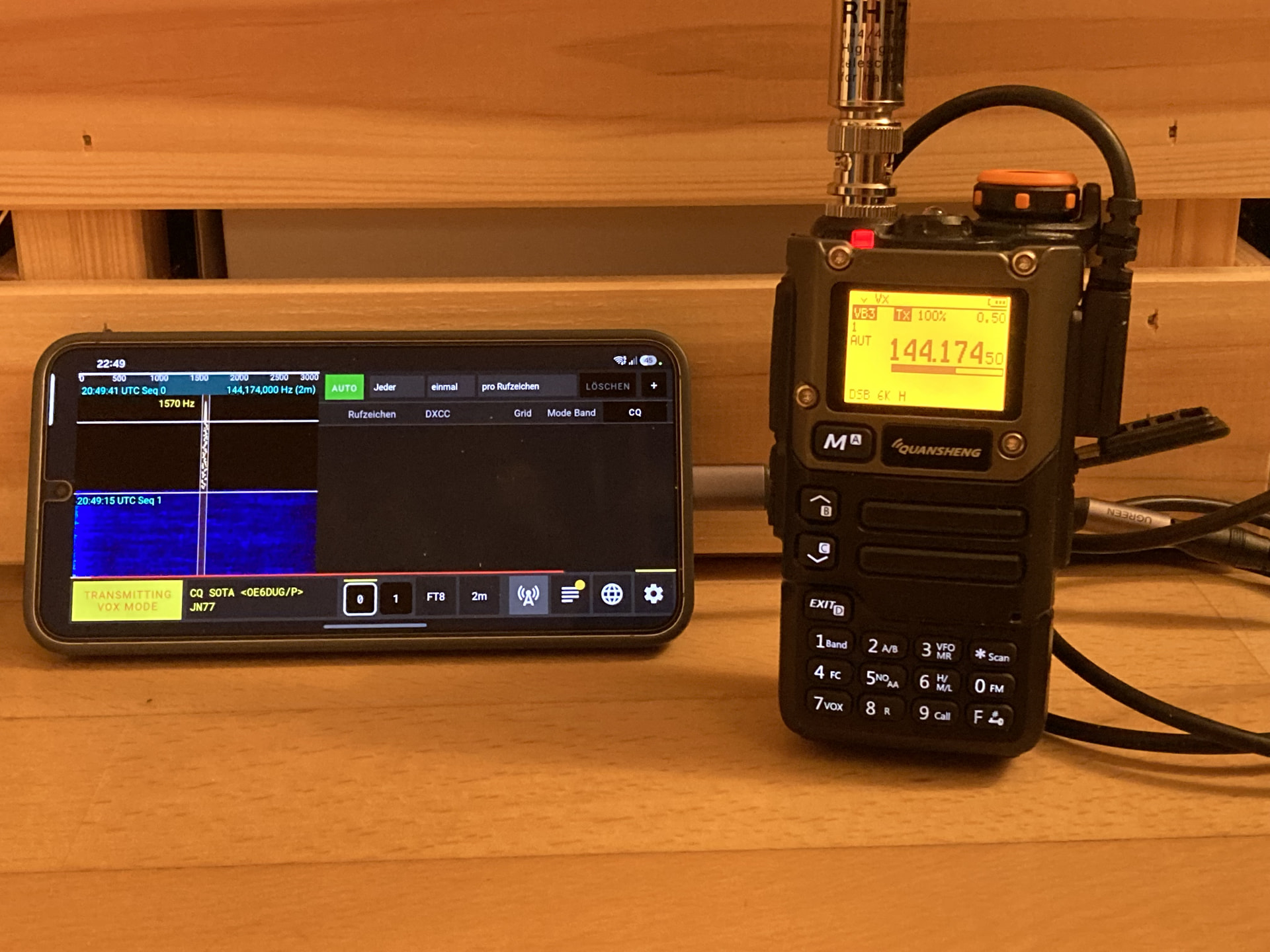
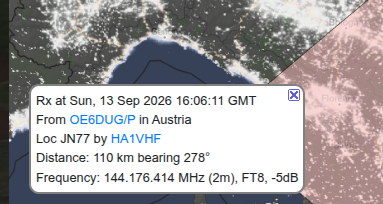
As soon as I switched on the radio, a bunch of stations could be heard. Using the same equipment as during my previous SOTA attempt, I was able to complete QSOs with stations up to 200 km away. In addition, I copied stations more than 500 km away in Italy and Romania, but they were unable to receive my weak 5 W signal.
Obviously, the equipment performed quite reasonably, especially considering that it costs only a fraction of the price of all those shiny Icoms.
Only one real shortcoming showed up, and it is something that only becomes apparent in contest situations with lots of signals on the band: the Quansheng’s VOX refuses to trigger transmission when there is an incoming signal from the receiver, i.e. when the squelch opens.
This behavior is typical of most handheld radios and makes perfect sense for FM operation. However, on SSB — and particularly with FT8 — there are often several signals within the filter bandwidth. So sometimes it takes quite a long time for a message to get out. qFT8 generates the audio output correctly, but the transceiver does not actually start transmitting until the frequency appears to be clear.I don’t know whether this could be mitigated by modifying the firmware. After all, IJV, the only firmware that offers DSB transmission, is not open source.
One possible solution might be to use a DigiLink Lite instead of a USB sound card between the radio and the mobile phone. This device can be controlled by the qFT8 app, either by acting as a VOX itself or through control lines from the simulated serial interface.
Maybe the next steps will be to try the DigiLink and perhaps a directional antenna, such as a SOTAbeams antenna, for the next activation.
It’s a pity that FT8 is still so uncommon in SOTA, because it allows you to operate quietly without disturbing other people who are out in nature looking for some peace and relaxation.