Inexpensive methods of attaching cords to high branches in very leafy tall trees?
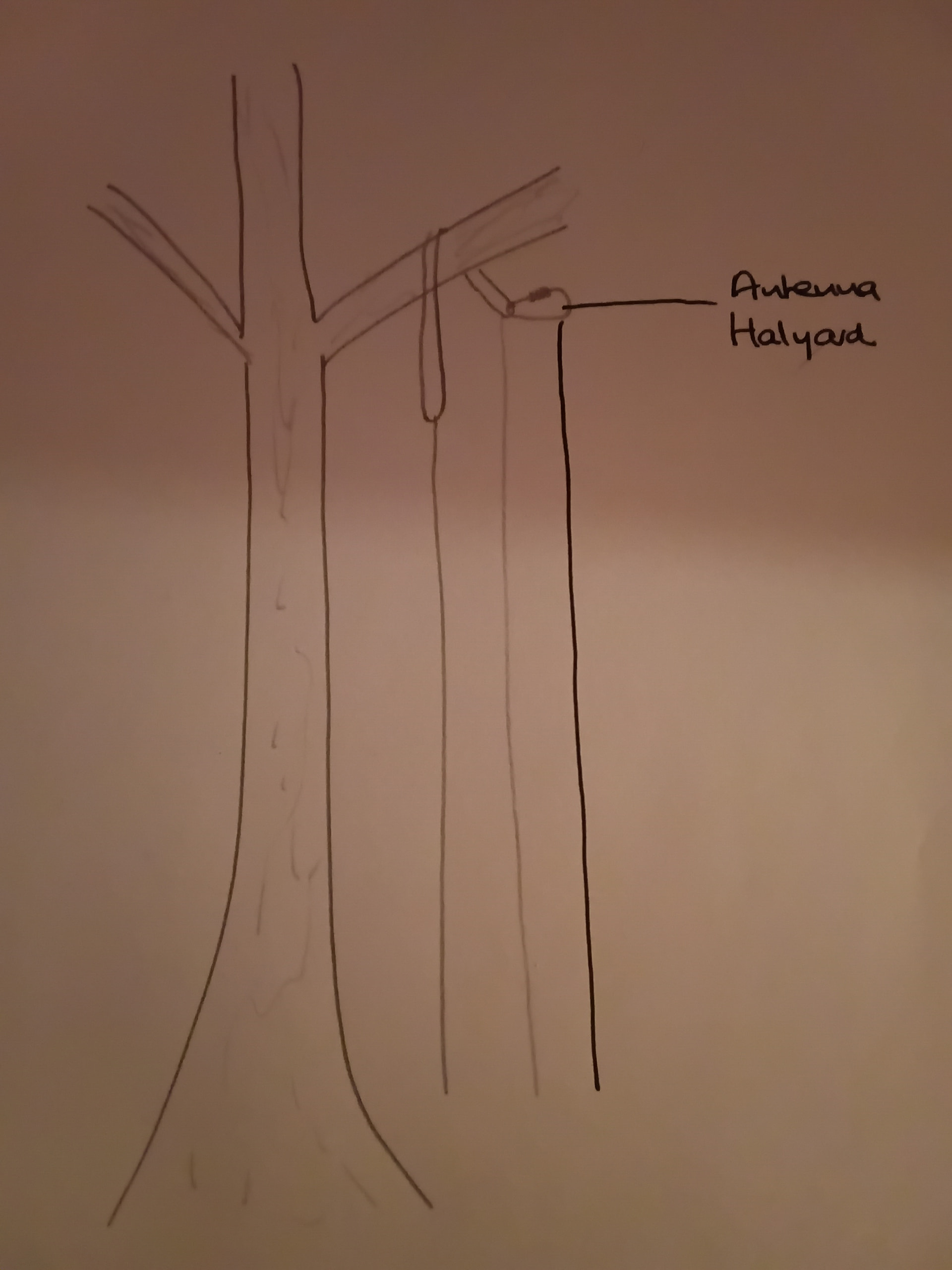
I have an 80-10m OCFD antenna which runs most of the length of my home property. It’s the only practical orientation that can get ~40m of wire up as high as possible. The far end wire terminates to 2-3m of cord [so the antenna wire is clear of the tree] which is attached to a paracord halyard looped over a branch (about 15m up) on a tall mature tree. We are next to a west-facing estuary in NW England so it’s windy most of the time.
Every year or so, during a storm the cord will snap, probably due to constant rubbing against neighbouring branches. I use the halyard to lower the loop (like a flag), repair the cord / joint, and raise the antenna wire again. This time it was the halyard itself which broke, probably due to constant rubbing against true bark.
Originally, we paid an arborist to climb the tree and attach the halyard to a rope on the high branch. The arborists were here primarily to remove big branches over-shadowing the garden. The ‘antenna rope’ job was an extra. I can’t justify (to my wife) the call-out charge for the halyard job alone. Meanwhile, no HF from home for me.
So, I’m looking for other ways to get some fishing line (initially) or similar over that high branch. The are multiple practical problems doing it from the ground: a) it’s 12-15m up, b) there are other branches nearby, c) they all have lots of leaves.
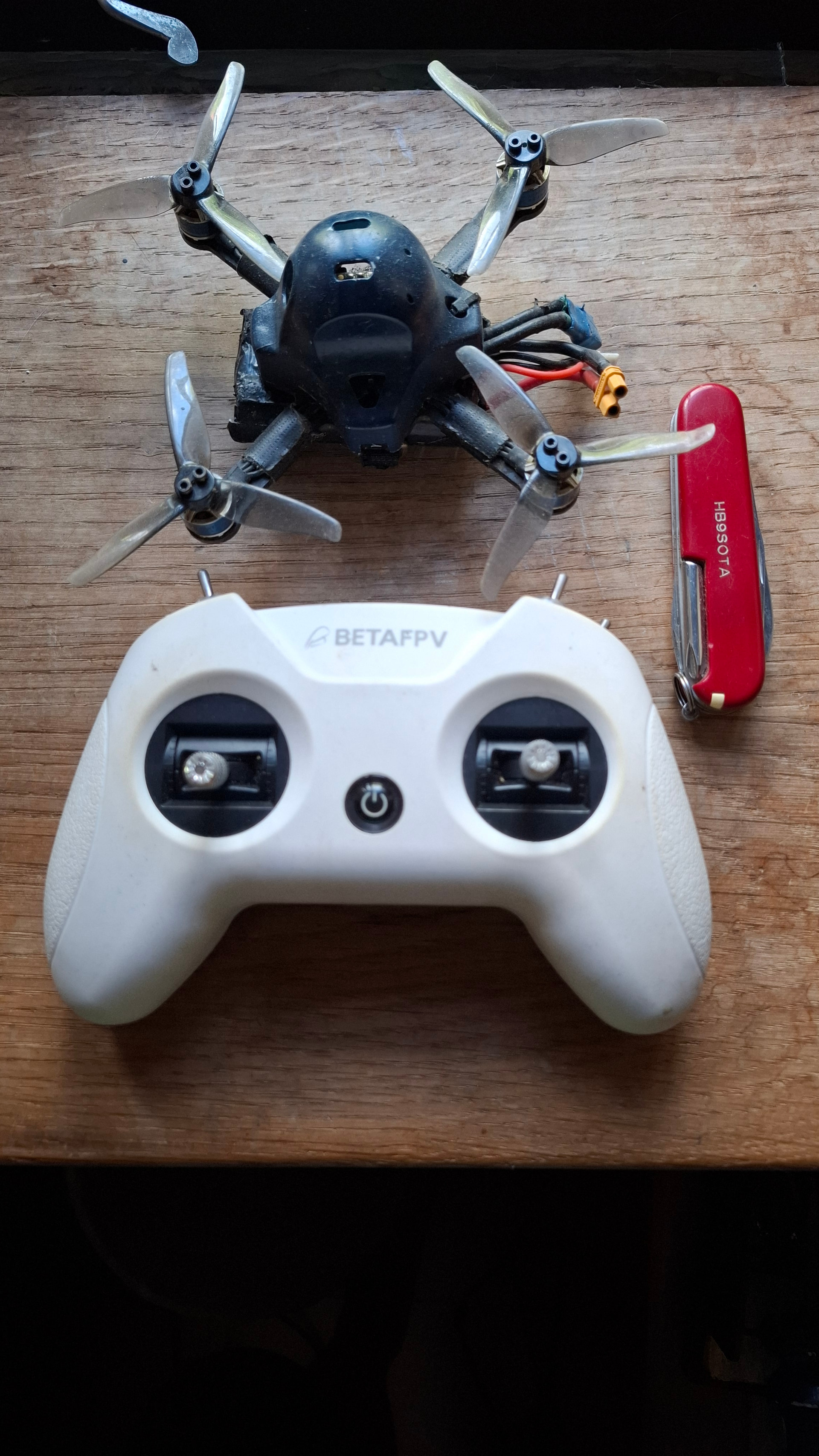
I’ve used my (nearly) 8m SOTAbeams pole with hook ‘thing’ taped to the top to drop a weighed string over a branch, but this branch is much higher. I see products like ‘Weaver Leather Throw Weight and Line Kit’ (~£30) on Amazon. Anyone had any experience of this kind of device? Remember, this is no ‘clean’ isolated branch but one surrounded by others usually waving around in the wind.
Ask your local archery club? They can probably use an old sacrificial arrow to drag a line through the leaves etc.
On the tight-slack-twang effect of the wind. Run the antenna line through a pulley at one end then down to a weight. The house end is often more convenient. As a side effect you get a wind gust/speed indicator from watching the weight move up and down as the tree waves in the wind.
I use an arborist throw weight attached to a long lightweight cord with good results. It takes some practice throwing, but it can get to reasonable heights.
I use a throw line and weight occasionally for portable operations. I’ve used different types of paracord and a couple of different weights.
Weaver and Petzl (a really good brand with experience in this stuff. Mainly known for head torches, I use the NAO RL) make good throw weights. I use the following:
I had a Weaver throw weight in the past but lost it somewhere along the way last year.
The SOB (nice acronym ) throw line has worked really well for me across all seasons with different types of tree and foliage.
Hope my very basic, amateur experience with this stuff is of some help. Best of luck.
Three ounce egg-shaped sinker tied to fishing line, launched by a competition sling-shot. Very accurate. Set the spool of line on the ground. Line streams out, never snagging. I demonstrated for G6WRW and MØYHB, and it went more than 100’ vertically.
Obviously you need to be a good shot with a slingshot, including controlling just how hard you propel the sinker, and you need to be sure the line will pay out smoothly. It all takes a bit of practice.
Lost a few sinkers, some because they parted company with the line and others because the line ended up tangled among branches…
Equivalent skills are needed with a throw-line. Another simple matter of practice…
I know some folk fly drones on hikes, but inevitably (at least in the UK) these days there’s paperwork involved in flying them (unless IIRC they’re under 100g flight weight), and places where flying’s forbidden.
Same in EI. I have a UAV licence and part of the training course is learning about the fly zone maps and different area classifications, (not) flying over groups of people etc. Plus you aren’t supposed to carry a payload without the appropriate licence and paperwork - regardless what you wish to carry.
Oddly, callsigns rotate in EI as well. I got notification recently I’ve to apply new callsign decals to my drones as it has been rotated. Totally forgot they do that annually!
Hi Andy,
There have been some interesting suggestions of using a drone, throw lines, and even archery. I am not sure that any of these are going to allow you to target a specific branch in a tree with heavy leaf cover.
I have played with a throw line and an arborist weight. I am sure that there are experts in the group, but my inexpert experience is that it is difficult to target a specific branch within a tree and the weight continues it’s trajectory through the tree rather than falling nicely to the ground after it has gone over your chosen branch at the precise point that you wanted.
I think that your idea of using a long pole to manipulate a line into position has potential but a 15m pole would be very heavy. There may be a way of using a ladder and a pole but that sounds awfully dangerous.
Do you have any rock climbers in your social circle? This is precisely the type of challenge that they enjoy.
When you do manage to get something up in the tree I would recommend using a climbing sling or nylon webbing, looped over the branch to minimise damage to the tree and save the rope from wearing.
I agree. There is heavy leaf cover. The fixing point is where the branch meets the main trunk. That was easy for the arborist as he climbed the trunk. I think trying to throw a weighed line or flying a drone in through the tree canopy (even on those few days the wind isn’t making the branches / leaves wave about) to exactly the right place is unrealistic. That’s ignoring the fact that I don’t have weighed line throwing skills or drone piloting skills (or even a drone).
Notwithstanding your natural concerns, that is my plan. Despite my advanced age, I quite often bow-saw branches off our garden trees using a two-stage ladder with the top rung tied around the tree trunk with thick paracord rope; I’m in hard hat and a heavy-duty full-harness (legs and arms) which is attached to the ladder with a strap with two Class-B carabiners.
I’ve already done a feasibility recce today. Firstly, I had to clear long undergrowth and saplings on the house-facing side of the tree even before the ladder could be put in place. With my extended 5m Life’s a Breeze pole, standing near the top of the ladder, I could easily slide the pole up close to the trunk - avoiding the tree canopy - to (and above) a suitable fixing point.
The original fixing point chosen by the arborist, although higher up, meant more interference by branches with the antenna’s 3m-long antenna-to-halyard cord, hence it snapping every few years. My new target fixing point, although a bit lower, should have a more-or-less clear path out towards the house (and the balun on the chimney) – at least that’s the idea.
I’ll take this opportunity to replace the UltraLite wire on the long leg of the OCFD.
The arborist could simply knot a length of rope around the branch and/or trunk in situ. Somehow, I’ve got to do that from the ground. I plan to use my previously-mentioned method of taping a Y-shaped thing to the top of my pole with a weighed string hanging over the ‘Y’. Then I guide the weight to drop over the target branch and hope the weight overcomes any friction as I ease the string out.
So now we come to the bit I still haven’t worked out. When I hold both ends of the string I could attach paracord to one end and haul it up. But that doesn’t give what I want: a small loop around the branch through which my halyard (very long loop) can pass. As I understand it, a climbing sling is a closed loop of webbing with a carabiner. So, I don’t know how that would get up there and attached to the tree.
8-July UPDATE
I’ve removed the AI-hallucinated instructions previously posted here as they were wrong.
I’m looking for help on how to get a climbing sling to choke a high branch by making it form a girth hitch remotely. It seems it is physically impossible to choke the branch with the sling using only the guide lines -there must be another way.
END OF UPDATE
I also realise why it was the halyard that broke this time (and not the support cord rubbing on branches as before). I recently moved the lanyard ground anchor closer to the main tree. That created a much steeper angle, which drastically reduced the “give” or swing room in the rope. Also, I left no slack in the line. When that recent storm hit, the swaying tree made the rope completely taut, causing it to snap. I’ll add a heavy-duty bungee cord at the base.
Yes, it takes a bit of practice, and a proper choice of materials, but 15m isn’t a problem, and I can make 20m on a good day with braided PTFE-coated fishing line. Usually I use bright pink braided mason’s twine - braided rope slides more smoothly over the branches than twisted rope.
And the rope weight makes a difference in the achievable height.
Swinging the weight underhand is much easier on my arm than trying to throw it overhand. The weight has to be heavy enough to pull the rope back down through the branches. The type of tree bark makes a difference, too, as some are more rough and cause more friction. Getting the weight down from the tree is often a greater challenge than getting it up over a branch, especially if your weight is too light.
I typically then use the throwing rope to pull over the permanent rope or webbing, which is tied to a suitable counterweight at a convenient height to reach. The rope (or webbing) needs to be loosened periodically to keep it from cutting into the tree branch and getting stuck in the pitch.
One good approach is to use two ropes: one goes from ground level up over the branch to a pulley, and the second goes from the end of the antenna through the pulley and down to the counterweight near ground level. That way the rope over the branch isn’t sliding back and forth over the bark as the tree moves, reducing damage to the tree.
If you have someone climb the tree to install it, the best thing for the tree is to attach a pulley to a screw eye sunk into the tree (or passing through it to a nut and backing plate on the back side), with enough extra length for the tree to grow. That causes much less damage to the tree than passing a rope or something around a branch, which can damage the bark.
Periodic maintenance is important: one friend had his rope attached to a cleat nailed to the tree, but the tree grew around it over the years, and it was quite difficult to free it when we needed to take down the antenna for repair.
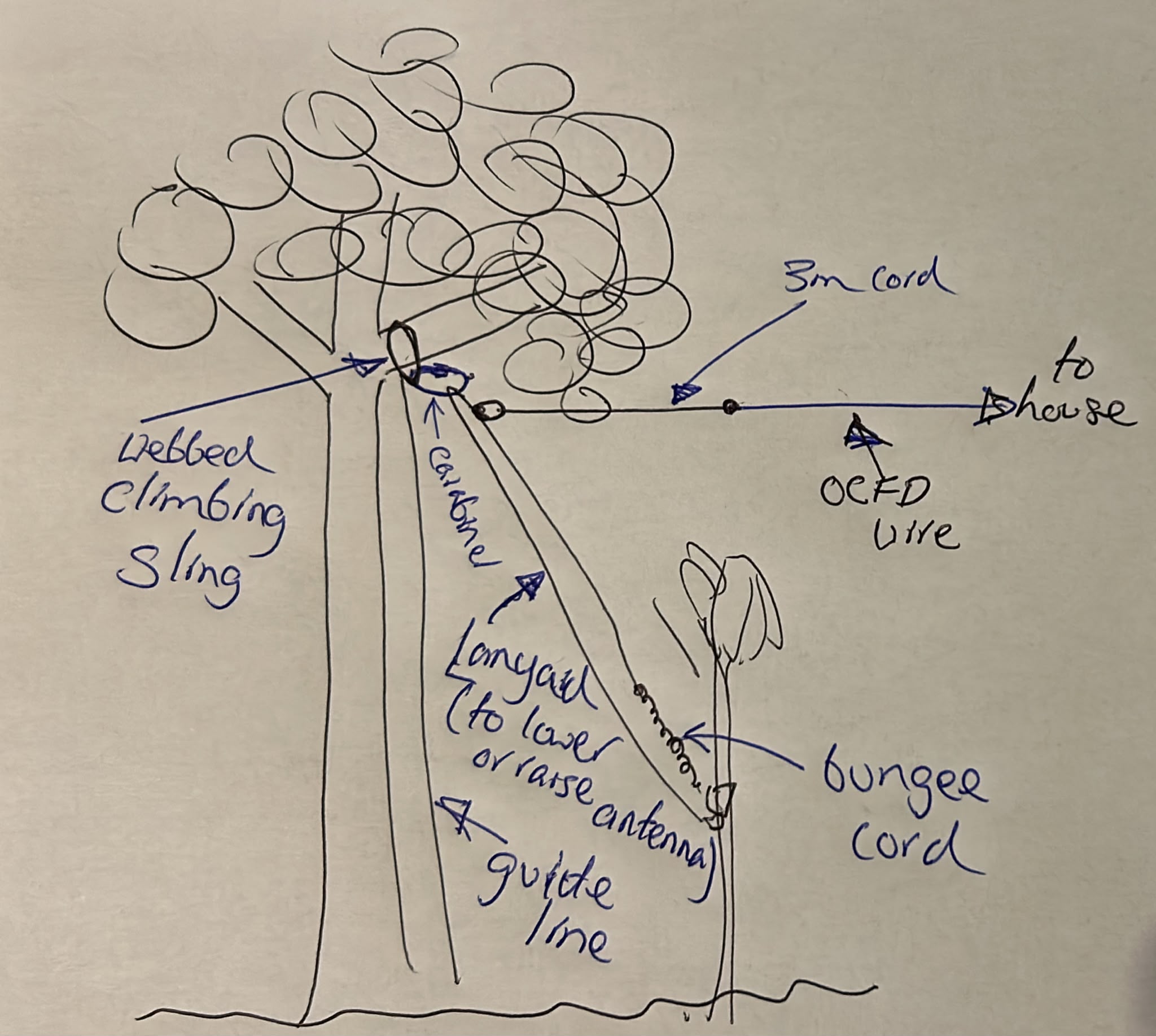
That would provide a guide line attached to a sling hanging over the branch. If this is what you are trying to achieve I would attach a carabiner or pulley to the sling for the antenna halyard to run through. Unfortunately this would leave you with two potential modes of failure. If either line were to fail you would have to start all over again.
If you were to provide an additional line you could have a line attached to the sling on either side of the branch so that you could bring the sling and pulley/ carabiner to ground level for maintenance or to rethread a replacement halyard. I hope that I have understood your requirement.
Guide line: after pulling on one end to make the sling ‘choke’ the branch (using a Girth Hitch) I think this becomes redundant.
Sling / carabiner: Adding a (stainless-steel) carabiner should avoid the rope-on-rope friction between halyard and sling.
Halyard: a long loop (with a very small knotted loop) - used to raise or lower the antenna (like a flag) for maintenance or repairs. The ground end will be attached to bungee cord tied to a sapling (strain relief when the tree sways about in strong winds).
3m support cord: goes between knotted loop on halyard and OCFD wire; used to get the antenna wire out of the tree canopy.
The two points of failure since it was first erected 7 years ago are
branches / leaves rubbing on the support cord (Action: moving to a branch (a bit lower) but should be clear of those branches
Halyard snapped last week due to my recent mistakes [see above] (Action: move halyard ground fixing point further from tree and add bungee cord).
That is exactly the arrangement that I have here except for my chimney taking the place of your tree.
If you were to loop the guide line through the sling rather than tying it to the sling you could pull it through once you have your girth hitch (larks foot) around the branch.
 ) throw line has worked really well for me across all seasons with different types of tree and foliage.