While cleaning up my files and folders, I stumbled upon an HT whip antenna field test that Tom @OE9TKH, Christian @HB9GIN and I performed some years ago. I don’t remember why we never posted the results, but before they are lost forever, and at the risk of beating a dead horse, I thought I’d post them after all.
TL;DR
- The three tested half-wave antennas were within 1 dB of each other on 2m.
- The four tested λ/4 antennas were up to 10 dB down from the half-wave antennas on 2m, but adding a tiger tail brought performance on par.
- On 70cm, the tested whip antennas differed by up to 10 dB.
The goal was to find out how much difference there really is among the commercially available 2m/70cm whip antennas, and how much a “tiger tail” would improve performance in practice. Was it just a few dB, or perhaps much more? The following article on the web provided some useful information: HT antenna comparisons
The problem is that when you read the results of someone else’s antenna comparison, you rarely believe them 100%. Even if you know the people who have done the comparison, and trust them, there is still a small element of doubt remaining, and in any case, they may not have compared the exact same antennas on the same radio that you are interested in. This means that in order to really believe in the results of an antenna comparison, you must do it yourself 
With that in mind, and knowing full well that we didn’t excercise absolute scientific rigor, but in the hope that the results may still be useful, and of course at the risk of not being believed, here are the results of our real-world comparison of HT whip antennas for 2m/70cm.
Test setup
-
Transmitter: Yaesu VX-3 set to “low” power (~100 mW) transmitting a carrier in FM mode, antenna = DUT, device held in hand as if speaking into the microphone during normal use, operator standing on a “mini hill” about 2 m high.
-
The transmitter output power was measured with a direct connection (+ attenuator) between the HT and the spectrum analyzer at the start and the end of the test, to ensure that it had not dropped by more than 1 dB during the test due to battery discharge.
-
Receiver: Aim-TTi PSA6005 handheld spectrum analyzer connected through 10m of RG-213 FOAM cable with a Diamond X-30N antenna on a mast 4m above ground.
-
In theory, receiver antenna/cable/etc. are not important here as we’re only making relative measurements.
-
Test frequencies: 145.000 MHz, 435.000 MHz
-
Distance between transmitter and receiver: 220 m, flat terrain, no obstacles/buildings in the way.
2m results
| Antenna | Weight | Length (coll.) | Length (ext.) | Result w/o TT | Result w/TT |
|---|---|---|---|---|---|
| Diamond SRH771 | 38 g | 40 cm | -7 dB | 0 dB | |
| Diamond RH770 | 85 g | 22 cm | 93 cm | -2 dB | |
| MFJ-1712S | 32 g | 12 cm | 40 cm | -8 dB | -2 dB |
| MFJ-1714S | 68 g | 26 cm | 107 cm | -2 dB | |
| Comet SMA 24 | 8 g | 41 cm | -12 dB | -3 dB | |
| D-ORIGINAL SRH-519 | 12 g | 19 cm | -9 dB | -5 dB | |
| Tomtenna (*) | -3 dB |
Results normalized for easier comparison; reference level (0 dB): -45 dBm
For comparison, we tested two non-whip antennas at the same site (connected to the same HT through 3 m of RG-58):
| Antenna | Result |
|---|---|
| N9TAX Slim-Jim @ 2 m AGL | 0 dB |
| Collapsible HB9CV @ 2 m AGL | +5 dB |
Analysis
Adding a “tiger tail” improved performance by up to 9 dB on the λ/4 antennas. Performance of λ/4 antennas with a tiger tail was virtually identical to that of the three half-wave antennas in the test (RH770, MFJ-1714S and Tomtenna). The short antenna didn’t benefit as much from the tiger tail; perhaps this could be improved by tuning.
In the worst case (Comet SMA 24 without tiger tail), the signal was 12 dB or two S-units weaker than in the best case (SRH771 with tiger tail).
70cm results
| Antenna | Result w/o TT |
|---|---|
| Comet SMA 24 | -6 dB |
| MFJ-1712S | -4 dB |
| D-ORIGINAL SRH-519 | -11 dB |
| Diamond RH770 | -1 dB |
| Diamond SRH771 | -2 dB |
Analysis
Not much to say here – 2m λ/4 antennas (Comet, MFJ-1712S) seem to work well on 70cm also. The complicated RH770 with its “2x5/8wave radialless” design on 70cm had the edge. The SRH771 is a bit of a mystery as it is “1/2wave” on 70cm according to Diamond – maybe we should cut one open to see what’s in the base.
Tiger tails for 70cm were left as an excercise for future comparisons…
Notes
-
The tiger tail (TT) was approx. 47 cm long and tuned on a MiniVNA for the Comet antenna only. Further improvements may be possible by tuning it to the actual antenna in use.
-
A tiger tail was only tested on antennas where this made sense (not on half-wave/“radialless” antennas)
-
Naturally the received signal strength varied as the operator was moving slightly, so we used the best measurement during an approx. 10 sec. transmission.
-
The VX-3 is a physically very small radio; perhaps λ/4 antennas without a tiger tail work better on bulkier devices whose frame acts more like a counterpoise.
-
(*) The “Tomtenna” is a home-made EFHW by Tom OE9TKH with a small matching inductor + capacitor in a box, connected to a steel telescope.
Conclusions
-
A λ/4 antenna with a matching tiger tail is a good choice in most cases.
-
Half-wave antennas do not provide a real advantage (aside from doing away with the tiger tail) given the bulk that they add.
-
Performance of “any random HT antenna” can vary by as much as 12 dB compared to the best case.
-
Short (~20 cm) rubber ducks are convenient, but expect to lose around 6 dB.
How to attach a tiger tail?
I like to use a crimp ring cable nut with a suitable inner diameter to fit over the SMA connector. This may not be possible on all HTs (recessed SMA connector etc.).
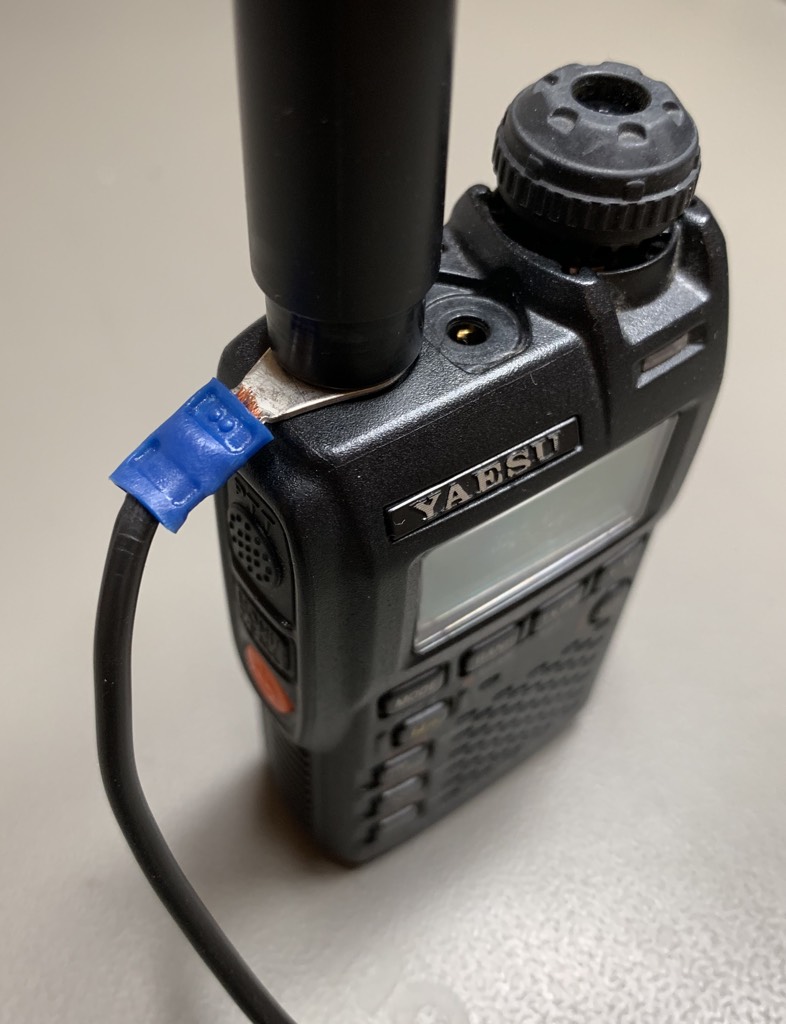
Here’s another way:
