James Clerk Maxwell

There are many famous Scottish Scientists and Inventors. Included in their number is a certain James Clerk Maxwell FRS FRSE (1831-1879).

Maxwell, within input from others, put together a set of equations providing a mathematical model for electromagnetism, together with electric and magnetic circuits.

Nearly all that happens in the context of radio, electronics and signal propagation can be described by Maxwell’s four equations.

These equations are typically presented something like this:
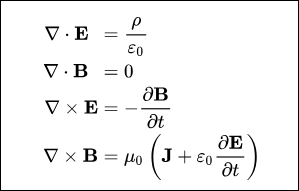
On first sight, I suspect many ask: “What are those funny upside-down triangles?” And they are probably equally-perplexed by the dots, crosses and curly 'd’s.

The good news is that you can have a full and enjoyable lifetime of ham radio knowing little or nothing of Maxwell’s equations.

For many, I suspect this is close to reality, but I am not sure. The percentage of hams who understand these equations in full is probably very small?


Over the years, most hams seem to ‘get to grips’ with coaxial cable and its use, even if for some this is a rather muddled and confusing journey.

But, when it comes to microwaves and waveguide, relying on intuition to grasp
what’s going on, certainly for me, was something of a ‘dead end’. In this field, it seems you need to rely rather more on the good work of James Clerk Maxwell.

Most can understand, and have personal experience of, how water moves down a pipe that is initially empty. But how on Earth does RF move down an (often rectangular) waveguide, which seems to be no more than an empty pipe; there’s no circuit?

73 Dave

2 Likes

You are doing him a disservice by only mentioning his set of equations.

2 Likes

The book, “The man who changed everthing” by Basil Mahon has a very readable account of Maxwell’s life and work.

Maxwell’s equations were re-formulated into the now familiar form by Oliver Heaviside (Yes, the same Heaviside layer mentioned in Cats). There is a very interesting book on Heaviside by Paul J. Nahin. Highly recommended.

Many years ago I was driving towards Castle Douglas, on the A713, I think, when I entered a small village with a sign adverting its association with Maxwell. I stopped at the small grocery store and was amazed to find a small display of Maxwell’s notebooks at the back of the store! I had a chat with the owner, and he said there was a steady stream of people who came in to see the papers. I think the village was Parton, where Maxwell is buried.

4 Likes

As VE6IXD said, it was Oliver Heaviside who distilled Maxwell’s about 20 equations into the 4 that are well known today. Heaviside was self taught and lived in poverty most of his life, but thankfully was recognised later in life.

The reason Heaviside got interested in electromagnetics was because his first job was working on a telegraph cable from Newcastle to Denmark and was frustrated about the speed that morse could be sent over the cable!

So without CW those 4 equations might not have existed :grinning:

2 Likes

Dave,

Your question must be more sublime than I can comprehend.

I think what you are saying is equivalent to saying it’s incomprehensible how light can travel from the Sun to the Earth. Or how is it possible that a car can progress down a country lane? Or how can ripples propagate after a stone it tossed into a pond?

While I have some understanding of Maxwell’s work I found it totally unnecessary for building and using waveguides and horn antennas on 10 GHz.

Perhaps you could ask your question at a level a simple person such as I can understand?

Thanks.

73

Ron

VK3AFW

3 Likes

Jonathon,

Most of the equations and theorems dished out in my schooldays were distillations of the original. Heaviside also devised a process for solving differential equations that wasn’t accepted as legitimate for a long time. He had insights into the jungle of advanced mathematics and was able to use these to make his work easier. His work on Maxwell’s equations is less well known imo. Even so the work by Kirchoff and others presents us with simple working models for specific applications.

The only example of an original theorem that was made more complex by later educators, that I can quickly think of, is Hooke’s Law. He said “ So the extension thus” which became dx = k*df.

73

Ron

VK3AFW

4 Likes

Ron,

I know I am not alone in being curious about how things work. With something new, initially I may just have to accept that it works ‘as if by magic’. I know little of its internals, how it was designed, or the underpinning maths / physics / chemistry etc.

Unpicking the inner-workings of a ‘complex something’ can often take years, and is not for everyone. My family are happy just to watch TV. The have no interest in how the signal travels from the satellite to the dish on the side of the house. They know nothing of LNBs, they don’t puzzle about the error-correction protocols being used by the DVB-S2 broadcast standard, and so forth. But we’re all different.


Like many hams, when it comes to coax, I have a reasonable grasp of:

1 The telegrapher’s equation, its derivation and its solutions.

2 How to use the Smith Chart, or write code, to solve impedance-matching problems and the like.

3 The behaviour of voltages and currents on the line, particularly where the VSWR is other than 1:1.

Equally, I accept that many just use coax with their radios; they don’t need to care much at all about the above.


When it comes to microwaves and waveguide, I know very little about these. Among many things, what I CAN’T currently do is:

1 Understand how Maxwell’s equations are used to determine the various ‘operating modes’ of waveguide, and just how the energy propagates down the ‘pipe’.

2 Write some code of my own to model what is happening. Just being able to confirm for myself the ‘answers’ given in books / on the web would be a big step forward.

3 Know the material well-enough to be able to draw pictures on a white-board, and explain to others what is going on.

Of course, to get QRV on microwaves, there are well-established ‘recipes’ in books that beginners can follow. But for the curious, this will never be enough.

73 Dave

1 Like

I have a useful collection of old ham magazines in PDF format. I’ve acquired most of the magazines I owned as a spotty boy learning about electronics. So here I was looking in a May 1950 issue of Wireless World and there is an article by Sir Edward Appleton title “Oliver Heaviside and his Layer, an appreciation of his work”. What’s striking is that article is by Appleton, the Appleton who had received the Nobel Prize for Physics 3 years earlier for his work on the ionosphere and resulting in the Appleton - Barnett region, better known as F1 and F2 layers.

In many ways electronics seems very new, some of my colleagues are working on chips with more than 50billion transistors in them and then here is a magazine that in many ways doesn’t feel 75 years old looking at some of the photos in it of equipment I’ve seen and used with an article written by a man alive when I was kid about a guy who’s been dead 100 years. The duality of electronics being both old and new at the same time always makes me think.

4 Likes

Dave,

I don’t think you can easily go from Maxwell’s equations to coding representing the hardware required to launch a EM field down a waveguide.

I presume you understand the idea of using a probe to radiate a signal into a waveguide. And also that it’s position relative to a short determines the impedance it presents to a coaxial connector. It is usually inserted in the wider side of rectangular waveguide. Once set up the energy has to propagate toward the open end. Again not obvious (to me) from a couple of very general equations.

I’ve always been happy to use specific solutions, like the simplified telegraphers equation rather than labour through the process of deriving them from Maxwell.

I think of Maxwell as being a net that captures all electrical physics, elegant but not much use to a practicing engineer who needs a screwdriver not a net.

73

Ron

VK3AFW

1 Like

Ron

Where possible, I try to write my own simulation & modelling code; as noted earlier by @GM4LLD, funding commercial software might sometimes require the sale of your house.

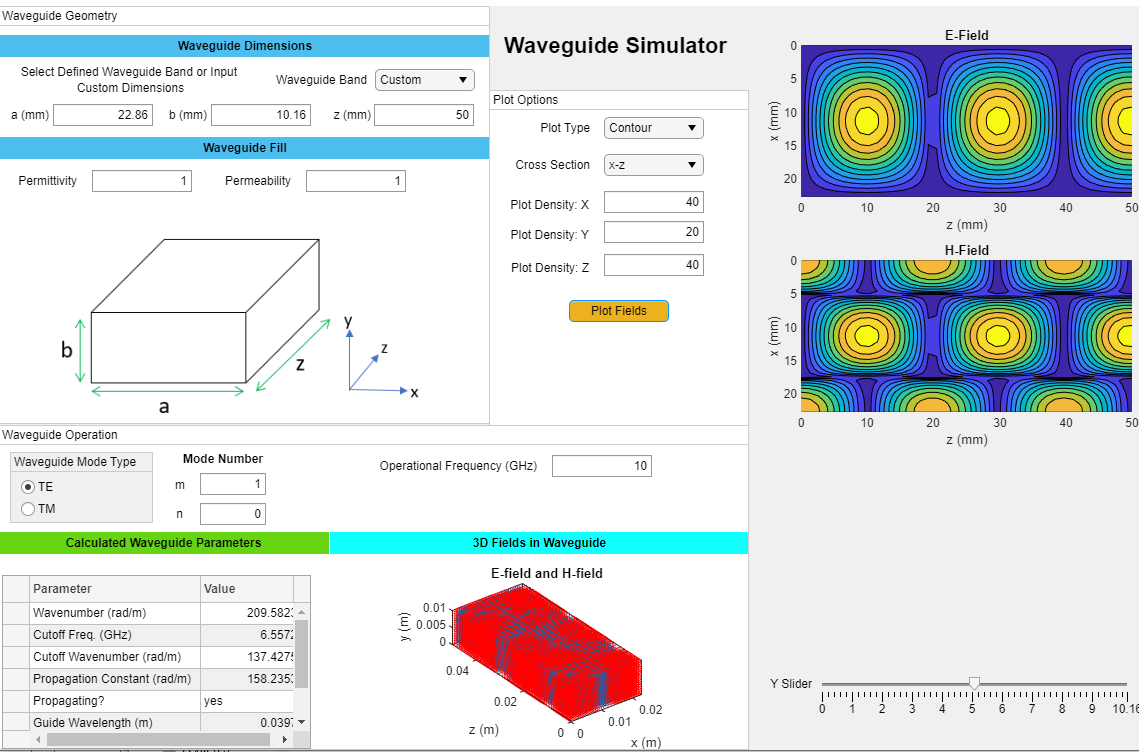
Digging round on the web, I found the link below which points to a 3rd-party add-on for MATLAB that simulates waveguide. As you can see from the image below, this has a rather helpful GUI. Most of my more-rudimentary code has simple CSV input files with lists of values.

My expectation would be that this nice simulation software, with its E-field and H-field patterns, is developed from Maxwell’s equations; but I can’t be sure.

73 Dave

https://uk.mathworks.com/matlabcentral/fileexchange/98779-rectangular-waveguide-simulator

Dave,

I would be confident that the software uses standard engineering equations rather than derive the algorithms from Maxwell’s equations. And not all established rules and equations are derived in excruciating detail from Maxwell. For example.

Ohm’s law. Kirchhoff’s law. Calculation of the diffraction zone for a parabolic dish. Maxwell looked at these and other work and combined the information into a dozen equations. Heaviside distilled it to 4.

Yes all of these and more are encompassed by those equations but they are more accessible.

I know people who put great effort into deriving various design rules every time they used them. I had been through the derivation once and never looked back. Life is too short to reinvent the ball race bearing. Just design around standard off the shelf solutions.

If you don’t want to use paid for solutions for MathCad or whatever then you can write your own of course. You are happy to use their implementation of cos(X) or that in XL I presume?

Feel free to code up the Maxwell equations. It’s a bit like a Londoner doing to Paris by heading West. Valid but not the shortest route.

I’ll check back in a year to see how it’s going.

Good luck.

73

Ron

VK3AFW

1 Like

Finally managed to find what I was looking for …

Two-conductor transmission lines (coaxial cable, open-wire line etc) typically operate in what is known as TEM mode. TEM stands for Transverse Electric and Magnetic fields. This means the electric and magnetic fields are both at right-angles to each other, and to the direction of travel of the RF up and down the line.

By contrast, where a line has only a single conductor (eg a rectangular metal waveguide), these lines cannot operate in TEM mode. Instead, they operate in what is known as TE (transverse-electric) mode, or TM (transverse-magnetic) mode.

Consider a TE mode line: the electric field is at right-angles to the axis of the wave-guide, but the magnetic field is distributed ALONG the axis of the waveguide. As far as my rudimentary understanding goes, the magnetic field is involved in ‘carrying’ the signal down the waveguide. There is no two-wire circuit.

Taking the wider dimension of a rectangular-section waveguide, we can compute the frequency at which this corresponds to half a wavelength. This represents the CUTOFF frequency (Fc) of the waveguide. Successful TE or TM mode operation requires that the waveguide be operated above Fc. My understanding is that the waveguide is typically used over a range of frequencies from 1.25-1.90 X Fc.

This is just a brief, tentative, summary put together by a curious beginner. The book linked below (free download) provides a fuller, though somewhat daunting, account. I imagine one of the authors’ goals was to help you pass the ‘end-of-year 2’ Uni electrical engineering exams. But there’s an overview to be had just by looking at the diagrams; there will be simpler ‘beginner’ texts elsewhere of the web.

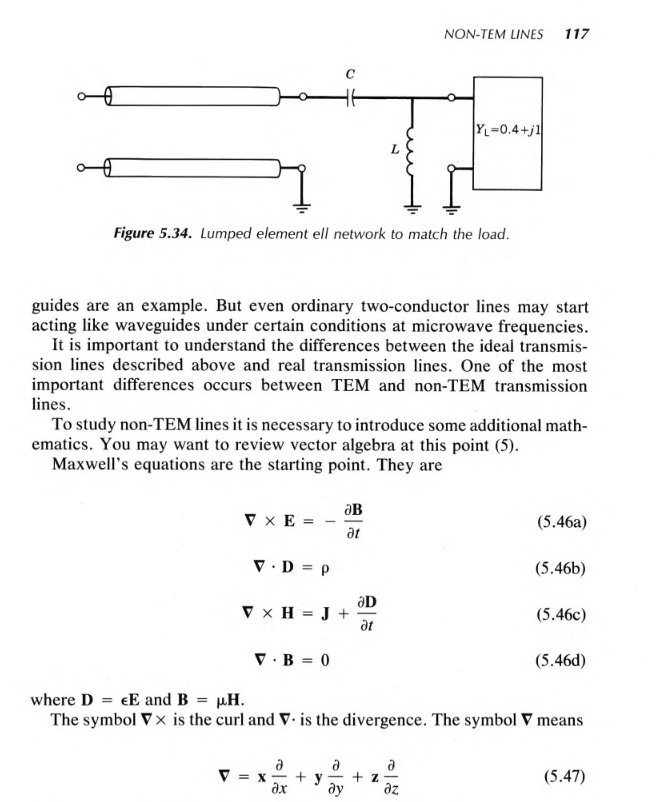
The image below is taken from page 117 of the book. As it points out, to get your head round what is going on, Maxwell’s equations are indeed the starting point :slight_smile:

73 Dave


1 Like

Dave,

I’m glad you found the answer you were looking for.
I would have said your original question was partly answered by Faraday. An alternating electrical field produces an alternating magnetic field. The missing bit of your question is then why does it propagate. Who explains it? Maxwell? Newton? Einstein? What is the role of the photon?

Has Maxwell really explained how energy propagates down a waveguide?

73

Ron

VK3AFW.

1 Like