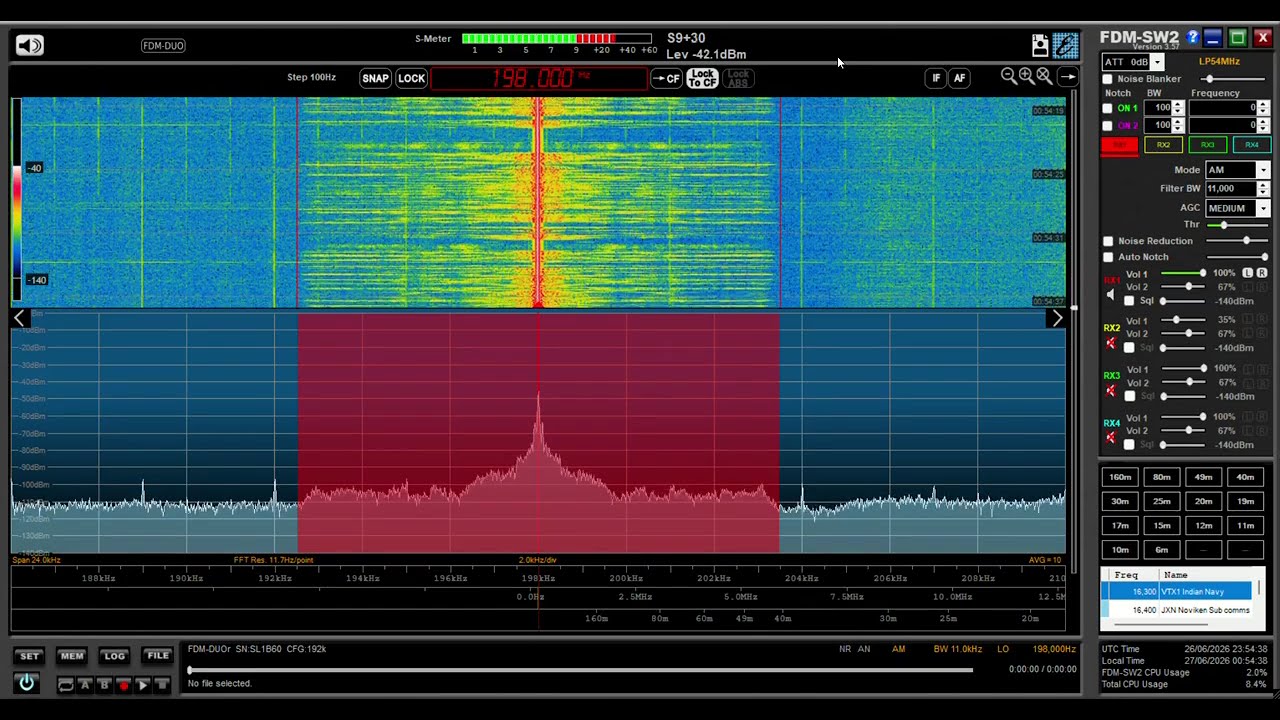
…and that’s it. After 100 years. Sleep well you buxom longwave pup. 
…and that’s it. After 100 years. Sleep well you buxom longwave pup.
Longwave weather forecasts go the same way as ground-based hyperbolic navigation did. As GPS signals are massively jammed and spoofed in some areas, hyperbolic navigation might come back at huge expense. Relying on satellite transmissions only is dangerous IMHO.
Whilst the transmitters are broadcasting a no-more-R4-LW message right now, I’d keep checking 198kHz over the coming days/weeks. You may well be surprised. Just saying…
Yeah, I’m wondering whether they’ll actually turn the transmitter off any time soon, though the power bill for keeping it running must be… interesting…
The retuning messages cost will have been built in to the decommissioning costs. I spoke to a man who knows someone who knows someone… the rebuild services for the Droitwich TX valves has now been discontinued meaning the valves left are really now the last available. Its life is limited so it needs be turned off in a controlled manner.
Even though high power LF TX can be bought still, the cost of removing the old pair of TX, buying a new pair and installing them never mind running costs is enormous for the very limited audience.
I found this …
The 198-kHz Droitwich transmitter carrier signal itself is scheduled to be turned off completely on Tuesday, 30 June 2026.
Although normal programming ceased at 1:00 AM BST on Saturday, 27 June 2026, the physical LW carrier wave remains active for a short period to support the automated loop message. This four-day window gives the infrastructure operator (Arqiva) time to run final operational diagnostics before dropping the main carrier power entirely and silencing the transmitters permanently.
Impact of the carrier shutdown:
The RTS sub-carrier signal used to manage legacy Economy 7 electricity meters terminates in tandem with this final shutdown.
The ultra-stable, rubidium-locked 198-kHz carrier frequency (Frequency Standard) historically used by hobbyists and laboratories as a precision 10-MHz reference standard will disappear entirely.
Shame that CPI and Econco are not offering t he rebuilds. As you say, you can buy new ones, the Chinese are still making the valves that power the Marconi B6042s, So if Arqiva and the BBC wanted to, they could source brand new valves.
Really, if the BBC wanted to keep it on, and if the Govt demanded they do so, then they could have replaced all the transmitters with Nautel 100kW solid state transmitters.
The Nautel J1000 (which I have the service manual for) is a bunch of Class D modules, probably 90% efficient, tell that to the government economists…
As I explained elsewhere, this is not (just) a technical issue about replacing [expensive, hard-to-source] PA valves. The BBC has undergone huge cuts in real-terms to its budget over many years from all governments. It is therefore having to make very tough decisions about what services it should and can maintain.
The numbers of listeners to its R4 LW broadcast have been shrinking for decades - the cost per listener is unjustifiable especially as R4 can be received in so many other ways.
I’ve been a LW SWL since I was young but I’m also a license fee payer and I want the BBC to do the right thing. LW is only the start: we have a demographically-led crisis for traditional broadcasting in the making which will make MW broadcasts then VHF-FM/DAB broadcasts hard to justify in ~10 and ~20 years time. Young people largely don’t listen to them.
BTW: The BBC has an official ‘Internet-First’ transition strategy which is a long-term plan to switch off all linear television and traditional radio broadcasts in favour of pure internet delivery.
The senders (to give them true BBC speak names) are nearly 40 years old and have a design life of 25 years.
I feel sad that something that has been with me all my life is going away, but the inescapable fact remains… there are so few listeners to the service who don’t have to pay to fund it and the BBC keeps getting less money to spend means the closure is inevitable.
The shutdown of VHF 405 line TV in the UK was in 1985 and I don’t recall there being as much concern of its demise at the time.
Just like decimalisation of the UK currency in 1971, I recall interviews with elderly folk who said “Why couldn’t they have waited until all the old people died first?”
Actually, there were some die-hards who said that they were perfectly happy with their low-res B&W-only TVs and didn’t see why they should be forced to scrap them and buy a new (expensive) 625-line TV.
The closure of broadcasts for R4 LW and 405-line TV epitomise the dilemia of getting every listener/viewer onto the replacement service.
…by which time colour 625 line TV had only been on the air for about a decade and a half, and monochrome 625 line a few years longer. I guess the LW close-down has been rather more years in coming, but it’s also had its own line in interesting (to some) programming.
I pointed some friends at the video at top of thread, and they complained it didn’t include “Sailing by”..  .
. 

It was hard to get to sleep last night due to the silly temperature and humidity here so I thought I’d listen to the shutdown. It seemed appropriate to dig out an old radio to listen with, but after hunting high and low I realised that I couldn’t find one anywhere in our household, which I guess highlights the problem. In the end I had to fire up my Flex and we listened on that.
Sad to see it go and can only think our reliance on non-resilient infrastructure will come back to bite at some point. I do have fond memories of visiting Droitwich as a trainee BBC engineer in the early 80’s that I shall treasure.
TU 5XX,
Jonathan
There is something magic about the big old broadcast transmitters. Amongst our contesting amps we have a few LDMOS jobs. They are nearly silent in operation and have built PSU. So it’s connect up mains, connect up PTT cable, connect up N patch lead. Job done. The older ones with 4cx250s or 3cx800s had interesting gubbins, humungously noisey snail blowers, tune and load controls, meters for all kinds of goodness and badness. They had presence and atmosphere and were not a nondescript box. The same with big transmitters. Another reason why seeing these things being shutdown and phased out is quite sad.
I dread to think that some RN nuclear sub would have surfaced and concluded the UK must have been wiped out in a nuclear war because it couldn’t hear BBC R4 LW [when in fact one of those ancient PA valves had a melt down].
Talk about a single point of failure! The internet is more resilient by being distributed and capable of re-routing around individual points of failure.
It seems France’s Allouis transmitter (162 kHz) is the only one that maintains its carrier after ceasing public broadcasts. It’s still used as a primary frequency standard and the signal carries phase-modulated time codes used to synchronise public clocks across France and controls critical infrastructure, including regional electrical grids and public transport timetables,
If the tx failed for a lengthy time, it would cause widespread synchronisation chaos across France’s civil and industrial infrastructure.
I heard rumours about a pirate station maybe taking over but I dunno, that is just talk. So long as Talksport don’t take it over. Radio’s version of The Scum, sorry, The Sun. 
plonk
My last listen to R4 LW was about ten days or so ago on a Torn. E. b. That I’d just finished restoring.
I doubt it was the first time this Wehrmacht receiver had been tuned to that frequency 
Some people will be very surprised about what happens.
Having spent the last 5.5 years working as a TX Engineer on the 8 (was 10, but 2 are mothballed) “Senders” at Woofferton, you’re spot on there.
However, I had a tour of Droitwich a few weeks ago and the engineers on site kept referring to them as Transmitters.
I asked the question, do you lads call them transmitters or senders? and I was told “Senders when it comes to HF, transmitters when it comes to MF/LF”
Fascinating site, and they will still have to keep one of the masts up, as it is pat of 693kHz antenna system. Suspect they may fell the other one.
Without a doubt, the cost per listener is stupid. I currently drive a 2014 VW Up, the DAB receiver has gone faulty, and I now stream BBCR5sports extra, for the cricket commentary. It does have an MF reciever, so 693, 1368 and 648 all get a listen, but no LF receiver in the car. So yes, it seems logical to shut it down, albeut sad for us Radio Enthusiasts.
The “life span” is an intersting one, we have the Marconi BD272 at Woof, circa 1963, still going well and can get spares for certain parts, but the final valves are impossible to buy nowadays, thankfully we have loads of spares following the closing down of other stations. The Marconi B6124, circa 1979-1981, still going, but we are down to only 2 of them now, the other 2 have been used for spares, however, we can still get the valves for them! What is astonishing now, is that the “new” 5 x RIZ trasmitters are 20 years old!!