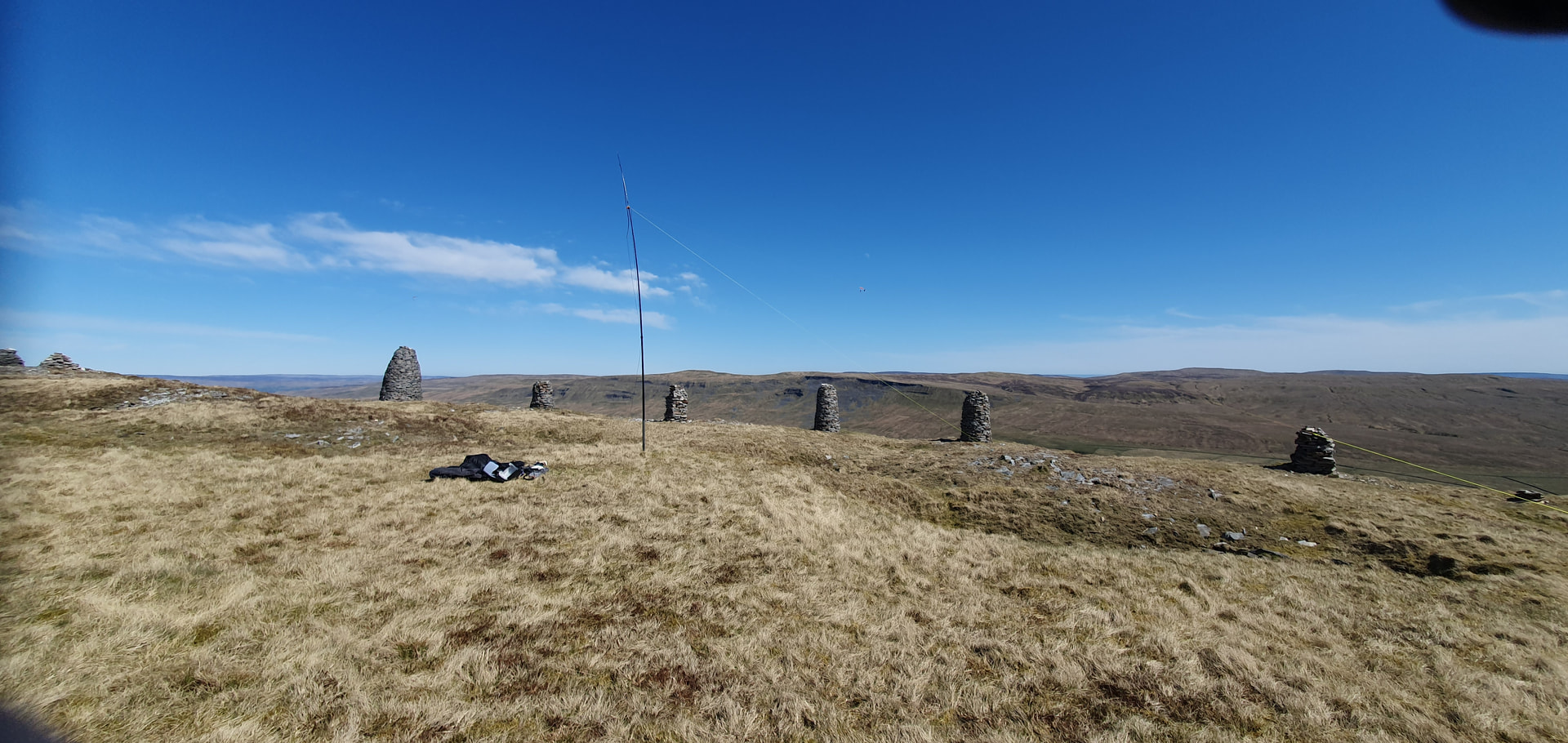
Today was a special day. Maybe as special to me as mountain goat day was for @M0JIA (well done Ian).
I set myself a difficult challenge a year or so back. I wanted to combine my love of hills and radio communication with SOTA being the obvious way to structure the combination. I realised CW would be advantageous for this hobby.
This was more of a challenge for me than the average CW learner. While getting to instant character recognition was straight forward. Just many hours with LCWO. Upgrading to head copy felt impossible. Reading posts that you just have to put the time in, and others found it hard too, meant I kept going even with no glimmer of improvement. To put this into context I can character copy at 15-20 wpm but if I attempt to head copy 5-character callsigns at 2wpm it is almost impossible. I can read copy 4 digit callsigns at 15wpm. This after many months of a little practice each day.
Some might be quick to provide helpful advice and tips but there is another part to this. When I was about 18 I had tests to figure out why I read incredibly slowly. I excelled with school/college in general. Just the reading and zero ability to speel properly. One test I now recall was to have numbers read out in sequence. I read back 3 and 4 digits with ease. More and I always failed. I’d forgotten about it until now.
Only recently with head copy practice did I research this and it is related to poor “verbal memory”. That bit of the brain that processes sound or vision into usable data.
So the challenge was a big one.
Today, with the occasional help of a decoder and the ability to recognise common phrases like TU and 55N, and more importantly the very patient chasers, I was able to log 15 CW QSO.
Thank you to those that repeated callsigns and queued patiently. You made my day. I’ll repay to a future morse learner one day.
For those considering CW, go for it. The reach with 5w and some wire is huge compared to SSB. More importantly the personal reward for getting to 10wpm basic QSO capability is very satisfying.
Congratulations on your first CW activation and thanks for the S2S. I hope I wasn’t too fast for you.
I don’t head copy. I write callsigns down - why would I need to remember it? I don’t write anything else down (except for a summit reference) but if the sender goes off piste I do have to write it down. So don’t worry about it and just enjoy your QSOs.
Congrats on your first CW activation Ian. Well done!
As Richard @G4TGJ and Andy @G8CPZ wrote: You don’t need to head copy the call sign of your QSO partner. You have to log it anyway. Just start writing (or typing) as the letters roll in.
Head copy is fine for all the other information exchanged during a QSO, though (gm/ga, your name, rst, 73, tu, …).
In addition to the oft-cited benefits of CW over voice modes (e.g. 10-13dB process gain, lower power, smaller rig/battery) there’s another one for me. I’m mildly dyslexic [apparently we left-handers are more prone to it]. This shows up on FM and SSB QSOs where I sometimes swap letters writing down the chaser’s callsign, e.g. G3ACB instead of G3ABC. Oddly, I’ve never had this problem with copying Morse. My theory is that’s because the brain decodes each character individually and you unconsciously write it to paper as a single operation. Whereas with voice, you take in the whole callsign before writing it down.
Many congratulations Ian on the first CW activation. I’m sure you will become more relaxed the more activations that you do using the mode. Hopefully I will work you on the mode in due course.
I find the need to write things down largely depends on how the morse is being sent. Several times over the years I have given praise to Reg G3WPF who I ised to work regularly on 2m CW when out activating. His rythmical morse was easy head copy and we often used to go off piste. I was reminded of this during the past week when the excellent weather coincided with a bit of free time, so I went out to activate a local bunker that had not been activated previously. I worked Peter DL3NAA who was on a summit and I felt somewhat embarassed to be portable, but not on a summit for an S2S. I apologised in brief - “sri no ref, bunker Hi” Back came the easy response “no problem”. Such a delight to have the words just form in my head.
You’re a few years older than my sister and she’s a few years older than me. When she went to infants school and tried to write/draw left handed the teachers made them at first sit on their left hands. If they persisted they got a smack on the knuckles with a ruler. So yes, they beat the sinister tendencies out of 5 years old kids back then.. She’s right handed now. I wonder if there are people who are 110% left handed or 110% right handed and you can’t influence that and just some who aren’t really either and can be influenced if done when very young.
Do you still get “the reversals” ? i.e. hearing B and writing V or 7 instead of 3. 17 years after starting to use CW on every activation I still do that. Yes, very poor show.
Ian, well done on persevering when you have a condition that makes it harder. If I head copy calls it’s subconsciously done as most of the time I write down each character as I hear it, There are some calls, maybe because they are sent so impeccably, that decode themselves. i.e. I hear CW and just write the call down with no intermediate recognising the letters. Occasionally you get 2 callers suitably netted so both calls materialise in my mind at the same time. Not too often and I’m normally so impressed with my super skills I then louse up the rest of the QSO!
Well done! Next time, most likely, it will go more smoothly.
I suspect that your progress may actually be rather closer to average than conversations else-Net might suggest. I can relate very strongly with the way you stepped back and thought about the learning process and how difficulties learning Morse might be related to difficulties much earlier in life learning to read and write. My progress was extremely slow until I did that. There are still characters I muddle up from time to time. Headcopy? I get some short common words, but most of the rest (particularly callsigns and summit references) I still have to write down. Frankly, for SOTA, the bits I have to write down are usually the bits I need for the log anyway…
Weirdly, if I’ve made one of those on receive then I’m very likely to reverse it on reply so the OP at the other end hears back from me what they sent…
I sometimes mix up F and L or Q and Y. The hardest thing is distinguishing S and H. I normally get it right subconsciously but doubt myself and write down the wrong one. I think I find sending H the hardest (with a paddle).
Snap Richard. I force myself to make sure I never count the dits. If unsure about if it was S or H I say to myself that was “di-di-dit” and then it’s often very obvious if it wasn’t.
I just wanted to say thank you for the encouragement. This is a great community. SOTA is so much more than a structure to encourage portable operation.
The reminder / re-enforcement that you can activate while on a lower rung of the learning ladder compared to ragchewing is really useful.
Though dealing with small pileups is useful. I used to operate from Antarctica where my callsign was a little more attractive than as a G0. So learnt some very interesting ways to cut through a wall of noise. The more interesting stories will have to wait for a pub.
I am a lifelong leftie (85 years). My father went to my elementary school teacher and asked her to force me to write right handed. This was back in the 40’s. He was told even then that such a move might cause problems. My mother found out about what he did and she really came down on him. So I grew up as a leftie. All of my bugs and paddles are right handed (?) instruments but I use them as a leftie and have never had a problem. So, I say, hats off to the lefties of the world !!!
Welcome to the CW club! QRS or QRQ it doesn’t matter a jot. I’m crap at CW but I practice every day and want to learn and get better at it. Next to VHF/UHF of all-sorts of operating, CW is my joint favourite thing about amateur radio.
It’s widely accepted in this more enlightened day and age that forcing a young child to use his/her less-dominant hand for writing and drawing can lead to dyslexia, reading issues, stuttering and speech disorders. It was a cultural norm based on conformity and often superstition and spurious arguments like smudging the ink (as the pen moves left to right).
I’m left-handed so I learnt (in my youth) to straight-key with my left. Then years later (in middle age) I taught myself to twin-paddle with my ‘wrong’ hand, so I no longer needed to drop the pencil or move it to other fingers when switching between paddling (RH) and logging (LH). It’s still no problem (in old age) using my right thumb and index finger iambically to do the so-called squeeze mode for the iambic seven (C F K L Y Q and R) even in cold weather.