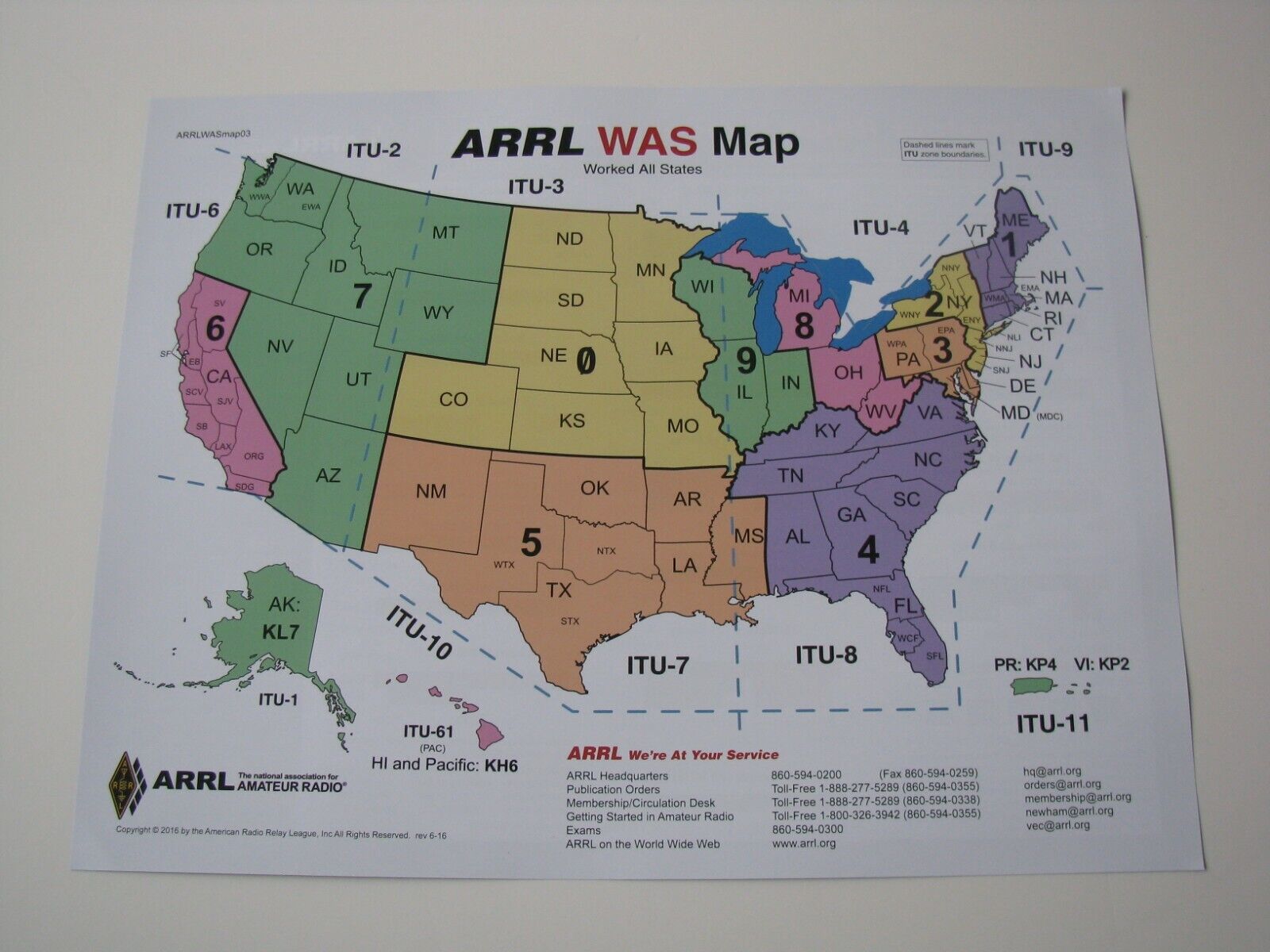
The correct number to add to the W prefix when a foreign amateur is operating under the CEPT scheme is given by this ARRL map:
So, if I were operating in California I would sign W6/G8CPZ.
And yes, as you already have a US license you would be expected to use your domestic callsign within the US. Well done on passing the UK exam and getting your UK callsign.
Echoing what Andy already said, when in a country where you have a licence issued in that country, that is the one that you must use. I for example, cannot use DL/G8GLM or DL/VK2JI in Germany however I can use OE/G8GLM, OE/DD5LP or OE/VK2JI in Austria as I don’t have a locally issued licence there (as an example).
The FCC (as is the ACMA in Australia) is a signatory to the CEPT 61/01 agreement, even though they are not CEPT countries.
While there is a direct agreement between the US and Canada you would expect that to be the one utilised by US hams visiting Canada, while those full licence holders visiting from Europe would operate under the CEPT agreement. So you could have both suffixes and prefixes in use in Canada for visiting hams. The same can be the case when direct agreements between two countries exist outside of, or in addition to the CEPT agreement (if both countries are signatories).
73 Ed.
Nice one Fraser!
I’ll have to keep an eye out for your spots, assuming you’ll be taking part in SOTA while away.
SOTA with a P. The highest point in Bermuda is Town Hill (79m). Short of volcanic or seismic activity before our arrival, no SOTA.
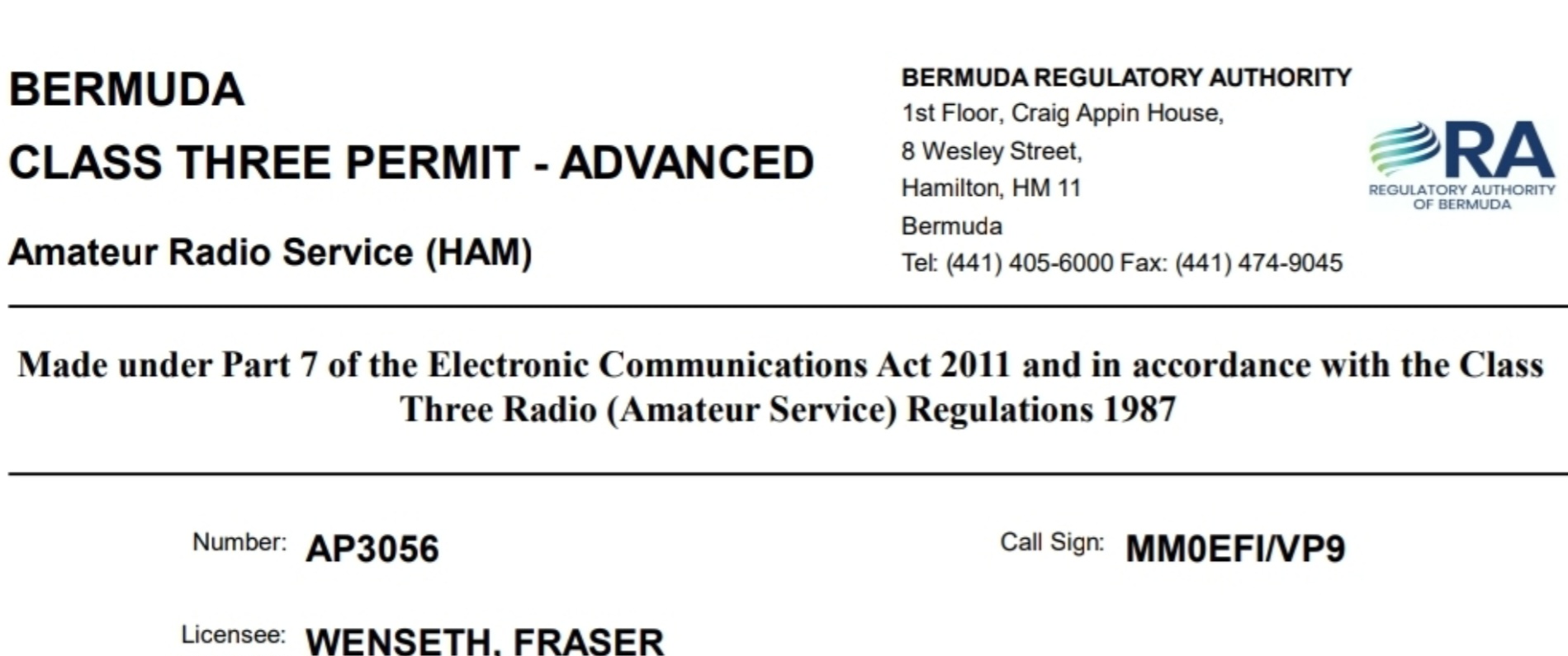
The main point of posting this was to illustrate that the callsign breaks convention.
It looks like they issued you a reciprocal license using your home callsign and where the requirement is to put the country ID as a suffix.
Bermuda is not a signatory to CEPT where the requirement is to have the country ID as a prefix.
No convention has been broken, it’s two different conventions for two license methods, one permanent but needing a formal application, the other for 6-months maximum at a time but no paperwork needed.
EDIT UPDATE: it’s 3 months maximum, not six.
Yes. And no!
My mate Norman from my club regularly goes to Colombia and he has two reciprocal licences for Colombia: HK3/MM0BMG and HK7/MM0BMG (different provinces/states) Colombia isn’t part of CEPT so he had to produce a paper UK licence as part of the application and he provided the only paper copy he had which said his call was MM0BMG. People with long memories will remember that before somewhere around 2015 your licence had your call including the RSL and later it changed to the wildcard format. So I have paper licences saying MM0FMF and M#0FMF with notes saying what to do with the #. The Colombians on receipt of paper licence with MM0BMG allocated HK3/MM0BMG. Which looks CEPT but isn’t and looks wrong because MM0 means Scotland. But he did what the Colombian authority asked for, provided a genuine paper licence and they used the call on it.
Now like Fraser’s MM0EFI/VP9 the fact it’s “wrong” doesn’t amount to a hill of beans… you provide the authorities what they ask for and use the call provided.
But I do see further changes to RSLs in the UK. The latest changes here are the voluntary change of 2E0AAA calls to M8AAA/M9AAA. The clever ILs will try and make a dash for the “best” M8/M9 calls first. Later remaining 2series calls will be revoked and a new M8/M9 call will be issued automatically to them. You’ll get what you get ! But when there are no more valid 2 calls in the UK, the only call where use of an RSL is mandatory has gone. Their use now is voluntary in IL and Full licences but most people who had to use them (Scotland, Wales etc.) still do, partly it’s automatic, partly to show we’re in a different DXCC and partly to show we’re not English  (Some people will get the real joke there!)
Once there is no mandatory use case I strongly suspect Ofcom will move to have them phased out totally. Which I’ll be sad to see 'coz I’ve been licenced for longer in Scotland than England. And partly because having engineered a use case with Ofcom and opened my sporran to the tune of £20, MS0TA will be just M0TA which is less spiffy for SOTA purposes. 
Maybe not. But it’s what I would do to undo the years of UK calls not following ITU requirements.
In what way?
If you allocate M0FMF to someone they shouldn’t insert things into the allocated call because they have moved to a different part of the country. More correct would be to do the old US/VK thing of of tagging something on the start/end of the call. i.e. VK3AFW/6 or K6EL/3. Or not bother because it serves little purpose.
I was living in Scotland in the ‘90s when I got my A Class licence and the paper licence was MM0ALC. Pity I didn’t keep it for posterity.
As long as the call starts G, M or 2 can’t the UK do what it likes?
Well, the license document I provided showed my callsign as M0EFI, so go figure that one out.
Bermuda Regulatory Authority must read this forum while they wait for their hill to grow.
Google AI: While the ITU allocates prefixes globally, the specific format, number of characters in the suffix, and individual call signs are assigned nationally, allowing for variations while ensuring unique identification for each operator within a region.
Sadly the AI misses a crucial point, the format is whatever we want as long as we start with G, M or 2. There are rules the 2 must be followed by a letter then a number. But the crucial thing is M0FMF and MM0FMF and MW0FMF are considered 3 separate licences by the ITU not regional variations of the same licence. Which is why other countries use regional variations using /number for example as VK and the US did.
The UK is the only country that inserts modifiers into an existing allocated callsign essentially creating a new licence. Inside the UK it matters not that we do this, we know how it works and we like to think Ofcom knows how it works. But when we operate outside of the UK, we should be using the real licence callsign and not some UK local version. This is why the rules changed (can’t remember when) so in 90s and early 2000s I would operate in Europe as DL/G4MGR/M or EA8/MM0FMF/P but at some point new guidance came out that said you must not use RSLs when operating under CEPT and it also stopped people using club calls (G4MGR) under CEPT and I started being EA8/M0FMF.
Hello thaar Stranger!
Can you point to a specific ITU regulation that says those variants cannot or should not be assigned by Ofcom to the same licensee?
The ITU has assigned the MAA-MZZ series entirely to the UK.
Here’s my AI friend again:
No, the UK is not in breach of ITU rules; Ofcom’s policy on Regional Secondary Locators (RSLs) for amateur radio callsigns, which permits licensees to optionally vary their callsign with an RSL (like MExxx or MWxxx) to denote operating region, aligns with ITU international conventions, as RSLs provide clear identification while allowing for flexibility within national licensing schemes. The allowance of such suffixes, in addition to the mandatory country prefix (e.g., ‘M’), is a national licensing choice that adheres to the principle of identifiable transmissions.
Disclaimer: AI could be wrong [but if you think so, please provide evidence]
[Pity that AI splits its infinitives, still not everything is perfect]
Some intermediate licences holders with a 2 callsign seem to think that the optional RSL applies to them as well which I know isn’t the case. Back in September I was activating Woodhead Hill GM/SS-269 on 2m FM and I had a 2E0 mobile station call me. As he was signing 2E0, I thought he was in England to begin with, but then I was amazed to say that he was travelling A75 towards Dumfries. I told them that as he was in Scotland he should be using 2M0 and I explained that RSLs aren’t optional for 2 callsigns aren’t optional and that E is actually the RSL for England. I was amazed by how he reacted to this, he said that he thought RSLs were now completely optional for all UK callsign types and thought that due to this he was OK to sign as 2E0 in Scotland. However, following my explanation, he did start signing as 2M0 and I logged this QSO as 2M0 also.
I don’t think Ofcom will eventually change remaining 2 callsigns to M8 or M9 callsigns at all as I was of the understanding that Ofcom would just stop issuing 2 callsigns and those with a 2 callsign have the option of changing this to an M8 or M9 callsign. I know for a fact that as people that some people with 2 callsigns would prefer to keep their 2 callsigns rather than change to an M8 and M9 callsign. I know this because a very close friend of mine who I have known for many years has got a 2 callsign and he’s previously told me that he has absolutely no intention of changing this to an M8 or M9 callsign because he says he studied to get the 2 callsign and that is what he will be sticking with. However, this friend of mine keeps saying that he wants to study to get a full licence at somepoint. I am pretty certain that some people with a 2 callsign and who intend to keep their 2 callsign will be very unhappy if Ofcom decide to get to change this to an M8 or M9 callsign.
I think it would be very sad if Ofcom decided to get rid of RSLs altogether because we would no longer to easily be able to determine what UK DXCC we are working unless we already know where that station is based. Therefore, those collecting DXCC would have to do some research to check which UK DXCC they are actually working and research could prove difficult if that UK station isn’t registered on QRZ.com. However, I don’t think Ofcom will remove RSLs altogether, I think they will just keep RSLs optional, otherwise why else did Ofcom decided to get to introduce an optional E RSL for England?
Ofcom still remain adamant about removing lower level licences that some of us have. I am not to sure that this will ever happen. I logged into the Ofcom website recently and I have found that I still have my foundation and intermediate licences as well as my full licence.
Jimmy M0HGY
Good for him!
Even though some have pointed out that we don’t ‘own’ our callsigns, after many years of use [56 years in my case] many do get attached to them, find sending or hearing them automatic, like the sound of them (e.g. in Morse), may have radio equipment, plagues, QSL cards and literature with that callsign on. and many other amateurs (in SOTA and elsewhere) know them for that callsign.
Some have said (on this reflector), oh it’s just a callsign, you shouldn’t care what is it. Well, they are entitled to their opinion but it’s not empathic to those who think otherwise.
Hi Andy,
For CEPT it’s 3-months not 6-months. Of course there can be other individual agreements in place between two countries, that have different rules and lengths of validity. A reminder to always check which agreement you are operating under when abroad and to take a copy of the regulations with you.
73 Ed.