Are Ground Loop antennas compatible with families and dogs?

Nursing a rare cold and not feeling like doing much today I watched a video on building your own ground loop antenna. I’ve always considered their permanent deployment impractical at my QTH but thought I’ld experiment with a temporary GLA to see if any good.

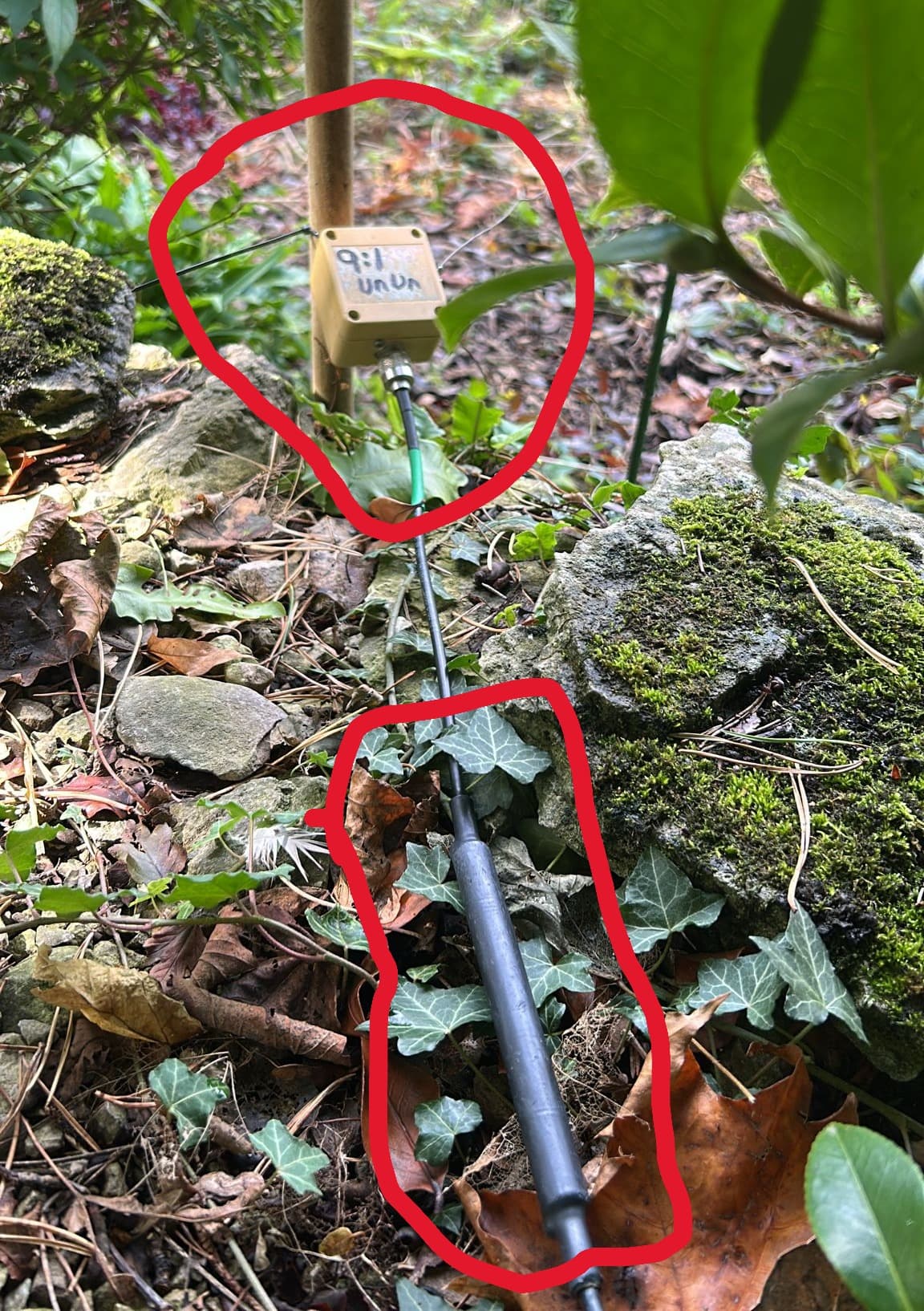
I set up the loop as a ~9m x ~10m rectangle using thin insulated antenna wire strung a few cms above and across the lawn and rockery. I hoped the pond in the middle wouldn’t affect things. The single loop went to an old 9:1 UnUn on a short pole, and from the UnUn SO239 socket 50 ft. of RG58 coax – with an in-line choke (from my Cha MPAS Lite) back to SDRduo / laptop in the shack.

I connected my Off-Centre Fed Dipole and the GLA to 2 of the 3 antenna inputs and used the SDRuno software to switch quickly and easily between antennas.

I listened across the HF amateur and broadcast bands (as well as VLF, LW and MW) and was amazed to find the GLA was consistently better, either with a larger signal-to-noise ratio and/or elimination of annoying buzzes or similar (local?) QRM.

There was a SSB contest on most of the main bands today which make it quick to compare signals from many countries. E.g. I measured up to 10-12 S-points improvement on 20m, 8-9 S-points on 40m, and 5-8 S-points on 15m. In some cases, noisy or non-existent stations on the OCFD became easy listening on the GLA.

It seems a great pity to have to take the GLA up as it performs so well but I can’t have people and dogs tripping over it. I’m sure my long-suffering wife would tolerate a ‘low profile’ version with my thin dark brown coloured wire discretely out of harm’s way.

So, I’m wondering if anyone has got around the practical problems I have.

Instead of the 9m x 10m rectangle on the lawn and rockery where people and dogs go daily, I could put it close to our boundary walls (mostly drystone walls about chest height) where feet and paws rarely go. But much of that is partially under mature trees and bushes. Is that a problem? Will there still be enough RF at less than vertical angles?

The circumference of today’s GLA was about 38m long. Going around the boundary at the rear of the house will probably triple that length. Is that good, bad or make little difference?

Finally, I understand one needs an antenna sequencer which apparently lets you tx on one antenna and rx on another without upsetting the rig. I would be using a Yaesu FT857D with LDG Z-11 Pro 2 ATU with the OCFD for transmitting and the ground loop (presumably without ATU) direct to the 857 for receiving. Suggestions welcome.

Interesting day (and it took my mind off the cold).

5 Likes

A sequencer sounds a bit over the top to me. If you aren’t using the amp-key on your 857, I would think you could use it to drive a relay to do the RX/TX swap over.

Folks with ground-mounted verticals used to simply stake out the radials directly on the grass with nails or small tent pegs. The first few times cutting the grass, they raise the mower’s bed a little higher than usual. Over time, the grass thatch firmly anchors the wires, reducing the risk of a mower blade spooling up all your hard work. In time, you’d struggle to even see your wire.

Of course, that probably works better in G-land. Here in VK, we plant grass, then sit around and watch it parch & die :slight_smile:

2 Likes

The LoG receive antenna can actually be buried (mine is), that way, no problem with it being a trip hazard.

73 Ed DD5LP.

2 Likes

Thanks, I could look into that.

No doubt you are imagining the lush green-grass pitch at Lords cricket ground or at The Oval. Or maybe even those velvet-like tennis courts at Wimbledon. I miss - well actually my wife, the proper gardener, misses - the loamy soil at our previous QTH widespread in southern and eastern England.

We now live in England’s most north-westerly county, Cumbria (G/LD land) which by contrast is mainly poor soil over rocks, rocks or lakes (hence the Lake District), great for tourists but on the whole very hard work for gardeners. Our back garden consists of a rockery / two ponds and, where there’s a cm or two of soil, two lawns & flower beds all over 345-million-year-old Dalton limestone.

Planting shrubs and saplings was easy back in SE England. Here, even making a 20-cm hole for planting is a backbreaking task with mattock and spade – especially if you are in your mid 70s – and yields more rocks, stones & roots than it does soil. We have a mole in the back and he must be very tough. We don’t resent him making piles of soil all over the lawn and flowerbeds as we reuse it for filling those holes we dig.

The thought of manually digging a long trench to bury a wire gives me the shivers. Because the soil is so poor and thin, the slightest stressing - e.g. spring droughts [Yes, it’s not just a SE thing, Cumbria gets them too nowadays!], female dog urine - can kill the grass in patches and I struggle to restore it even with TLC. I’m convinced digging a trench and trying to reseed or re-lay the grass would create a distinctly visible line where the wire is buried.

Pinning the wire to the ground is an option but pinning or burying, it would only be a question of time before that mole chewed his way through the wire in a few places.

Burying the wire on the rockery area would be unthinkable.

Placing the wire on the ground or slightly above it in a ‘no-walk’ area by the boundary walls is my only hope. But, as previously mentioned, it’s antenna performance that concerns me with most of it under mature trees and low bushes. So, although all points of the wire could ‘see’ the sky some would be at a 45-degree angle. Maybe, with the length of that GLA, it might still work. So, I would be interested to hear from anyone who’s deployed a GLA in similar conditions rather than in a massive lawn or field.

2 Likes

Hi Andy,

In my case, as I used that cheap green thin gardening wire that you can get everywhere, I think, there is no “trench” rather just a cut into the ground made with the side of a trowel, along the side of the small lawn normally. The wire sits perhaps a half inch under the ground, over the rocky bits it sits under some of the rocks, around others and is then covered with soil, so as not to be visible. Works great and passes the WAF (wife acceptance factor). Of course if you have less that 1/2” depth of soil, in places, you really do have a problem hiding such an antenna.

On your point about switching I use a Bavaria Contest Club Preselector, into which I added Rx/Tx switching and so enabling the choice of up to three receive only antennas plus the main antenna (the main antenna is always used for tx, but can also be switched to for receive when not using the other Rx antennas) - in my case along with the main antenna I have the LoG and a remotely tuned Magnetic loop antenna, with one socket free for another future Rx Only antenna.

The circuit for what was a BCC kit about 30 years ago, can be found online. The preselector is great for the wide-open front ends of some of the SDR based transceivers that we have these days.

You might look at some of the external units that add a Rx only antenna to a rig that doesn’t have the port already. I think MFJ used to make one.

Here it is: MFJ-1707B, AUTOMATIC RF SENSE ANTENNA SWITCH | MFJ Enterprises Inc

73 Ed.

2 Likes

It’s being so cheery that keeps you going isn’t Andy?

I go… I come back.

3 Likes

Paul G4MD uses a ground loop antenna to good effect. His QTH suffers from S9+ QRM on 40m and using a GLA is the only way he can copy signals on the band unless they are super strong. He actually transmits into it as well, throttling back the FT-891 to just 8 watts to avoid damaging the PA. His signal is easily copyable on a quiet summit.

I used to have a 40m horizontal full wave loop at a height of between 2m and 4m above ground . This was fed with 300 ohm balanced line direct to the ATU. Unfortunately I dismantled the loop when I moved the shack to the other side of the house and have regretted it ever since. It might have been okay with a coax feed and a 9:1 balun. I need to try this again. In the meantime I am using a QRM Eliminator with my 40m dipole, but many signals are still in the noise. Frustrating when I get 59 reports and struggle to copy the incoming signals.

2 Likes

Hi Gerald - Having tested Balun-fed and ladder-line feed on my SkyLoop, I have always come back to using a Q-Section of 75 Ohm coax from the feed point down to where the 50 Ohm coax starts and goes back into the shack.

Simple, no power limitation and even though cut for 40m works fine on the higher bands as well.

73 Ed.

2 Likes

I had a quick play with a ground loop antenna and found it received well. I didn’t do a comparison with my doublet though. I plan to put it in a bushy area of the garden. I don’t think the presence of trees or bushes will be a problem as it isn’t signal strength that matters on receive but signal to noise ratio.

3 Likes

Is there anybody who can simulate ground loop antena and dipol with diagrams and numbers in dB’s?

1 Like

That would be interesting and helpful. However, when highly constrained by practical considerations (as I am), it’s sometimes easier to build something and try it.

I might have the seed of an idea for a plan for a permanent ground loop antenna that should avoid lawnmowers, hedge trimmers, secateurs, spades, people’s feet, dogs’ paws and moles. It would run near the rear boundary walls, edge of the patio, and even over a trellis walk-through avoiding lawns, rockery, ponds and paths … and come close to the shack.

I can’t really vary the route to lengthen or shorten the GLA. It looks like 106m long in a trapezium shape. So, not resonant on the three bands with S9 noise - 160m, 80m or 60m. But I’m hoping that doesn’t mean the SNR wouldn’t be better than my OCF dipole. Just need that length of wire now.

1 Like

Simulation can say difference between dipol and GLA. Signal/noise ratio is different for every micro location.

Sometimes GLA would atenuate noise more than signal. But, I doubt that signals on GLA are stronger than on dipole high in the air. Maybe, just maybe GLA would be good for NVIS propagation. I don’t know

1 Like

Hi Andy,

As a receive antenna, you are not aiming to get a resonant length with a LoG. Mine is the length it is, because that is the length around the edge of one part of the garden and back to the 9:1 UNUN.

If you plan to transmit on it as well, then length will matter but as a Rx only antenna - simply as big as you can make it seems to be the rule.

73 Ed.

2 Likes

Hi Andy,

Hope the cold is better! My good friend and preserver of sanity Gerald G4OIG put me on to this thread when I spoke to him this evening, I don’t get here often these days :-s

I do use an LoG to great effect, my noise level with many variants of suspended wire antenna on 160, 80, 60 and 40 is S9+ making contacts near-on impossible whereas the noise on the LoG is generally around S2. TBH until I discovered the LoG I’d more or less given up on HF.

The “seminal” article on LoG antennas is by KK5JY ( The Loop on Ground Antenna - the "LoG" ) and makes interesting reading. My loop is rectangular, 2.5mm2 single insulated cable about 6m x 5m laid on the ground and buried about 50mm down in gravel where necessary for protection. It seems a longer loop is not necessarily better. It passes under trees and bushes without apparent detriment. I used a 9:1 (impedance ratio - 2:6 turns) transformer wound on a BN73-202 binocular core with about 10m of RG-58 back to the ground floor shack.

My transmit experiments were instigated when I noted that the SWR of the loop was about 1.2:1 at 7.100MHz and to my amazement it seems “if I can hear it I can work it” using 8W! I’m now experimenting with other bands using an ATU.

Good luck with your further endeavours,

73 Paul G4MD

7 Likes

For those who don’twnat to build their own LoG, there’s a commecially built one from a UK supplier here:

If you want to build your own, but not the UNUN - I used this one:

73 Ed.

1 Like

Intetesting reading given the S7+ noise we get here on 40m off nearby powerline. Sadly the toroid box is empty but a pack is on its way so will report back shortly once that has arrived and I have built a suitable isolation transformer.

Issue with deployment here is also a soil depth measured in mm, and the resulting lack of grass. Will have to run it close-by the 7-wire + rabbit netting boundary fence. Either on the ground or maybe elevated on the type of outriggers you’d normally use to add a hot-wire along a standard fence.

Thoughts on how a metal fence (part of many kilometers of wire fencing network) will affect both signal and noise, and the pros/cons of ground-laid vs outriggers?

1 Like

Matt,

The loop will couple into the fence which will be the dominant part of the antenna. Not what you want.

73

Ron

VK3AFW.

Feared as much. How far away do you reckon I’d need to be to avoid that? Or would the only option be to be on different aligment completely?

It’s very hard to give a minimum distance. Clearly, one would prefer no large conductive objects in the near field of the antenna (preferably at least 1 to 2λ away). Orientation makes a huge difference, e.g. whether the wire fence runs parallel to the ground loop or is at a right angle to it.

1 Like

My experience in using a hand-held direction-finding loop for 80m is that an overhead wire at 6m or less will affect the pattern. Basically, the telephone or other wire acts as the antenna, and the loop couples the signal from it. That means that, when I rotate the loop, the null in the pattern is based on the orientation of the loop relative to the wire, not to the received signal. I particularly notice that effect in my house, where the loop couples to the wiring in the walls.

That doesn’t mean that it won’t work, just that other nearby conductors will become part of the antenna. Whether they pick up more of the desired signal, or more noise, is hard to know in advance. If it is an active electric fence that might not work well, as those can be noisy (especially when they are arcing to tall grass).

My suggestion would be to drape the wire around on top of the ground temporarily and try it out. If it helps, then go through the effort of burying the wire (or staking it down, disguising it, etc.)

2 Likes