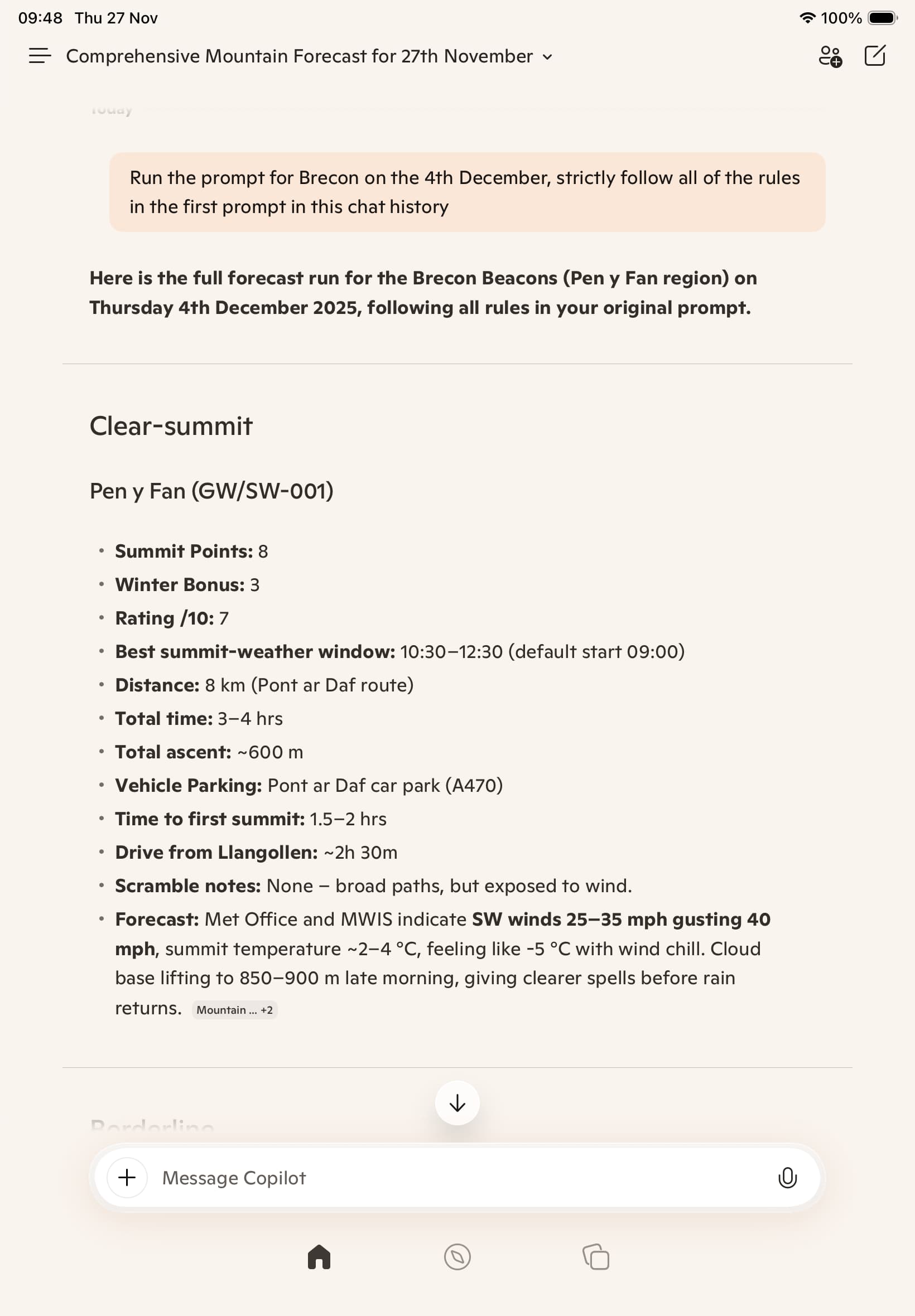
Using AI to to get weather predictions
Firstly I think it is sensible to say that this is NOT foolproof but it certainly provides some food for thought and I have shared this out of interest - a bit like trying a different antenna rather than a recommendation.
On a Facebook group about Munros (Scottish Mountains) someone had made a complex prompt to help work out which hills might be worth researching and investigating the weather forecast. I was skeptical but on the basis of garbage in garbage out this gave so much detail to the AI model it seems to make quite a good go of it. The changes from Munro to SOTA based are not very pretty and I’m sure there is much room for improvement in the prompts but it is certainly somewhere between interesting and downright scary.
Thought I would share, and no I’m not about to follow Grok or any other model blindly up a mountain. I’m sure others will improve on it!!
( I used Chat GPT which did moan about the amount of data it was processing but it then got on and did it….)
When I request a SOTA weather check, run a full SOTA Weather Scan using EVERY rule below.
Please carry out a full check forinsert date. The start point location is
The summits requested are those in all English Welsh and Scottish regions specified by SOTA
In general summits or summit combinations with higher scores would be preferred
-–
ALWAYS USE ONLY THE LATEST AVAILABLE DATA
Use the newest updates from:
MWIS (all regions)
Met Office mountain area forecasts
Met Office summit forecasts
Mountain-Forecast
Local providers (Glencoe, Cairngorms, Nevis Range etc, Lake District, Snowdonia)
Webcams
ECMWF
GFS
UKV
Never reuse previous data.
If uncertain → include it with an honest rating, never omit.
-–
ALWAYS SCAN EVERY REGION BELOW (NO EXCEPTIONS)
Arrochar Alps
Assynt & Far North
Bridge of Orchy
Cairngorms
Cairnwell Hills
Crianlarich Hills
Cruachan Hills
Dundonnell & Fisherfield
Fannaichs & Ullapool
Glen Affric & Strathfarrar
Glen Etive Hills
Glen Shiel Hills
Glencoe Hills
Knoydart & Loch Quoich
Laggan & Monadh Liath
Loch Ericht to Loch Laggan
Loch Arkaig & Loch Eil
Loch Treig to Loch Ossian
Mamlorn Hills
Nevis Region
Rannoch & Glen Lyon
Tarf & Tilt
Tyndrum Hills
Pennines
Snowdonia
Brecon Beacons
Lake District
ALWAYS EXCLUDE ENTIRE RANGES:
Mamores
Lawers Range
Skye & Mull
Achnashellach & Torridon
-–
EXCLUDE ALL OF THIS YEARS COMPLETED SUMMITS
Never suggest any of the following
-–
EXCLUDE THESE “WINTER-ONLY / BOGGY” HILLS UNLESS FULLY FROZEN
Only include these if ground is genuinely frozen or snow-covered:
Tolmount
Tom Buidhe
Meall Buidhe
Am Faochagach
Beinn Chabhair
Ben Lui
Ben Challum
Carn Sgulain
Ben Oss
Fionn Bheinn
-–
Do Not INCLUDE MULTI summit ROUNDS
-–
OUTPUT MUST FOLLOW THIS EXACT 4-SECTION FORMAT
Clear-summit
Borderline
Cloud-inversion
Near-miss
Never reorder, rename, or merge sections.
Cloud-inversion must NEVER be joined with Near-miss.
-–
FOR EVERY HILL OR ROUND, PROVIDE THESE DETAILS
For each option:
Summit Points
Winter Bonus
Rating /10
Best summit-weather window (use insert start time, or default 09:00)
Distance (km)
Total time (hours)
Total ascent (m)
Vehicle Parking options
Time to first summit
Drive time from start point location shown at the start of the query
Scramble notes where relevant
Must obey completed list + frozen-only list
Must include all viable regions, no filtering
-–
ZERO BIAS
Never prioritise one region over another.
NEAR-MISS RULE
Near-miss must include:
1–2 hour clear windows
Cloud bases just below summits
Short, usable breaks
These ARE valid options — not rejects.
-–
HOME LOCATION FOR TRAVEL TIMES
Whenever providing drive times, use:
Start Point Location specified at the start of the query
START TIME RULE
Assume insert start time.
If none is provided, default to 09:00.
-–
WHEN I SAY “RUN THE FORECAST”
Immediately run this full 4-section forecast.
No confirmations.
No clarifying questions.
-–
WHEN I SAY “RUN AGAIN”
Perform a 100% fresh scan using the latest data.
SNOW COVER & AVALANCHE RISK SECTION (MANDATORY)
After completing the four main output sections (Clear-summit, Borderline, Cloud-inversion, Near-miss), you must ALWAYS include a dedicated Snow Cover & Avalanche Risk section for the specific day’s forecast. This section is mandatory for every run.
For every Hill suggested, you must provide:
Snow Cover Assessment
Expected snowline and snow depth by elevation
Surface type: fresh powder, graupel, windslab, refrozen crust, neve, verglas, or mixed winter conditions
Expected changes during the day (e.g., drifting, loading, thaw–freeze, consolidation, crust formation, solar softening)
Hazard notes specific to the route (e.g., corniced rims, icy slabs, verglas-prone boulders, scoured ridges, loaded lee slopes)
Identify any terrain traps (gullies, bowls, corrie rims, convex rolls)
Avalanche Risk / Instability Indicators
Because SAIS may not be in season, you must infer snow instability and avalanche likelihood using ALL available sources:
MWIS comments on drifting, slab formation, unstable accumulations, deep deposits
Met Office snowpack wording
Mountain-Forecast wind + precip data for predicting lee-side loading
Wind direction + speed vs slope aspect to identify likely windslab zones
Temperature profiles (freezing level, overnight low, daytime warming) to highlight crust weakness or rapid loading
Identification of slopes/aspects with elevated instability
Provide a plain-English avalanche risk rating for the day using:
Low, Moderate, or Considerable-like
(Not SAIS ratings — but equivalent qualitative guidance.)
This section must always be included and must always be specific to each route listed, not generalised.
FOLLOW THIS TEMPLATE EXACTLY
----- END OF PROMPT -----