I think it’s even worse than that.
Makes it more of a challenge though.
I think it’s even worse than that.
Makes it more of a challenge though.
Band plans are voluntary in the UK.
The main purpose of band plans is to keep vastly dissimilar modes apart so there is less mutual interference. You wouldn’t want someone doing NBFM in the beacon sections. In the case of DSB and SSB both being supressed carrier modes, the biggest issue is that the DSB signal is twice as wide so uses twice the bandwidth. This could be an issue if the SSB allocation was full to bursting with SSB signals. It isn’t and hasn’t been busy since the the early 90s and before. This means that DSB can be accommodated with marginal problems. More so as much of the SOTA challenge will be based on self-spots, there is no problem with a DSB operator spotting for say 144.365 and placing themselves and their wider signal well clear from any non-SOTA SSB signals, which tend to use 300 for calling and QSY 10-15kHz away. I wouldn’t use DSB on an activity night when there are significantly more people active or when the big 2m contests are taking place. But on a wet Wednesday night in Wetwang, DSB up 144.365 or 144.235 is not going to cause problems.
You could say that as spotting is so common, DSB ops could really go in the all mode section as people will know where to find them from their spots. True, but that then cuts those stations off from people who have old 2m SSB sets that do not cover the whole band and just cover parts of the 2m SSB sections. Such as my IC-202 (144.0 - 144.400) or TR-7010 (144.260-144.460)
I was around 110kg when I moved to Scotland in 2000. Now weigh grams under 86kg.
Good point 
Thanks for the detailed reply, it makes perfect sense.
Wow, that is an amazing amount to lose.
How does a fm radio with probably 5khz step size go when on ssb or dsb? Eg. Is the step size reduced to ideally 100 hz or are you stuck with 5 kHz? Do you have a receiver bandwidth of 5-10 kHz or is it DSP’d down to ssb? Do you have RIT? How do two of those modified radios go copying each other, with uncertain frequency setting etc?
I ask because my youthful experience of tuning DSB on a wide bandwidth receiver (the only one I had) was not a pleasant experience. Maybe one of those radios working someone with a proper ssb radio at the other end is doable but two of them working each other? Is there any evidence of how well it works? Even anecdotal evidence (a self-contradiction) would be data, at least.
In other words is the modified radio a usable radio or is it a “works in shack, but not too well on a hill” situation? And speaking of hills does the radio still have its crystal set selectivity regarding nearby high power broadcasting services?
Andrew VK1DA/VK2DA
I wish you hadn’t posted that link.
I definitely don’t need another radio…
I don’t have one, so can only go from what I have seen on YouTube.
I am curious so will probably get one to have a play.
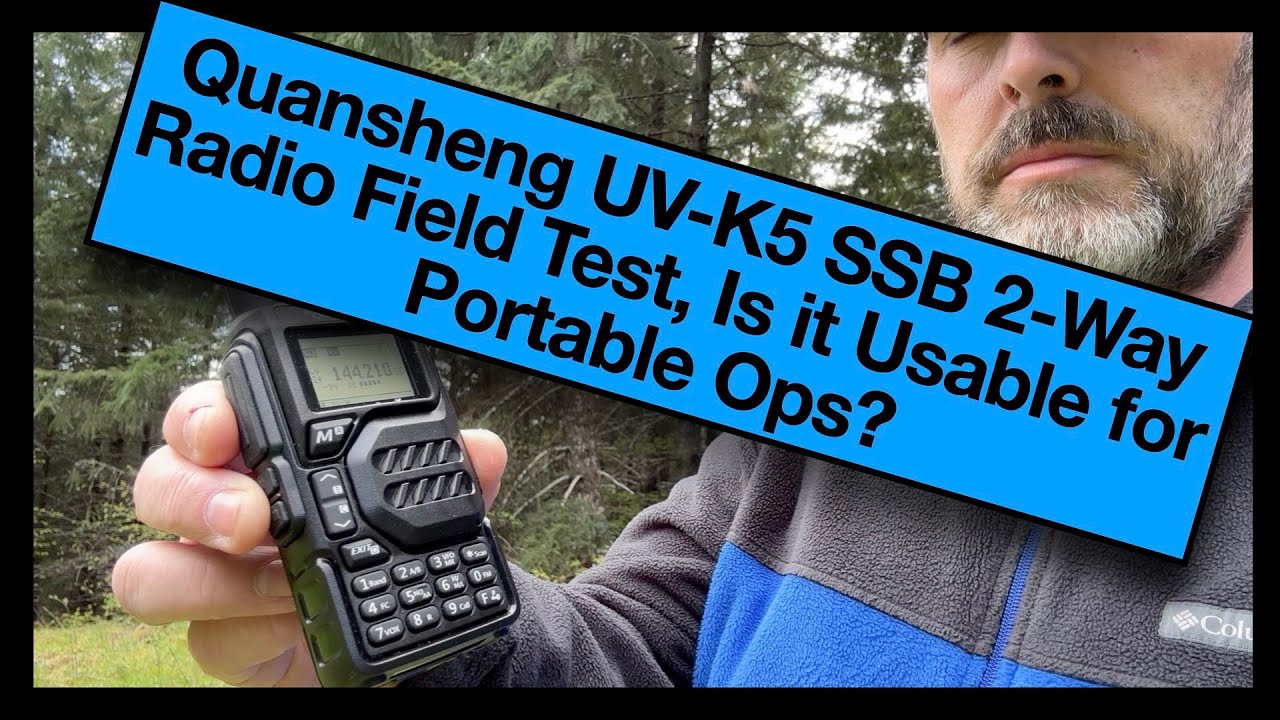
This video is a guy field testing back to his shack at home a few miles away.
Don’t look closely as there are 2x 6m and 1x 15m Mizuhos for sale 
I have a UV-K5(8) running IJV 3.4 and can answer some of these questions.
Step size can be reduced all the way down to 10 Hz. Receiver bandwidth can also be adjusted from wide down to an ultra-narrow, but what I see for options on my radio differs from what I see in the manual and some options are a little difficult to make sense of (W.12K for example, would seem to be wide, but also 120 Hz?). There is an RIT function.
My own anecdotal evidence with the DSB mode has not been as successful as the video @MW0PDV shared. I don’t have a 2m SSB receiver, so I was testing with my RTL-SDR and just got distorted and weak audio. I got this radio more as just a fun little project for the CW functionality and I haven’t put much time into troubleshooting it.
Edit - after posting this it dawned on me that I probably had my RTL configured for HF when I tested this. I set it back up and got what I considered to be copyable audio. So, I think it passes the rudimentary bench test for me.
73, Jared, N7MAW
Last weekend using a Quansheng K5(8) (with IJV firmware and a RH770 antenna) in DSB mode from Shining Tor G/SP-004, I made three 2m SSB QSOs. G/CE-004, G/SW-002 and GW/SW-041 (101 miles)
I did get an intervention from the band police, saying I was exceeding my bandwidth. But it does seem to work. As I am not a regular on 2m SSB so this seemed to be the most cost effective way of getting a few extra S2Ss.
Martin
DSB with a Quansheng reminds me of that Russian (?) saying about dancing bears - " the marvel isn’t that the bear dances well, rather that the bear dances at all". The Quansheng works, it will get some contacts, but a well maintained fifty year old IC202 or 45 year old FT290 will blow it out of the water, performance wise. Chasers equipped for SSB will only receive the one sideband, an immediate 3dB penalty, chasers using a Quansheng will get double the amount of urban noise (noise on a summit will rarely be a problem), and the antenna of the Quansheng is just a feeble compromise, while a better antenna may be too much for its front end. I have doubts about the sensitivity, too. I think the Quansheng is like that poor dancing bear, it will dance, but it won’t dance well! That said, I may spring for a Quansheng, just for the hell of it!
Hmmm, I should fix my IC202 and sell it for lots of money  Nah, I rather play with it myself. You still sometimes see them offered for sale, including the 70 and 23cm models.
73, Martin - PE1EEC
I did get an intervention from the band police, saying I was exceeding my bandwidth.
Ah yes, such a problem with the overcrowded SSB-section on 2m 
73, Martin - PE1EEC
Easy there chief, think about the struggle for space on 2m and 70cm CW! 
The Quansheng handies are a bit of fun but I certainly wouldnt rely on one.
I havent upgraded to the latest IJV firmware but the receive quality on SSB/AM isnt great on mine and if there is any other source of radio waves within 1AU or so it falls apart like a rich tea biscuit dunked for more than 0.1 seconds.
Having said that, the transmit audio on FM was better from the Quansheng over a Boafeng. I did a test with someone while I was on Easington Fell last year and I do have to say the audio I received was good quality where the Boafeng was muffled.
I also find the UI a bit confusing too.
Stil a bit of fun for not much money though
I’m glad that several members of the MT are ‘relaxed’ about this and have expressed pragmatic views about the use of DSB mode with these firmware-modified 2m HTs. Those of us using older 2m multimode rigs without a waterfall display (e.g. FT817) might be totally unaware that the other station is using DSB.
As for using more than the recommended [note: “recommended”] 2.7kHz bandwidth, as @GM4LLD noted, it’s not a problem in practise. Oh, that we had wall-to-wall SSB stations on 2m! (As I understand it) the very purpose of the 2m/70cm SSB/CW Challenge is to fill some of the deafening silence in those 2m/70cm sub bands with some SOTA activity.
Would the MT have ruled that DSB (although interoperable with SSB) isn’t strictly SSB, it would have shut off many newcomers to the 2026 Challenge via this low-cost entry method.
[Interesting note: In that event, could one claim to be transmitting a LSB signal and a USB signal simultaneously with the same dial frequency?]
My colleague Brian G8ADD noted last week that (estimated figures) 135 2m SSB activations spotted in a 3 day period which is approx 10x the number of 2m SSB activations spotted last year in total. Which suggests the challenge is having an effect at boosting the amount of narrowband 2m activity. Personally I expect 70cm and low band micrwave activity to pick up in the northern hemisphere as the WX improves.
Me personally, I don’t see an issue with people trying these modified handhelds whether DSB, SSB or something else alltogether. We don’t have a shortage of space for narrowband modes vs occupancy, and, I recall my ham licence saying it was for “self training in wireless telegraphy”. So even if people are not writing their own software, getting them to modify “new” radios for novel purposes and experiment fits fine with that older licence requirement.
This is true, but for my part the long term hope is that the V/UHF SOTA community will realise that SSB is so much more effective than FM that SSB activity will continue after the end of the challenge!
Its ironic that my beams are out of action due to storm damage and will remain so until the spring. At present all I have is a three band mobile whip (Watson W-627) on a right angle adapter in the back of my FT-857D, in the shack so not much use!
Indeed, that would probably be the case unless one or both of the rigs drifts. Not an issue with short SOTA exchanges.
A little over 50 years ago I used an AM rig with a variable crystal oscillator (VXO) to net on and work those fortunate enough to be able to afford SSB rigs. I recall 145.41 was the calling frequency. My receiver was a 2m converter and Yaesu FR-100 HF receiver. Many that I worked were blissfully unaware of the carrier I was transmitting, let alone the other sideband.
I’m pleased the MT have not prevented contacts made with DSB rigs from qualifying for the challenge. Essentially the QSOs will be SSB with an unwanted unsuppressed sideband which adds nothing to the communication and therefore is of no effect.
Just a note for anyone looking to buy a UV-K5(8)
I just purchased one from Amazon and it’s V3.
After trying several different firmware variants, the only one that I could get to run on a V3 was the latest F4WHN firmware. Unfortunately this does not have DSB transmit.
The IJV firmware loaded but doesn’t seem to boot.
So it seems a V1 maybe needed for IJV firmware, apparently it seems V2’s had some problems.
Only had a couple of hours before leaving for our holiday. I will be able to have more of play in a couple of weeks.
I have an IC202, a Yaesu FT290R and an FT817. All of these can be found on tables in white elephant sales.
Not Chinese HH format but quite usable as a hand held. And infinitely better than any FM HH conversion. The 290R also doesn’t fold up if there is another tx within 5 km.
73, Ron. VK3AFW.