About 3 years ago, during an activation of Shining Tor (G/SP-004), I met another activator who had a small 20W 2M amplifier, which he said was HB. Smaller than an HT and fitted in his jacket pocket. Are these easy to make? I would like to have a go at making 20W/10W/5W versions.
2 Likes
By the one on eBay with a busted pre-amp for £25 that gives upto 35W. I would guess the pre-amp FET (3SK88 perhaps?) has been subjected to the well known “In through the outdoor” effect.
If you like homebrewing and have some basic test equipment, they are not too hard to make. One straightforward approach is to use a Mitsubishi module and put it in a box with a changeover relay. Minikits in Oz have a kit for using these modules.
I have built two, one using a 30 watt module and one using an 80 watt module. You just need to make sure you are running them in the linear region if using SSB. They will also need a second harmonic filter as described in the kit notes and he has a kit for this as well.
These modules can be the basis of a very compact amplifier.
Glenn VK3YY.
5 Likes
I put an eBay alert for Tokyo Hy power and eventually got a 30W 2m amp for a sensible price.
Although I’ve yet to work out how to use it with SSB. Works fine with FM, flick the switch to SSB, and it appears to do nothing.
In fact, it was this model.
1 Like
The SSB switch does possibly 2 things.
- For RF switching it increases the hang time on the relays so the PA stays in TX during the gaps in speech. On FM, the carrier is present when you TX and that RF switches the amp to TX. Typically the delay is increased to about 0.5sec.
- It may change the PA bias. Some amps run the active devices in Class C for FM and only apply bias for Class A/B or Class B when you switch to SSB. Other leave it biased for SSB always as it works fine in FM too.
Use a PTT line from the radio wherever you can.
3 Likes
Thanks. I’ve not investigated it properly yet - my discovery was on a summit (in fact ES day). I started on SSB - having never used the amp before other than to check power output via fm at home - so wasn’t sure what to expect but did notice high SWR. Still made a couple of contacts, probably with 1W due to 705’s protection and through the preamp RX circuit!
Switched to FM and then heard the relays work and SWR was fine.
I did think a cabled PTT would be better but it doesn’t come with PTT connection out the box so maybe needs some mods to achieve that.
2 Likes
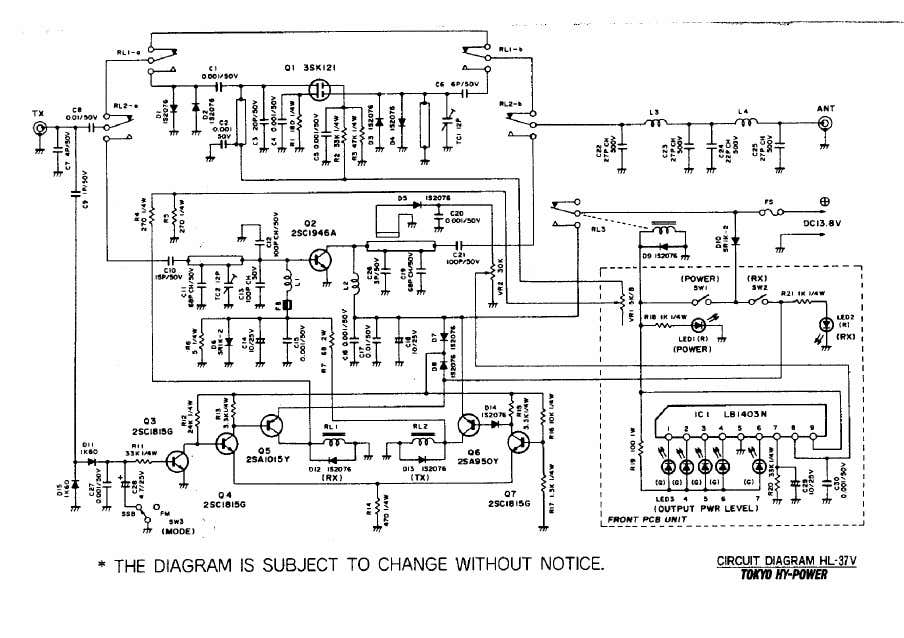
You should be able to get a circuit easily enough, Tokyo HyPower products were usually good and are well supported by the community. Look at the circuit, there’ll be a small capacitor from the input socket to a pair of diodes rectifying the RF and using that to switch on a transistor which keys the PA. A wire to drive that transistor will do the switching. Normally PTT from a radio goes low to signal TX, you may need to add a transistor to invert the PTT signal going low to one going high and use that. It needs a coat of looking at because it should switch on SSB… perhaps the switch is faulty or something goes O/C when you select FM.
Simplest option is probably to add a capacitor to the switch so it stays on longer in FM which works.
2 Likes
I’ve also used Mitsubishi RA modules for both 2m and 70cm, in fact I’ve recently had a pcb made to build a compact Sota 2m amp.
I found some boards require a LPF others don’t, what they all need is an adequate heatsink to get that heat away quickly.
One day, I’ll get this finished, but it’s way down on the list of projects.
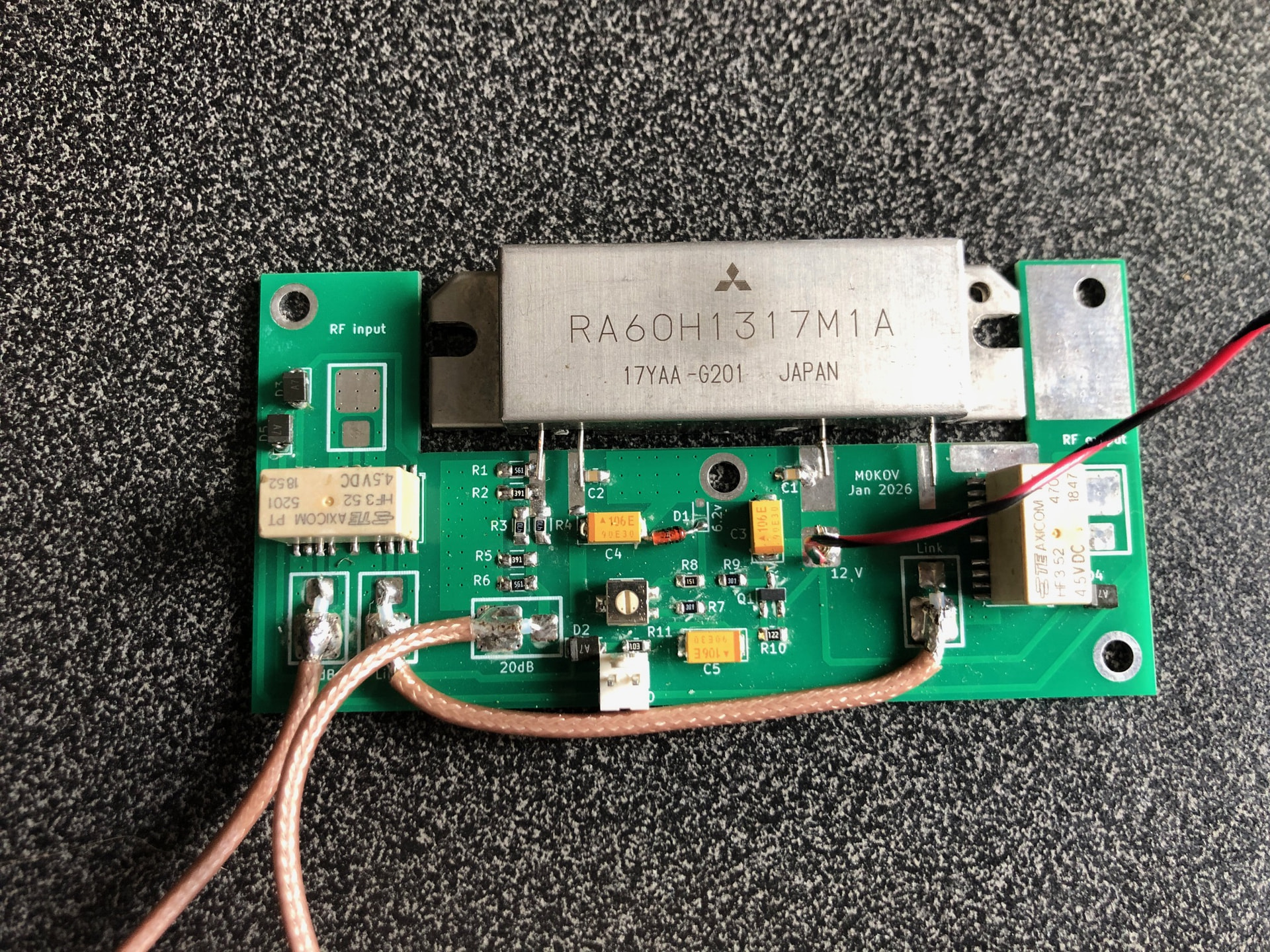
4 Likes
I’ve got one of the Tokyo ones (although there are several very similar versions with slightly different circuits). They are pretty good although the Rx Pre-Amp bias circuit is too simple and is affected by input power voltage and needs tweaking if not run from 13.6 volts.
Circuit:
2 Likes
Glenn should’ve linked his blog if people wanted to read more about it.
1 Like
Thanks Alex…. ! I should have put in a link..
This is the 80W one in the field doing some aircraft scatter. It has a larger heatsink, but same Minikits board.
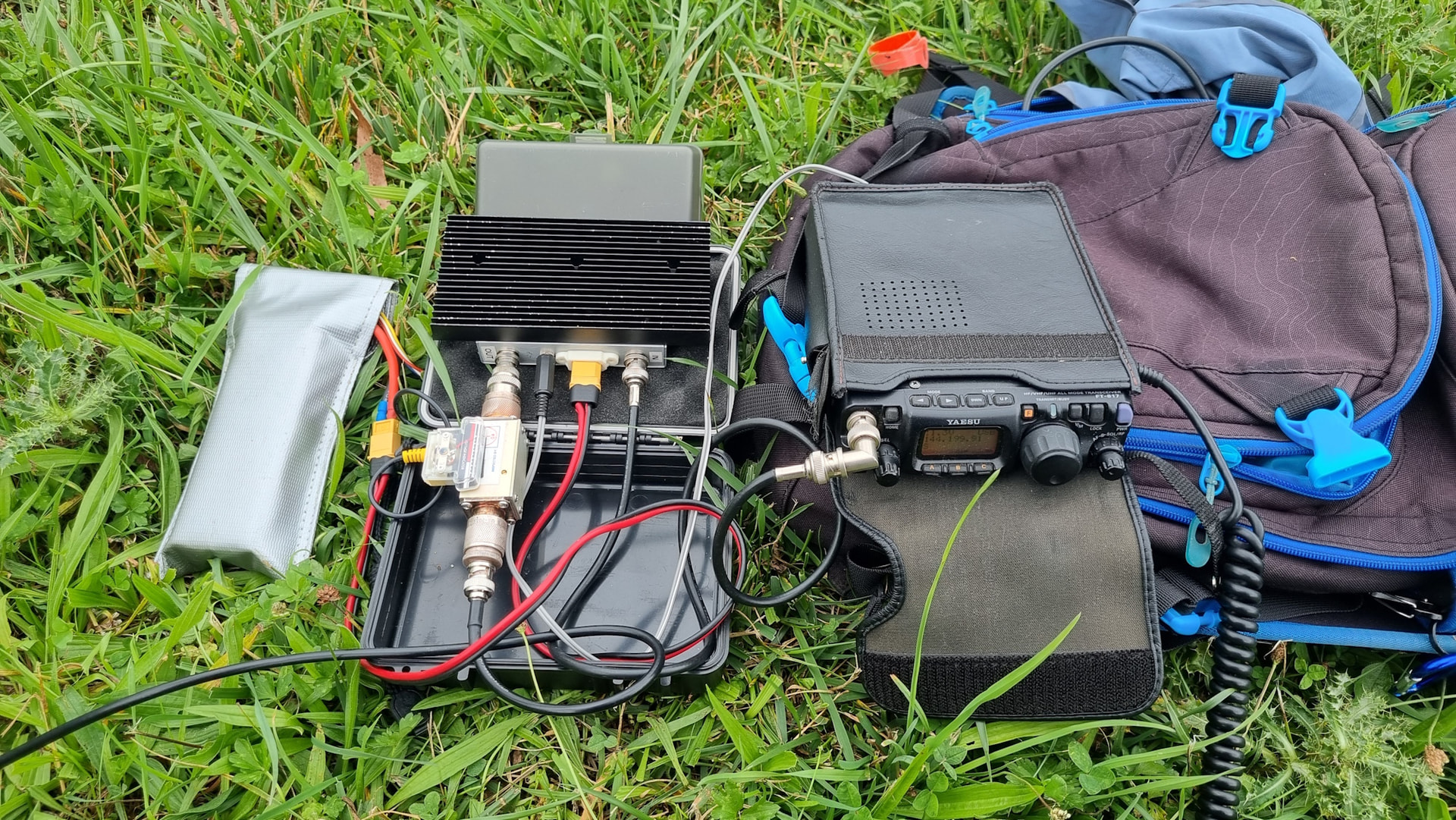
Glenn VK3YY.
2 Likes
Water can be a light heatsink you don’t have to carry when you aren’t using it.
I made a system for an HF amp that had a far too heavy and sharp heatsink, using a pair of little laptop cpu heat pipes going (siliconed) though the cap of a (plastic) softdrink bottle (which is upside down in operation). Extremely light and you can drink the water after use. A drink bottle has a large surface area, it only needs to be half full of water and squashed flat so there’s no air.
Of course just using a couple of old laptop heatsinks with the matching fans directly, would also be very light and compact.
5 Likes
Interesting idea, I’d never considered water cooling for a mobile setup. The module shown in the picture is dead, most likely caused by over heating. It was part of an amp/preamp setup in the house loft space and although I’d carefully levelled the mating surfaces of both the module and heatsink and used cpu grade heatsink compound, it failed after a few months possibly due to the high temperature the loft reaches in summer.
73
1 Like
I bought a Tokyo Hy power 50W 6M off eBay, unfortunately, the on/off switch doesn’t work, looks like another E season without it!
Just solder a wire link across the switch - you don’t really need an on/off switch you can just unplug the power lead instead 
3 Likes