QRZ is working fine for me.
It was the web site that was down. Down for many people and also the “DownForMe” type sites which check things. It could have been a routing issue so that some web traffic could reach the servers. That could explain your lack of issue.
No… I haven’t got time. I flatly refuse to go up into the loft and bring down my 1984 vintage Commodore C16 to see if it still works.. 
1 Like
What about if you accidentally on purpose go up to the loft? 

2 Likes
I’ve still got my Nascom II. It looks like by version 3 of the RAM card they had added some decoupling:
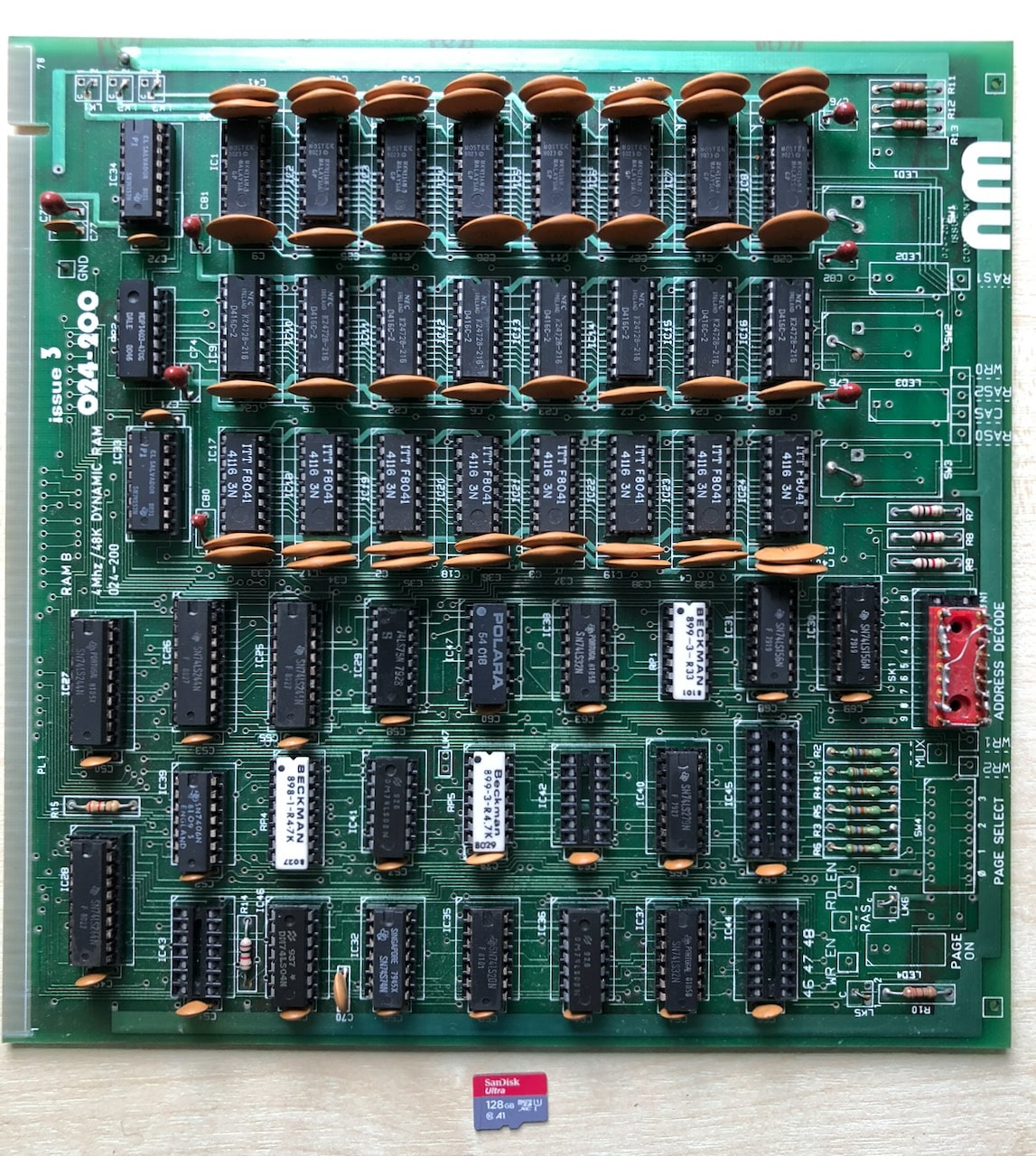
I added a microSD card for scale
I wrote my own split-screen RTTY software in Z80 assembler and used it in quite a few BARTG contests back in the day.
Jonathan G4IVV
4 Likes
Do you still have the code anywhere? Could be handy for the Internet Archive?
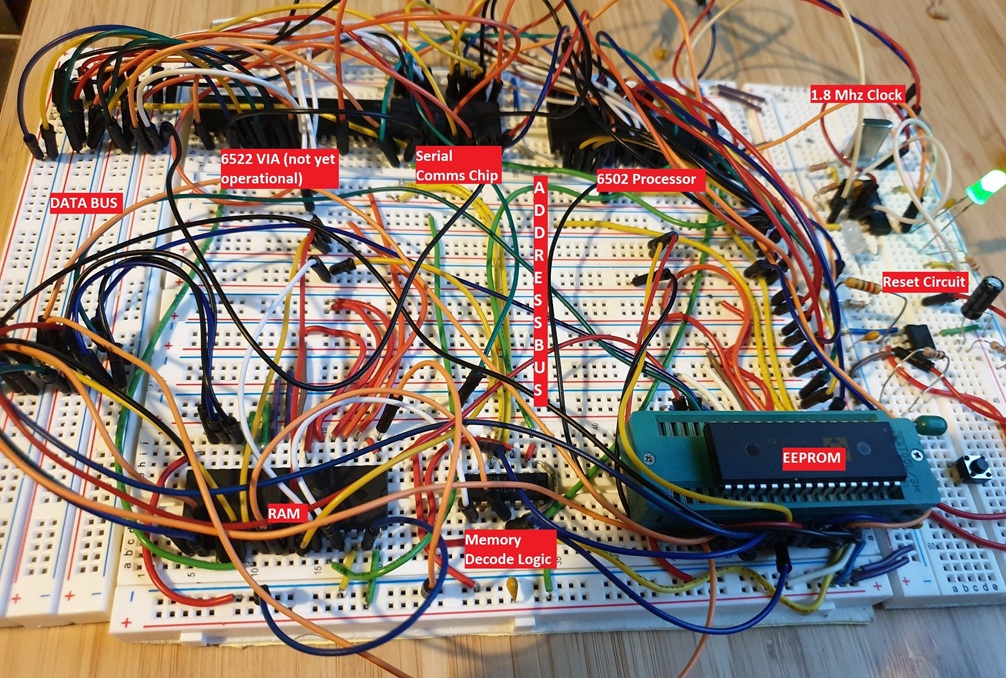
Put the above together a few years ago. Based on the designs by Ben Eater
Processor was actually a 65c02 and used mainly from a terminal on the PC via the serial chip. If I remember correctly, it had both 64Kb ram and 64kb of Rom on the chips but only 64kb total available. It was split 50/50 with the Rom being the higher 32k of total memory. It was just simpler to implement with a single address decoder chip rather than some banking style memory configuration.
The eeprom contained by MS Basic interpreter and a monitor. I did manage to get the 6522 Via working with a 2 line lcd display and a ps2 keyboard, however it slowed everything down to a crawl.
I still have it on a shelf but not sure if it still works as the wiring was prone to come out of the breadboard at the slightest touch.
I did consider trying to add a display board set of breadboards and designate some of the ram as display memory, but it looked very fiddly and the timings had to be exact which wasnt something easily done on breadboards.
4 Likes
I think I have a cassette tape, will try to find it. Then I could record the sound and it shouldn’t be too hard to demodulate the audio FSK tones to extract the program listing. It’s not a high bitrate! 
1 Like
Yes, this works well. I found an archive of TRS-80 Model 100 software that was saved as audio files. It was easy to rig up a cable from the sound card output to the cassette input on the M100. Worked perfectly.
Do you recall a TV program in the 80’s that would include small programs as audio during the end credits? I don’t remember the name of the show, but I remember thinking that was a neat idea. Computer were so much more fun back in the day.
1 Like
There were tests by the BBC where there was a flashing white square on the TV screen. You held up an LDR to the screen and data was sent by modulating the on period. I think it was an ORP12 to an op-amp and fed into a PIO on the BBC computer.
This will help. I read Kansas City standard and I was transported back to 1981 and my summer job fixing Colour Genies, Nascoms, and the odd Apple II. 
3 Likes
This is not the show that I remember, but same idea:

There were radio programs on the BBC that used to broadcast software on their shows. Magazines sometimes distributed software on vinyl records before cassettes became the more popular medium alongside 5.25 and then 3.5 inch disks.
Television sometimes did similar ‘data bursts’. Not software but compressed burns of pages, similar to Ceefax that you would record and then play back frame by frame. I have some CAV Laserdiscs with this feature embedded. Laserdisc was incredibly good for this kind of data feed as frame by frame was (still is) very accurate and stable as opposed to VHS, Beta et al.
Bad Influence was one such show I remember that did this.
1 Like
With all this talk of old school hardware, I found a brand new, still sealed box of 5.25” floppy discs the other week and a copy of Novell 3.1 on CD
3 Likes
I have this hardware/software setup called Kryoflux and a 5.25" drive that can recover and backup old disk media at the lowest level.
I have a few tubs of 5.25" disks with software on them i bought on eBay in job lots years ago. I’ve not recovered them yet but always had notions! Maybe I will find Colin Porch’s long lost C64 Parasol Stars code! A holy Grail in C64 terms.
1 Like
Ooh thanks, yes that’s good. I haven’t found the tape yet, but I did find a printout of the source code on fan fold dot matrix printer paper. 21 pages so I’m not going to rush to type that in! I’d also need to check the caps in the Nascom PSU before applying power.
3 Likes
Can you scan it or take photos and use an LLM to OCR it?
1 Like
It’s amazing that NOS computer stuff like that still exists… by pure chance. My favourite old computer is a 486DX33 that I built back in the early 90s which has both 3.5” and 5.25” floppy drives, though I can’t recall when I last used the larger format. The machine runs on DOS 5.0 and Windows 3.1. which I have to relearn each time I switch the machine on.
2 Likes
A whole chunk of the formative years of my career is missing. All the software written from leaving University in 1983 to 1989 is missing. Games, games development software, support software for Z80/6502/68k etc. using Atari 1040ST as the development engine, graphics/sprite designers, disk copy protection, debug systems (like GDB remote but ST develop to target using the MIDI ports and ST->Amiga using bidirectional parallel ports). A huge 6 years of work gone. Worse I’m not sure how they were lost…  The archives start around 1987/88 on PC (DOS) code but the 68K code, all that work has been lost in time like tears in the rain.
2 Likes
I can see that none of you have gone through those evolutionary pinch points where your entire life has to fit into 25kg of hold baggage plus 7kg of carry-on. Or perhaps, more capacious, a Hiace van.
Of course in these days all that detritus of life would be backed up to the cloud for me to reminisce over at will. But as it is … it’s long gone except in my memories, and I can’t bring myself to shed any tears.
2 Likes
I’ve still got my first computer, bought with all the money in my childrens TSB account. It was every penny I had been given on birthdays and Christmas etc. My Dad topped it up a bit.
That was in 1979, I was 15… it is an original Commodore PET 2001 4K, the one with the “chicklet” keyboard and built in tape drive.
I haven’t tried turning it on for a couple of decades. I probably should dig it out. Apparently the power supply caps go bad and it is a really bad idea to just try switching it on… best to get it sorted first. Maybe I’ll get it spruced up for its 50th birthday.
3 Likes