Matt,
Your post above referencing the SOTABEAMS “Antenna Center + 1:1 Guanella Balun” prompted me to take a look at this solution.
When looking at this description, I noticed 2 things in particular:
-
In the winding instructions for the “grey” (?) toroidal core according to Reisert’s method, particular importance is attached to how many windings are to be applied before and after the crossover (although from an electrical point of view that doesn’t matter, at most for the wiring), but that the crossover winding is not numbered and counted. Either way, this balun has 14 turns.
-
The green graph shown for |Z| (presumably to be understood as common-mode impedance |Zcm|) does not have the typical course dependent on frequency and complex permeability and the values appear to be somewhat good (assumption: FT-114-43 toroidal core).
As a reference I used a quick prototype setup with only 1 conductor of insulated 0.8 mm hookup wire.
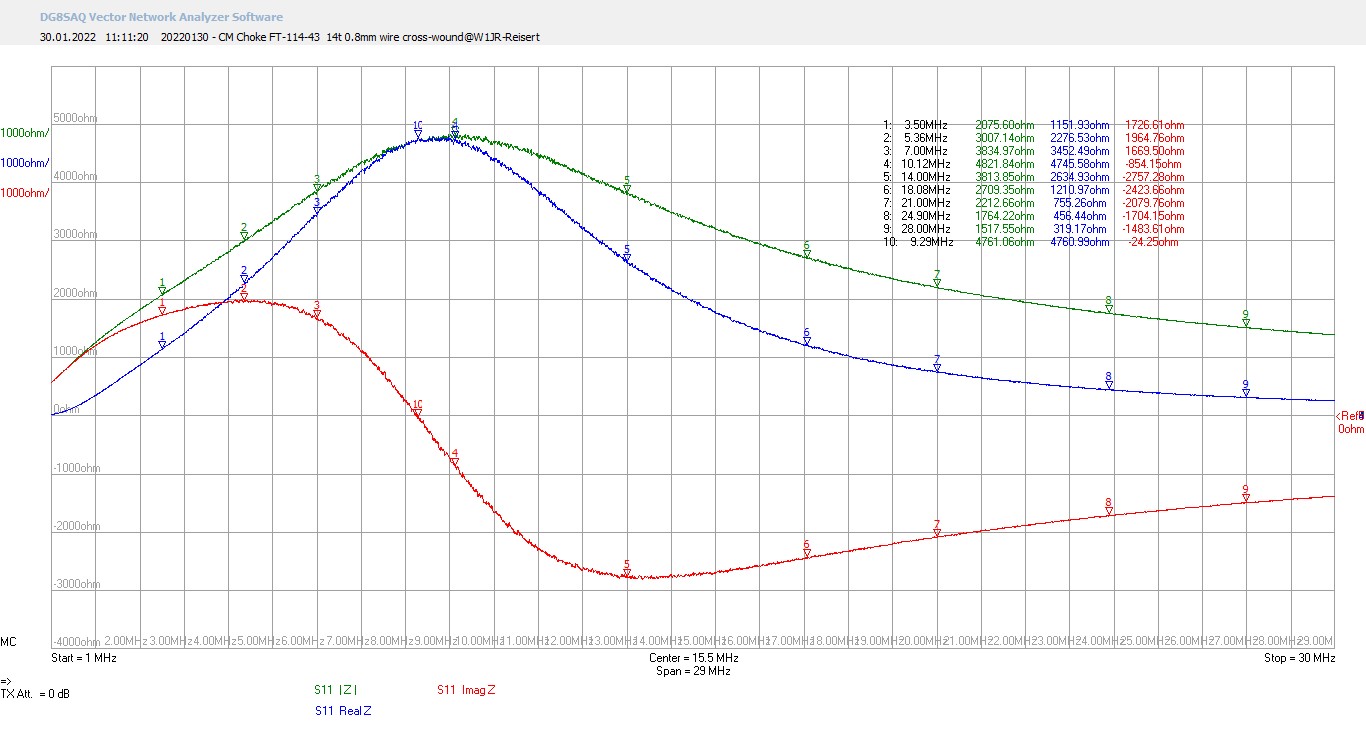
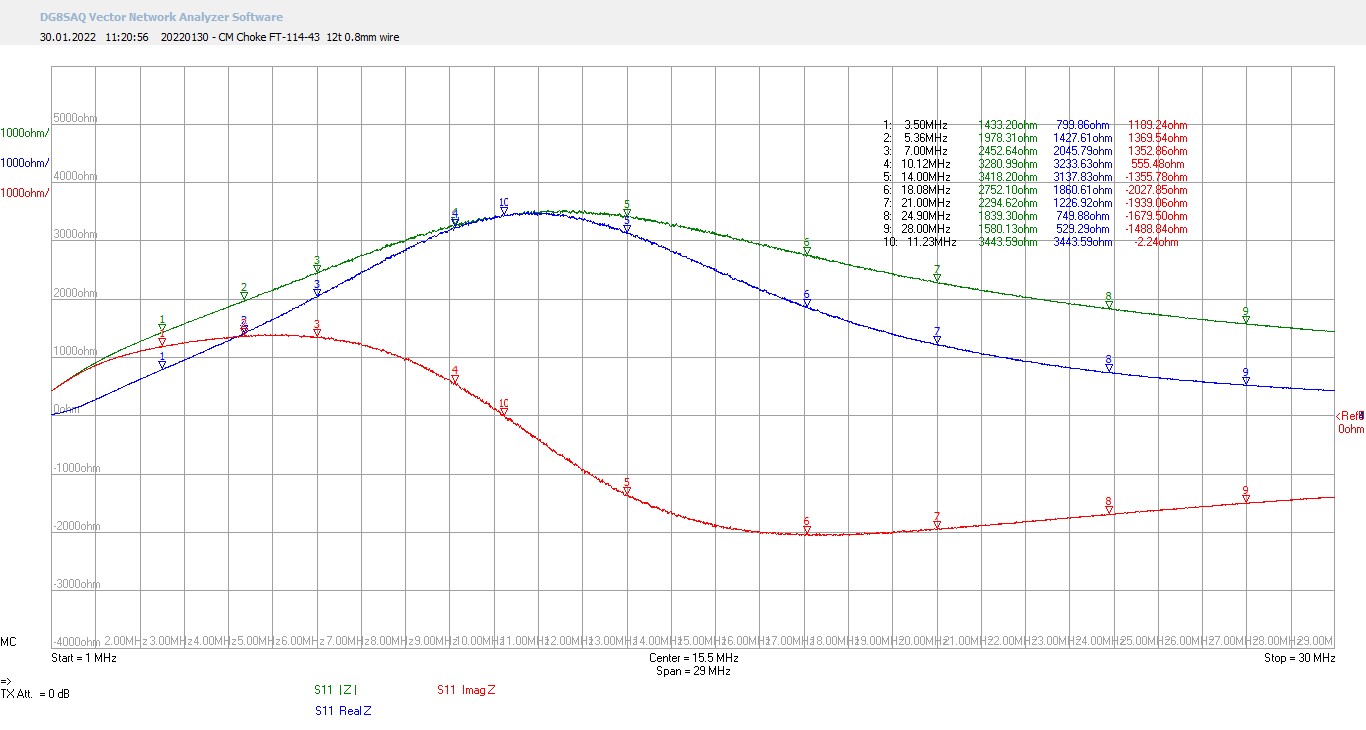
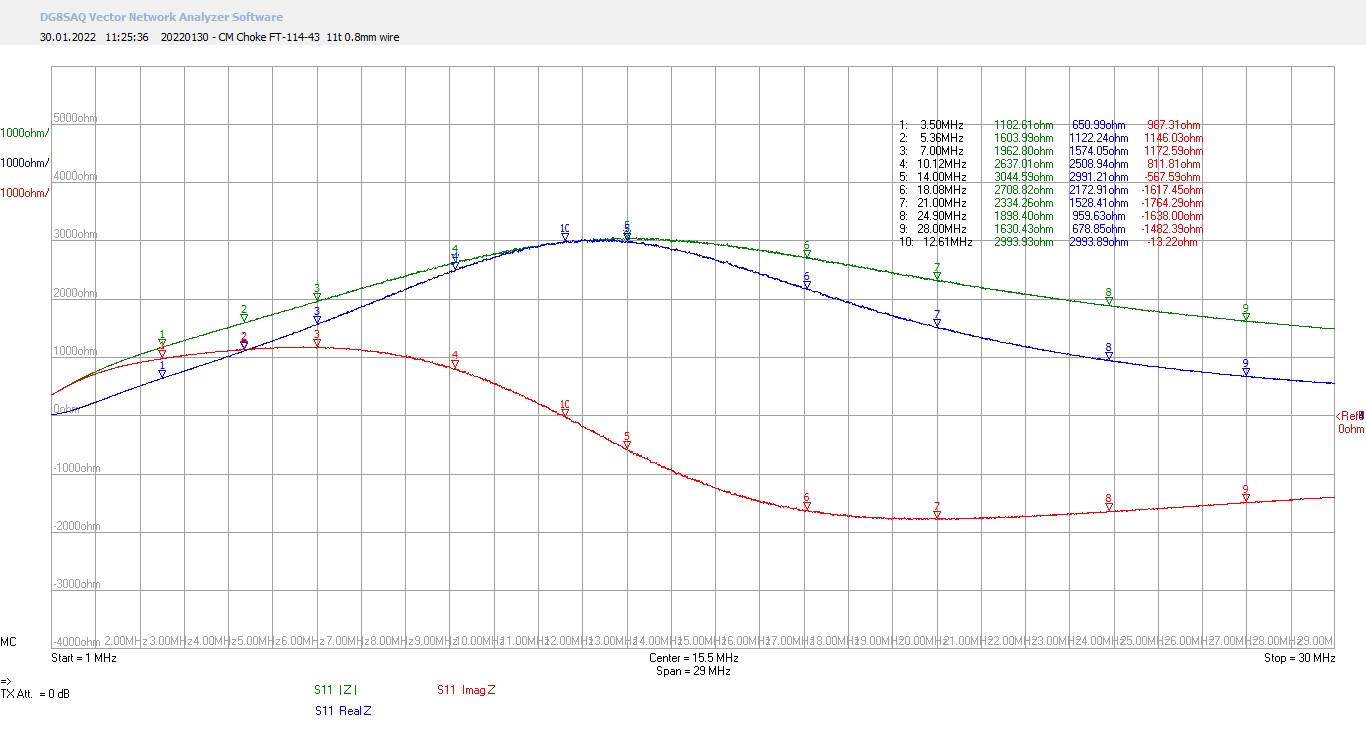
The VNA graphs below show the following:
-
Zcm for the original version with 14 turns
-
Zcm for a 12-turn version
-
Zcm for a 11-turn version
Marker #10 is set to the self-resonance frequency in each of these graphs.
It can be seen that for applications in the range of 40-10 m or 30-10 m with fewer turns, a larger Zcm value can be achieved on the higher bands.
Pro memoria: Because Zcm occurs on the outside of the coax braided shield, it cannot be measured with an S21 through measurement, but with an S11 reflection measurement (if the conductor is made of coaxial cable: on both sides of the braided shield and if twisted lines: on both sides with both conductors together).
73, Heinz