For my next summit activation, in addition to my HF gear I may want to take a cheap handheld which I just bought (BAOFENG UV-5RM Plus) to see if activating using a much lighter radio is possible. Now, don’t laugh please, but I’ve never communicated on VHF/UHF. Can someone give me dumbed down step-by-step instructions on how to do that?
I understand I always operate on FM and in split mode in on VHF/UHF (i.e. TX and RX are on different frequencies)? Can I even count on any success with the factory-mounted rubber duck antenna? (In the few videos I’ve watched I saw people carry a Yagi antenna with them.) I guess this needs to be line of sight, so with this small radio I suppose the best I can count is that a chaser would be within the radius of several km of me? Which is probably not achievable. Finally, is there any frequency preference? I see people spotting themselves on 145.500, 146.520, 146.580 and similar.
Any practical advice welcome. Based on what you say I may end up giving up on the idea altogether. But I’m curious what y’all think.
I never use splits, just simplex on a different frequency.
Range will depend on the antenna, the surrounding terrain, and your proximity to other VHF users. With a 5w HT and a halfwave whip, I’ve had contacts out to over 100 miles. Up to 50 miles is very common.
Which frequency you use depends on the band plan in that locale. Here in the US it’s mainly 146.52 and 146.58. On UHF, it’s almost entirely 446.
Hi Adam,
I can understand why you might be thinking split mode - activators often spot “145.500 listening 145.450” or similar. This just means that they are calling on the calling channel (145.500) and then intend to move to 145.450 for the QSO once someone has responded.
It is good practice to avoid chatting on the calling channel!
Split mode is only used when working through a repeater, and calls via repeater do not count within the rules of SOTA.
There may be better channels (centre frequencies) to use for you, there are local variations. Its probably worth listening for local activity around Cork to get a feel for it, and maybe drum up support!
Good luck,
Adrian
G4AZS
Stating the obvious, VHF/UHF (only) activations – are much more dependent on your summit’s location w.r.t. large towns and cities than with HF where the ionosphere’s going to get you national and continental coverage.
As you mentioned a ‘light radio’ I assume you want to avoid taking a Yagi, which is fine. Most VHF/UHF SOTA activators I know – unless taking part in an event like a contest – will use a 2m/70cm 5W FM handheld with either a whip antenna (e.g. a Diamond RH770 ½-wave telescopic whip is very effective) or a vertical slim-jim or j-pole on a 5-10m pole. I almost never bother any more with the latter as the extra range gained wasn’t worth the extra faff in setup/takedown as I rarely got less than 4 chasers to qualify the summit. But you might need it to reach chasers farther away.
Given the greater dependency on summit location, it’s important – as well as alerting - to self-spot (if you can) or ask a chaser to spot for you. You are always working simplex on SOTA activations. I can’t think why anyone would want to work split mode.
I self-spot for the calling frequency (145.500) and add a comment “will QSY nearby” and call CQ. Agree with the first chaser, the QSY frequency and others listening will follow you there, or know to flip through channels to find you (25kHz spacing, I can’t recall anyone using the intermediate 12.5kHz channels). Some activators prefer to specify a working frequency in the spot either before calling CQ or after QSYing.
Calling protocol is much the same as voice mode on HF. Call CQ giving your callsign twice (once using the NATO phonetic alphabet – personally I don’t like non-standard phonetics, it distracts me). My working protocol with chasers is much the same as when on HF SSB.
If you’re having no replies to your CQs, try breaking into another QSO on the band or access a local repeater and request callers (who can hear you on input) to join you on a simplex frequency.
You may be in for an exercise in frustration with VHF on summits in the south west. There’s not a lot of activity sadly. If you do make contacts, they will typically be in the single digits, and you may be stuck on 3 and calling, calling, calling…
I usually don’t bother with it anymore and stick to HF. You will do well in GI land and maybe the wicklow mountains which opens up the possibility of GW. You should get well over a few km in range though. In June, I made a S2S from Commedagh to Lugnacoille (140km) on 2m. My best is from the Knockmealdowns to the Lake District, about 400km. That is not usual though. The same day I was getting APRS packets from a repeater in Northern Spain, so conditions were good. All with 5W and the standard rubber duck antenna.
Anyway to answer your question, no split ops needed, call on 145.500 and QSY up/down a bit for the QSO. You could hop on a repeater and try drum up a bit of activity, but QSO’s must be simplex to score the points. You can work the LEO sats though and they count. I havent done that yet. I don’t know if QO-100 counts.
My first activation was using a Baofeng UV-5R. It’s difficult because the audio from the radio is rubbish (low deviation and poor microphone) but using a flowerpot dipole instead of the rubber duck antenna helped.
I found the UV-K5 better than the UV-5R, even with the built in rubber duck and I think it is smaller and lighter as well. Not sure how it compares with the UV-5RM plus.
Many handhelds get overloaded easily if there is a radio mast nearby. If you have a nearby repeater programmed into the radio you can check whether or not you can hear it before spending ages calling CQ and not being able to hear the replies. If this happens frequently, you can get a simple external band pass filter to solve the problem.
Put an alert up on Sotawatch and try to drum up some support in advance so people are listening out for you.
If you struggle to qualify on VHF/UHF then don’t be put off and try again. Tweak your setup if needed (different radio, different antenna etc.)
145.500 is the FM calling frequency in the UK (and EI I believe), 146.520 is the calling frequency in USA.
I use a Yaesu FT-65 (as recommended by Nigel Mansell and several folks on this reflector when I asked a year or so ago!) and an RH770 which work very well. Sometimes I use a Slim G dangling off a 7m carbon mast which works super good - I got 2 QSO’s in Wales from Ben of Howth before on 2m. Probably not a good choice if the weather is poor and/or windy though.
Good on you for giving VHF/UHF a shot. We need to keep our beloved 2 and 70 bands alive and kicking else we will lose them!
I’m working away on 2/70 CW with a couple of modified Quannies trying to drum up support in EI for that too. Good times!
I primarily activate with CW, but always try to mix in some VHF/UHF contacts before I head back down from the summit.
Just to back up some of the great advice already provided here.. I had the most success during my last activation using my FT-60 with a n9tax roll up J Pole attached to my portable mast. I was able to make a S2S contact over 125+ miles away. I also upgraded the antenna on the HT from the stock rubber duck to a ZBM2 industries antenna. Both antenna upgrades were fairly affordable and make a world of difference.
The roll up J pole in action on West Kill Mtn in NY
As already said where you are makes a huge difference to how well 2m works so if it fails in one area don’t abandon all hope.
The big advantage of an aerial on a pole is that you can be sheltering from the wind but your aerial is still up high.
When spotting, state the frequency you are actually on - don’t expect people to find you. I often spot for 145.500 and then update the frequency once we have found a working frequency.
I already love this forum. So much useful advice. I’m going to read through all of this and digest, and if I am able to mentally prepare myself before Saturday, I may attempt a QSO on VHF… TBC!
I normally only operate on VHF/UHF and have over 1400 actiations in the log. - some more successful than others! At a quick read of all the valuable advice above I’m not sure how many times it has been emphasised that you MUST be at the very top of the hill - or at least in a position with the best take off (eg above a cliff, top of a rampart, way away from any high trees), This means that you will need more warm clothing as you’ll catch any weather that is around while companions on HF may be skulking in the undergrowth or in the lee of a rock and still be in shirt sleeves. This is even more important when operating on 70cm where the calling frequency is 433.500 and you usually move off IF you actually find a contact. I have virtually given up bothering with 433.500 as almost no-one seems to listen on it. I call on 145.500 and hopefully get a contact, then QSY to another 2m frequency eg 145.475 or 145.525 in quieter areas and, if the signal report is good enough say 53 or more, then ask the caller if he can also make a contact on 70cm. Pick a frequency, eg 433.450 and arrange to meet him there (and susggest you return to the 2m frequency if nothing is heard - which is very likely - so you can compare notes), check the frequency is clear and then try to make contact. The most likely outcome is that neither of you will hear each other, followd by I hear the caller but he can’t hear me as he’s using 30+w while the maximum from my Yaesu VX7R is 5w but I am up a hill using a dipole 2+m above the ground - or the RH770 if I’m in a hurry - so sometimes I strike lucky. Sometimes the contact on 70cm is clearer than that on 2m and many callers are surprised at the quality of the audio.
I can only wish you good luck and suggest that you start by activating as near as possible to a centre of population - and don’t rely on just a rubbed duck (‘tho’ it has worked on occasions, especially on a s2s.).
Absolutely Viki, I find this is quite often the case when speaking to you. Sometimes I don’t even think we’ll make the trip and am genuinely surprised when we do.
the only men to talk to about SOTA activating on VHF/UHF in EI are Alex EI4JY and Joe EI3IX. They have dedicated themselves to this challenge very successfully thanks to persistence, determination and grit. Alex also operates Sat from SOTA summits and Joe EI3IX even activates on the Microwave bands. The rest of us take the easy way out on HF
Hi Adam, My QTH is 650ft / 198mtrs asl in Grid IO72. I have a clear take off to EI/GI from here. Over the years I have worked every county on mainland ireland encluding quite a few islands. I also proudly have an IRTS Worked all Counties Certificate for 144/5 mhz only, No 94.
When ever i’m in the shack I monitor 145.500 even if I’m working HF. So I will try and answer any calls I hear especially if they are SOTA. I have a Diamond X300 & can use upto 50W on my 991A. The radio you take up with you will only be as good as the Antenna you take up with you. A lot of activators use a roll up slim jim made from 450omh ladder line. I’m sure you can find the details on the relector somewhere. I will be looking out for your CQ calls in the future, Good Luck.
It never ceases to amaze me what a small difference in height of the VHF/UHF antenna can make to the reception. Often - especially in cold windy weather - I’m kneeing down behind the trig point or stone wall to keep warm and the other station remarks that my signal strength improves markedly when I stand up thus getting the whip antenna higher (but usually worsening the wind noise on my microphone too).
As Richard mentions, that’s an advantage of using a J-pole/Slim-Jim on a pole with a long coax - you too can hunker down in the heather like the HF guys with your VHF/UHF antenna pole on the top and you sitting snug on the leeside of the hill.
Thank you all for these super informative comments.
@M6BWA Viki, the summit where I want to try it (Mangerton, EI/IS-006), has a laaarge and flat top, with no trees or rocks or any other protrusions, so even if I wanted, I wouldn’t be able to hide behind anything . I’ll make sure to stand up rather than sitting on my mat when operating the Baofang though. Regarding “centers of population”, the only one within a few km is Killarney. Let’s see if there are any chasers there! Regarding 70cm, based on this thread I may not even attempt that for now… I’ll be happy if anyone hears me on 2m.
@EI6FR Declan, I’m very new to all this as you know. I don’t know who is who yet. Thank you for the helpful information as usual – I was totally unaware of the work of Alex or Joe.
@GW0PLP Don, thank you this is super interesting. Didn’t realize VHF can get me all the way to the UK! Also, thank you for offering to chase. TBH I don’t think you will hear me. All I have for now is that little rubber antenna that came with the radio, and won’t be able to buy/build anything else by tomorrow. But I am going to remember your advice and offer for future activations.
Okay, I think I know what to do. During my activation tomorrow morning, after I’m done with HF, I’ll just spot myself again on 145.500, and take that Baofeng out and call CQ. Then if anyone hears me (highly unlikely), I will say for example “QSY to 145.525” (Is that the protocol?), and try doing the proper QSO with summit code, etc. there.
I think that’s what the A/B switch in the Baofeng is for – to switch between two frequencies, right?
I wrote this piece to try and set expectations for new folks doing VHF/UHF SOTA.
It has a US bias but it might be useful for you. In particular, Europe uses different frequencies.
 Remember: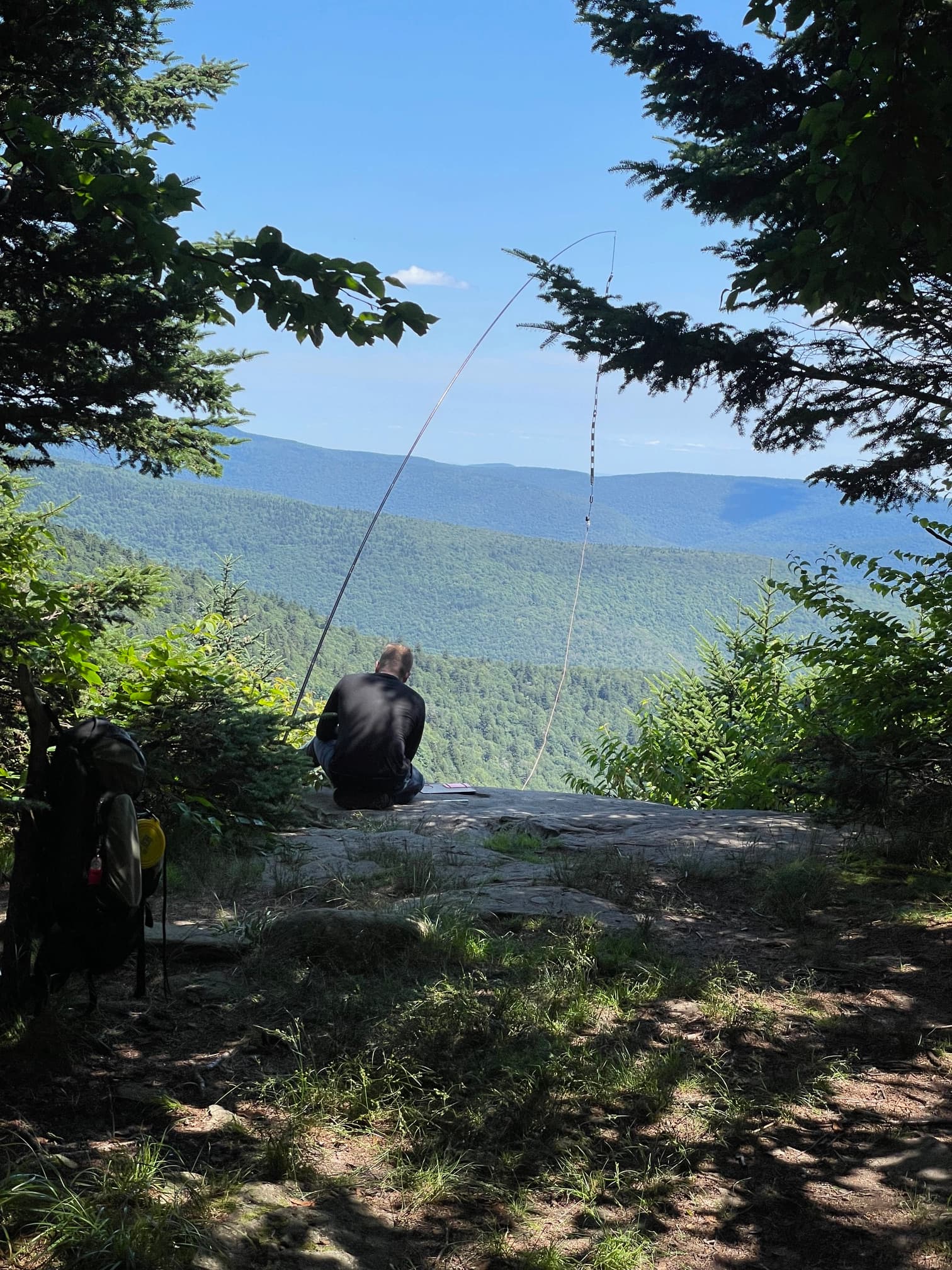

 . I’ll make sure to stand up rather than sitting on my mat when operating the Baofang though. Regarding “centers of population”, the only one within a few km is Killarney. Let’s see if there are any chasers there! Regarding 70cm, based on this thread I may not even attempt that for now… I’ll be happy if anyone hears me on 2m.