A way forward for SOTA scoring and mapless associations.

The points in SOTA are absolutely meaningless. Period.

But what saddens me most about the program is finding some summits that are difficult and dangerous, located right next to other, friendlier peaks that are perfect for outdoor activities like radio, but cannot be activated in SOTA.

The creation of regions with managers and ham communities who are unable to adjust maps “because they must be generated by an algorithm with zero room for subjectivity” is, in my view, the biggest problem in SOTA. And it’s one that could easily be solved by listening to the managers and the community, instead of locking everything inside an algorithm.

1 Like

I take your point with this, and perhaps it would be a reasonable adjustment to do something like, say, a point subtraction for a drive-on summit at an altitude over 1 point. But I also question what big difference it’s going to make in the overall picture of SOTA.

I take your point too about summits like Denali (which when I recently checked is still unactivated) which attract the same points as any other 10 point summit - with a cap of 10 points I get it can seem a bit odd. But frankly I don’t think anyone who potentially might summit Denali for a SOTA activation would be doing it primarily for the points but more for the glory of saying they did a SOTA activation on Denali.

I think point scoring is itself quite an anomaly in mountaineering/alpinism and I’m not aware of any mountaineering sports other than SOTA (not including skiing and so on which are less focused on summiting or traversal) which have a point scoring system and the sport is much more oriented around the glory or bragging rights of which mountains you’ve summitted or traversed, and with the 10 point cap in SOTA I think there’s still plenty of room for that as well, keeping it beyond simple point scoring. SOTA is also somewhat distinct in that it has an instant internet accessible record of an activator’s summits. I like the points, sure, but I like the list of mountains I’ve summitted more.

As for issues like difficulty etc. this is somewhat subjective. An individual mountain can often be ascended by multiple routes with different grades. Simple altitude can be deceptive about difficulty of ascent (this is why prominence for qualification as a summit in SOTA is IMO a good idea). Typical starting elevations vary between associations and regions which is why I think having local association management of scoring based on local knowledge is essential.

If you go by simple altitude it could be argued when comparing to other associations that the UK should have no 10 pointers at all. But they can be quite prominent, and quite dangerous. It’s routine every year for people to be severely injured or even die on British mountains. Where would considerations like this factor into a supposedly more objective difficulty rating?

1 Like

I think we’re being accused of being too subjective in this thread. Now I think we’re arguing the opposite :smiley:

As I mentioned in the other thread on prominence the other day, whatever decision we make, we lose. Without prominence, you have the situation that every little bump with a name can get points, so it led to a situation where you could walk along a ridge in OK and get 80 or 90 points in a day with little exertion. One summit had an almost single-digit prominence IIRC - ie, within the other summit’s AZ. So we cleared up that early association that had been created before we had better tools, and now it’s objectively fairer based on prominence.

Not perfectly fair, though, because that means some great summits get excluded. But that’s OK - HEMA, CQGMA also exist for a lot of these summits, if you need to chase their definition of points, or there’s POTA or WWFF, or you can climb the mountain and operate with the view. Get out and enjoy the sunshine, operate portable whether that’s SOTA, POTA, IOTA, HEMA, GMA, WWFF or whatever.

My point remains - no one in SOTA is deaf to changes, nor claiming that SOTA is perfect, no matter what you might perceive, but saying something is broken is the easy part. When you actually start to have to do the work to introduce a new system, you suddenly realise there’s a lot of effort that’s involved in making something work across 216 associations, 1501 regions and 179,255 summits, and could potentially impact 11.7 million activator QSOs.

2 Likes

With my very limited experience of 13 summits activated I may be risking making a laughing stock of myself here especially as this thread was meant for laughs, but… With every climb I had the same thought: why I, the activator, cannot contribute to adjusting the score after successful activation? As in voting for increasing or decreasing the number of points. A single vote wouldn’t count, but ten would. After ten votes for a given summit, and after the removal of outliers, the average adjustment could be considered for applying to the summit. I climbed Knockboy (10 pts) last Sunday, it was significantly easier than Mullaghanattin (10 pts) a few weeks ago. I’d vote -2. Nine more activators vote between -3 and 0 adjustment. One votes -7 and that vote is discarded. The votes could even be passed as a part of activation call. (“I have you 5 by 7, I’m activating EI/IS-020, adjustment -2”).

There would have to be clear rules of difficulty adjustments, such as only adjust by x points maximum (but a summit once adjusted by 10 voters could be adjusted again, so the very difficult ones would keep gaining their point value), don’t adjust based on your subjective fitness level, don’t adjust based on the deliberate choice of tougher trail, don’t adjust because it happened to rain on that day, etc.

Weighted averages could be considered: a more experienced activator’s vote could be weighted higher.

Such adjustments would have to be reviewed manually before being applied.

Such system would, by design, be agnostic to association-specific elevation thresholds, to seasonal bonuses, to prominence-driven separation of summits, etc.

This would of course create the problem of summits with not enough voters. E.g. very difficult summits which have never been activated would stay at their default values. A different system could be applied to these. The fact that a 10-point summit has no takers in an otherwise range of frequently activated peaks is a good signal that it should probably be a much higher-scored summit. Such adjustments would also have to be reviewed manually.

I’m sure this idea has been discussed before, but I did use the search feature above to check for “point adjustments” and similar, and cannot find any reference.

I fully agree. Personally, I’d rather activate Denali for a single point than collect 100 ten-pointers on some random 800-meter hills. My question then is: why be so conservative with the system if it’s calculating something that nobody really cares about? Or… maybe someone does?

I’m thinking of proposing a fully automated script where you input the GPS coordinates of the 10 highest summits in a given region (a SOTA region I mean). The script would then calculate a global coefficient based on the average altitude of those summits, the average altitude of the surrounding access roads, and the latitude. While it still wouldn’t distinguish between a technical climbing summit and a family-friendly one, it would at least provide a more accurate reflection of the overall difficulty of a region.

1 Like

You can still do that in some regions, you only need to drive instead of walking along a ridge.

In a perfect world, I imagine a program where any peak with a name can be activated. You should then establish a radius (in km) of non-activable summits after any activation to limit grinders.

Then, why rely on an algorithm to map the world? Just let operators create a reference when they first activate a summit.

Points in SOTA are already meaningless. You could establish a 0.1 point for every 100m of summit elevation and that would be a totally valid ranking system.

As for chasers, they could get 1 point for every summit no matter the elevation.

So do the work and demonstrate what you mean. I can see several areas of complexity based on experience that would need to be managed, but I’ll leave that as an exercise.

3 Likes

Don’t take this the wrong way, Andrew. I have no intention of pushing for any changes. If anything, I’d rather start a new initiative myself than trying to look for any changes on the current system.

I suggest that we invoke the ancient and mighty power of the conclave of the mountain goats, by whose wisdom, dedication, blisters, and curses, and an annual Internet survey peaks may be awarded 1-3 bonus difficulty points.

2 Likes

Undoubtedly this is a great way to learn the complexities involved :smiley:

I think Joe was lamenting the other day about the SOTA Activator android app - the history of apps, programs, etc disappearing when the original author disappears is a common refrain in ham radio. No judgement there - I’ve abandoned my fair share of projects along the way. But the reason why, in my opinion, is that the author starts something thinking it’s easy and straightforward, and then it snowballs quickly and then the interest wanes. I’d say about half the clients on SSO are for apps wanting to post spots that have fallen by the wayside. There’s one client that hits the API regularly with a steadily incrementing number because it’s broken but the author’s mailbox is full and it’s easier to block it at the firewall than try and work out what happened. They may have lost interest, they may have stopped ham radio, they may be dead. But their client keeps incrementing like a ticking doomsday clock, eventually hitting integer rollover in 20 years time or something.

The fact SOTA has survived 23 years is a small miracle in itself (largely because there’s been some good succession planning on various infrastructure pieces over the years).

5 Likes

In this thread we have seen advocated a number of “improvements” of SOTA, based on perceived imperfections and “unfairnesses”. This sport or pastime of developing fantasy SOTAs has a history as long as SOTA itself. I see it as a harmless eccentricity, on a par with trying to abolish the “offside rule” in football (soccer)!

I see it like this: SOTA is. SOTA IS. It needs no justification. It needs no improvement. It works as it is. And year upon year it grows and spreads around the world.

Before the game of SOTA there was the game of DXCC, chasing entities and counting your score of “countries”, IOTA, counting your score of island groups, WPX counting your score of prefixes, and so on. SOTA is just another game, another type of organised radio play with the distinction that it took radio out of the claustrophobic confines of the “shack” to the wide vistas of summits. As a game SOTA has no need of rationality, no need for justification, it just needs a defined set of rules that remains reliably constant, so that progress in the game can be measured by comparison with the achievements of past players. This need is met, SOTA has a couple of decades of continuity so that as SOTA expands into new associations it remains recognisably the SOTA that was played in its first year. It is this identity that is worth preserving, so that if our descendants in 2125 play the SOTA game they will be conscious of their continuity with the first participants in 2002.

Long live SOTA!

18 Likes

Indeed they are…. for one simple reason: SOTA is not a competition and we are all at liberty to decide how difficult or easy we make it for ourselves.

I personally have added the complexity of only activating unique summits. Since starting SOTA in 2006 and gaining MG in 2010, it has been increasingly difficult for me to accrue points towards my 2 x MG. This is my choice. I can make no comparison to the achievements of others.

Even with the uniques personal challenge, I could have concentrated on the easiest high point summits within the UK and EU and been well past the stage that I am at present. I could have moved to live in an area where there are more high point summits requiring much less travel. I could have made SOTA the most important thing on my life, above family and friends. … these are all the sort of variables we all have to make a decision on.

So, I agree that points are meaningless. Having a sad that, the system we have is entirely reasonable. Perhaps the only system that might be fairer is one point for every summit regardless of height…. at least that way we wouldn’t be discussing things like drive on 10 point summits in Germany and tortuous single point summits in Scotland.

7 Likes

One of the things about SOTA that makes it more open is that there are ten-point summits you can drive onto, and there are one point summits you need to be an expert climber to reach. Someone with limited mobility can still accrue a reasonable score even if the only summits they can activate are the ones accessible by motorised transport, and the expert climbers will get noticed by those in the know when they activate something technically very difficult to reach.

The points are what they are, but SOTA is about more than the points.

12 Likes

Ding! Ding! Ding! We have a winner :wink:

4 Likes

And indeed we already operate that system. (The Uniques). The only thing is that it operates on an all-time, as opposed to annual basis.

Given that the OP in this thread was a reprint of Richard @G3CWI ‘s hilarious but well-observed satirical take-down of the business of proposing “better” scoring systems - it appears to have stimulated a whole new round of such proposals!

We have six scoring bands (1-2-4-6-8-10) distributed over the altitudes of summits in an association. And that’s the way it will stay.

We will NEVER award points for (perceived) additional difficulty. That would be reckless. Should you get ten points for an almost drive-on summit in EA8 Tenerife, and the same ten points for Denali? YES! Absolutely yes! This way, only accomplished, experienced and highly capable mountaineers might attempt Denali, but most middle-aged activators of average fitness would favour the easier ten points elsewhere.

It could be argued that the seasonal bonus is an “incentive” to mount expeditions in more dangerous conditions. However, the experience of SOTA over the 23 years is that activators head for the lowest and easiest summits on which to claim the bonuses in the seasonal bonus period. It works superbly as a “pro-safety” measure.

I suggest those proposing changes to the scoring system go back and read the document shared in the first post of this thread, and try to understand the message within it.

5 Likes

It’s a flat 3 points for any summit over 1 point. Proportionally, it’s more worthwhile for a 2-4 point summit than a 10 pointer. Looking at my longer term plans I certainly feel more incentivised to save those kinds of summits for winter when the bonus applies - and maybe look for opportunities to cover 2-3 nearby 2 pointers in a day - and cover the 6-10 pointers in summer when it’s safe to do so without crampons and a lot of other winter mountaineering gear.

4 Likes

Or you can activate them twice in a year for points.

Once in summer for 2 points and then again in winter for 3 points. Ideal for local ones.

1 Like

While that is true in G it isn’t necessarily the case in other areas. For example, in EI I think you get the winter bonus for 6 point and up summits. This is because the bonus is given based on height. (A 2 pointer in G would be 6 points if it was in EI).

3 Likes

Rude!

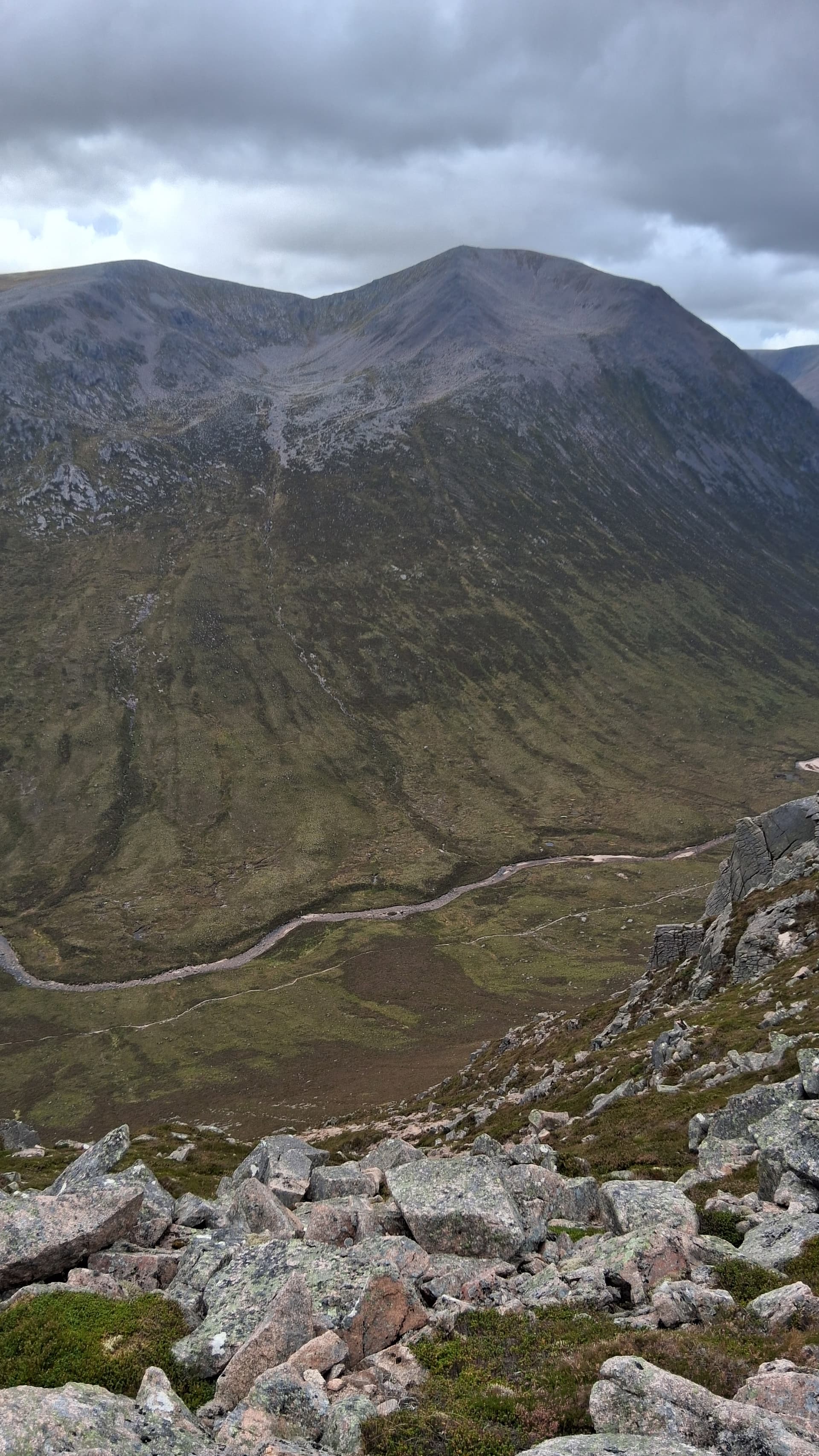
Cairn Toul GM/ES-003, taken yesterday, as I was completing a round of Ben Macdui GM/ES-001 and Carn a’Mhaim GM/ES-013. 32km, 1500m ascent via the remote Sron Riach ridge.

No cable car, no refuge or hut guardian, no cafe or picnic bench at the top. 18 points well earned.

Calling them “hills” is classic British understatement.

14 Likes

Experience them in a blizzard and the understatement becomes irony!

6 Likes